


It’s 7am in Al-Nuseirat Camp. The weather is cold and dry beneath a cloudy sky. I woke up exhausted after gathering firewood the day before. I got dressed and prepared to head to Al-Azhar University. It was already 7.30am, and my first lecture started at 10am. However, I was already worried about the struggle of finding transport.
I walked to the nearest parking area, in front of Al-Farouq Mosque. To my surprise, dozens of students were also waiting for any available transportation. By 8.30am, I could not wait any longer. I grabbed my backpack and walked another half-kilometre to the second parking area on Salah al-Din Road, beside the entrance to Al-Bureij Camp.
Just as I arrived, a driver was shouting, “Gaza! Al-Saraya!”
Without hesitation, I climbed onto the bonnet of the car. It was risky, but it was the only available spot, and I could not afford to wait any longer. The car’s old engine began rumbling. I held tightly onto the slippery hood and looked back, focusing on people’s faces as my vision slowly zoomed out while the car moved forward. I always do that, though I have never had a clear reason why.
“I hope we arrive safely. Last time, gangs detained my cousins,” one of the passengers said.
As we drove farther, our stress only grew. Among the passengers were a father and his son. The boy looked about six years old. He never stopped asking questions, as is natural for any child his age. Yet somehow, every question seemed to carry a much deeper meaning.
Dangerous Journey
The child, Omar, as I recall, pointed at the yellow concrete blocks and asked his father, “Baba, what are these blocks?” “Oh, Omar,” his father replied, “they are barriers that mark the areas we can and cannot access.” “But what happens if we go beyond them?” Omar asked. “It wouldn’t be good, son. Those areas are under the control of the Israeli army.”
Omar’s expression changed instantly. Then he almost shouted, “Do you mean we will die?” Suddenly, all the passengers responded in a tone of denial. “No, no. God forbid. Don’t worry, little boy. We won’t.” It was as though Omar had voiced the question that all of us were secretly trying to avoid. The question we had been hiding from had finally found its way into the open. The car carried around twenty-five passengers, along with the weight of all their dreams. Every one of them could have vanished in a matter of seconds. That idea alone was frightening.
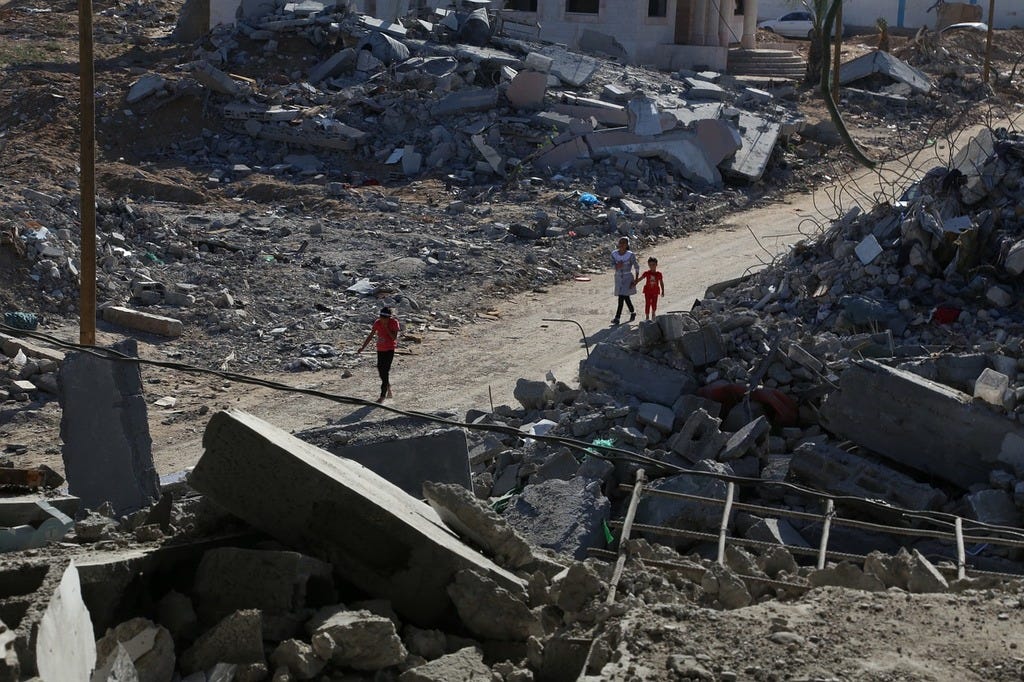
When we finally arrived, I walked to Al-Rimal, a district that used to be one of Gaza’s most vibrant areas. I stepped out of the car as though shackles had been removed from my legs. Still dizzy from the ride, I walked slowly through the streets. I looked around. Tents were everywhere. Smoke and ashes drifted through the air from makeshift street-food vendors. Buildings stood shattered and hollow. Miserable expressions covered people’s faces. Still, the cloudy sky had not yet brought any rain, making the already gloomy atmosphere feel unbearable.
I finally reached my university half an hour late and rushed to my first lecture, only to be disappointed when I found the door closed. What upset me most was not missing the lecture, but having to spend another half-hour alone with my thoughts. I gathered myself, took a seat and waited. This is what the beginning of a regular day in my life looks like, nine months into the ceasefire.
As I contemplated the university’s destroyed buildings, I thought about my life since the beginning of the ceasefire. I think I had raised the ceiling of my expectations too high. I thought I would return to a repaired university, one that was better than it had been before, or that I might be able to study abroad. But the harsh fact that I would still have to gather wood and fill water containers the second I returned home pulled me back to reality. It was time for the second lecture. The walls of the hall had been repaired with tarpaulins. There were not even enough seats for all the students. The microphone crackled and repeatedly cut out, yet I did my best to understand.
Broken Expectations
It’s 5pm, and I am sitting in a cart hitched to the back of a car on Al-Bahar Street, heading home. I look at the sea and take deep breaths. It feels as though I have finally rested after a thousand years. The cart bumps violently over every pothole, each impact feeling as though it might break your ribs. Finally, I arrive home. Completely exhausted, I go straight to filling the water containers. I fill two containers and carry nearly 40 kilograms of water for 200 metres. Then I climb to the third floor and pour the water into the small tank inside our house.
Now it is time to chop wood. I grab a large piece of wood and try to break it into smaller pieces. I keep hammering until my hands are torn. Eventually, I stop out of exhaustion, unable even to lift the hammer. My neighbour passes by. “May God give you strength,” he says. “God willing, gas will come back to the country.” He speaks with solidarity, with the shared weight of suffering behind every word. He makes me feel less frustrated. I gather whatever wood I have managed to chop, light a fire and cook breakfast, lunch and dinner as a single meal.
After resting for a while, my friend calls. “Mohammed, come down. I’m outside your house. Let’s go to the beach.” I do not hesitate. I grab my jacket, and we are soon on our way. We do not stop telling jokes and laughing throughout the journey. But the moment we arrive and see the sea, a sombre silence fills the space, as though the sea is the keeper of our sorrows. To us, it is the last sanctuary we have left, the final place where we can restore our hope and recover the will to continue beyond the unbearable.
As I contemplate the sunset and think about my day, I realise that nothing in it is worth singling out as a particular sorrow. It is the repetition of all those small, frustrating events. It is the continuous pressure. It is a life built on alternatives rather than solutions. All we ask for in Gaza, nine months into the ceasefire and after lowering our standards, is a dignified life with the minimum basic necessities: to open the tap and find running water, and to light the gas and find a cooking flame.
Yet we continue moving from one makeshift alternative to the next, doing whatever we can to adapt and survive. But for how long? Each one takes another piece of our identity with it.

We love you and we're fighting everyday for you my friend
Was engaged while listening, thanks and keep being strong