


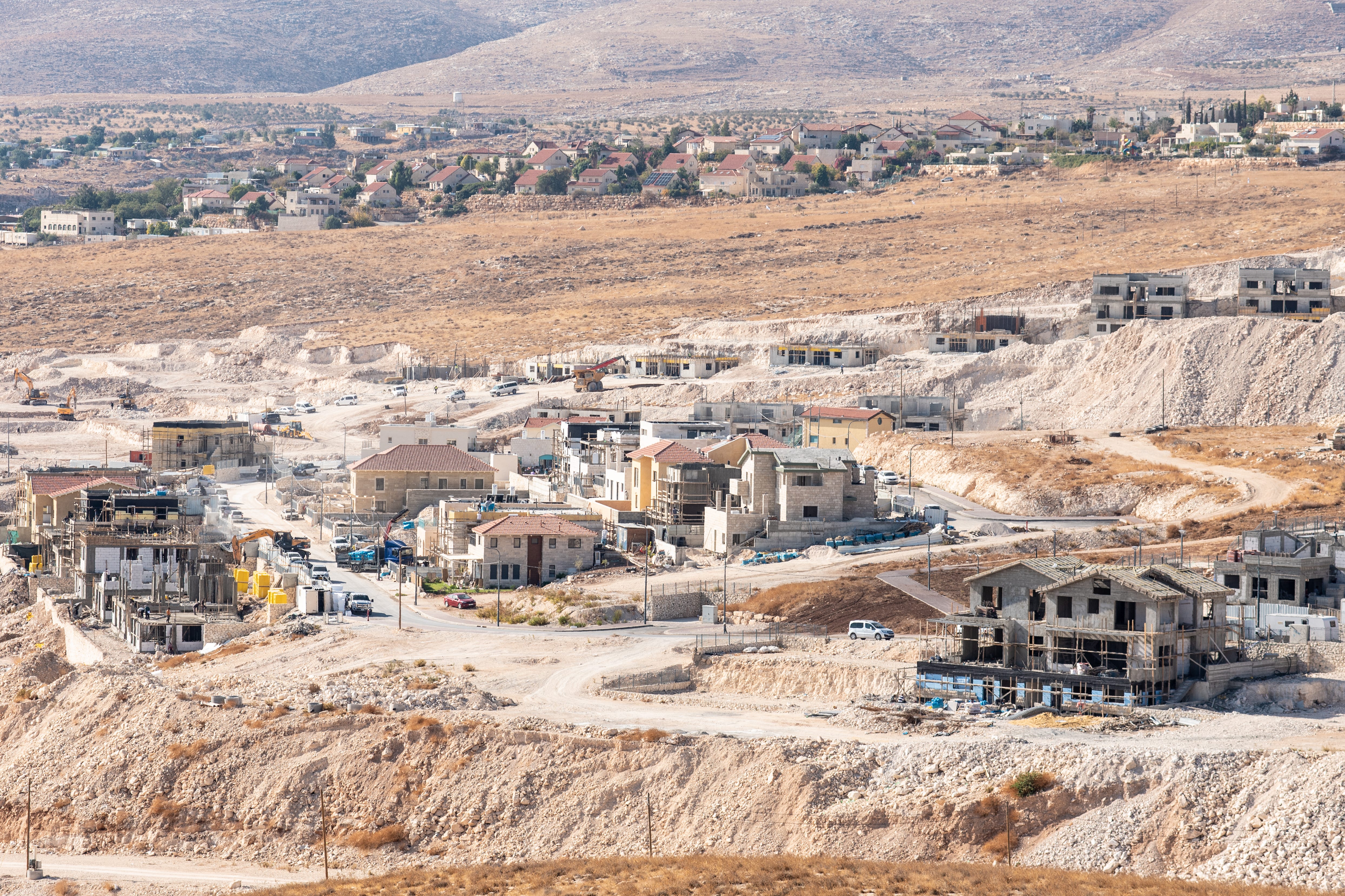
On the morning of 13 February 2026, more than 30 masked settlers, brandishing machetes and throwing stones, stormed the village of Talfit in the occupied West Bank.
They fired live ammunition at residents, their homes, vehicles, and even the town mosque. Several villagers were beaten and stabbed, and a 19-year-old man was shot in the shoulder.
“It’s the first time such a large attack has happened in the village,” said Yousef Abu Aisheh. During the assault, he sheltered in the centre of his home with his wife and seven young children, who screamed in fear as settlers pelted their windows with rocks.
The Israeli army was called to halt the rampage, but when soldiers arrived, they deployed tear gas at the community instead.
Such attacks have become increasingly common in the West Bank, particularly in Israeli military-controlled Area C, where settlers have established more than 120 outposts and displaced 78 Palestinian communities. Talfit, however, lies in Area B, under Palestinian Authority jurisdiction and once considered off-limits to Israelis. The assault reflects a broader pattern of settlers expanding their foothold across the West Bank, encouraged by a government moving steadily toward full annexation of the territory.
A new foothold
The settlers who attacked Talfit came from an outpost established on 21 January 2026 on Ras Ein Einiya, a hilltop overlooking Talfit and the Palestinian town of Qusra. Initially consisting of only a few settlers, the camp has tripled in size in less than a month.
The Israeli army dismantled the outpost at first, but settlers soon returned and rebuilt it just 100 meters away. While outposts are illegal under Israeli law, many receive state funding and military protection. Both settlements and outposts are considered illegal under international law.
Under the Oslo Accords, the interim peace agreement signed in the 1990s between the Palestine Liberation Organisation and Israel, the West Bank was divided into Areas A, B, and C. Area A, the most densely populated section, falls under Palestinian civil and security control. Area B is under Palestinian civil authority with shared Israeli-Palestinian security control. Area C, comprising 61% of the territory, remains under full Israeli military control. These divisions were intended to last five years, after which authority would transfer fully to the Palestinian Authority. That transition never occurred.
According to Dror Etkes, founder of Kerem Navot, an Israeli civil society organisation monitoring land policy and settlement expansion, settlers have established one outpost in Area A and 20 in Area B over the past two years.
“This stems from a decades-long campaign aimed at undermining the Oslo Accords. That’s what [Israeli Prime Minister Benjamin] Netanyahu sought from the start of his first term,” Etkes said. “What we’re seeing on the ground is a continuation of Netanyahu and settler policies from 30 years ago — Palestinians under Israeli control, without political representation.”
Expansion into Area B
Etkes emphasised that outposts represent only part of the broader expansion into Area B.
“Even when outposts are built in Area C along the border of Area B, violence and restrictions on access often spill into Areas A and B,” he said.
Suha Khteep has experienced this firsthand. Settlers who established an outpost in Area C, about one kilometre from the home her family is building between the villages of Jurish and Aqraba in Area B, have repeatedly blocked the family from reaching their property.
Tensions escalated to the point that on 13 February 2026, the Israeli army declared her home a closed military zone, barring the family from entering to complete construction. Meanwhile, settlers continue to raise the Israeli flag on the Khteep property.
“The settlers told us, ‘This is our land. This is our place. None of these houses belong to you. God gave us this land 3,000 years ago,’” Khteep said.
More than half of the new Area B outposts are located in the so-called “Agreed-Upon Reserve,” where the Palestinian Authority is responsible for planning and construction. In recent years, Israel has increasingly altered Oslo-era arrangements, expanding its authority in the West Bank to assert greater civilian control — steps critics say amount to formal annexation.
Legal shifts
In 2024, the Israeli military granted civilian officials the power to demolish Palestinian construction in the Agreed-Upon Reserve. Last month, the Israeli Cabinet approved measures easing real estate transactions for settlers in the West Bank, including allowing individuals to purchase property directly rather than through registered companies. Another measure makes West Bank land registries — previously classified — publicly accessible, enabling anyone to view land ownership records.
The decision also broadens the military’s authority to carry out demolitions not only in Area C but in Areas A and B if construction is deemed harmful to heritage sites, archaeology, or environmental resources.
These moves have prompted Talfit residents — at least 500 of whom own land at Ras Ein Einiya — to gather their deeds to demonstrate that the outpost stands on their property.
“The presence of this outpost in Area B is a clear, physical sign of the government’s latest efforts,” said Qutabeh Msallam, a Ras Ein Einiya landowner and Talfit resident.
Since the outpost was established, landowners have been unable to access their groves or the spring at Ras Ein Einiya. Water continues to flow to the village, but residents fear settlers may eventually cut off the supply.
“I have fond memories of hiking and climbing the summit as a child,” said Aysar Shaheen, another landowner from Talfit, gesturing toward the hilltop.
Already barred from tending his olive orchards near another settlement, he now worries he could permanently lose ownership of his land at Ras Ein Einiya as well.
“We’re completely surrounded by settlements,” Shaheen said, pointing to colonies on hilltops north, south, east, and west of Talfit that are tightening around the cluster of Area B villages south of Nablus. “Many farmers depend on this land. When you cut off their livelihoods, you’re starving them.”
***
Jessica Buxbaum is a Jerusalem-based journalist covering West Asia, primarily reporting on Palestine, Israel, the Syrian Golan Heights, and Egypt’s Sinai Peninsula.

Why is the UN and the world not stopping this from happening? The rule of law seems to have ceased to exist in this part of the world and Israel has been allowed to do what they like. It is totally abhorrent. How can the palestinians have their own state if this is continually happening?
This must stop. It is so wrong. Israel is not only destroying Palestine they are destroying their relationship with God. My God would not condone this genocide and taking of land and homes.