


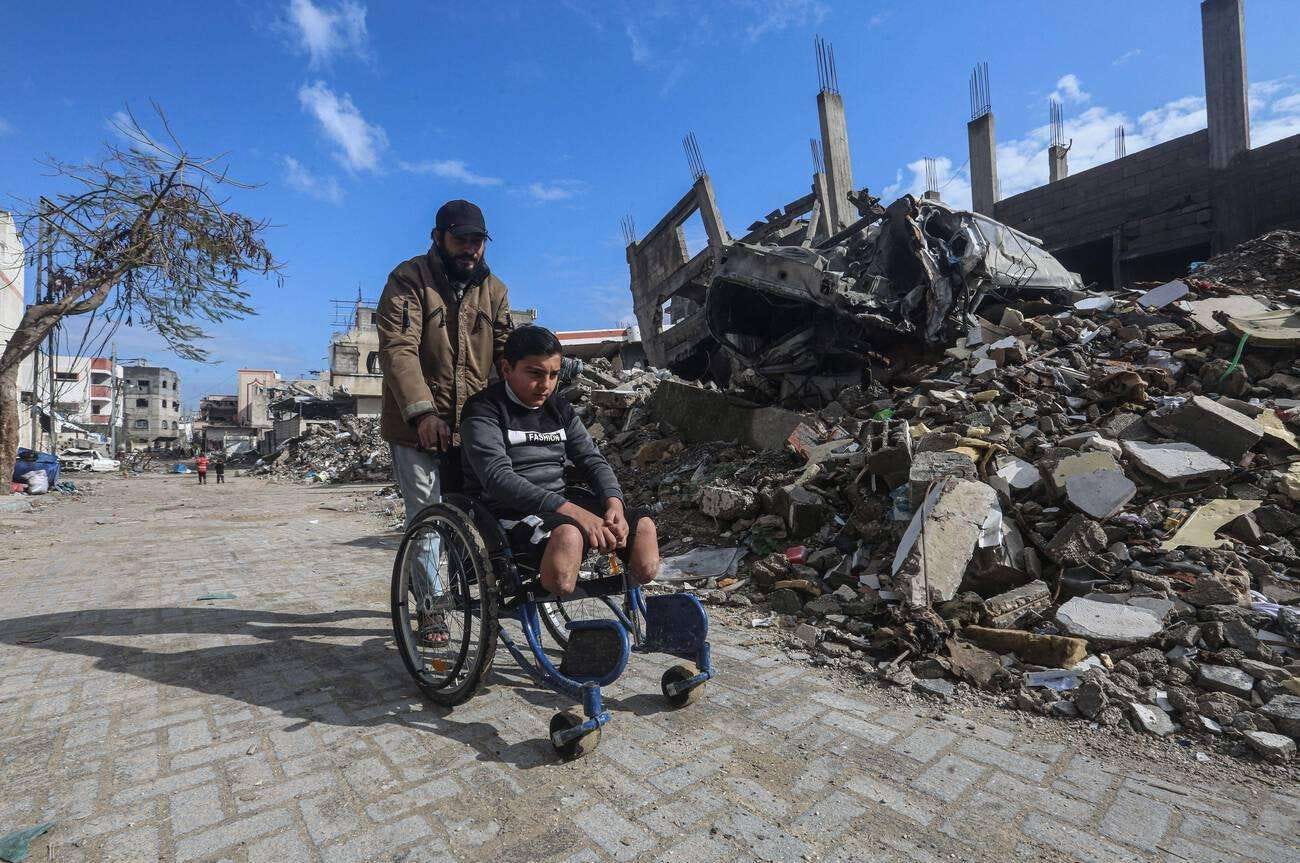
In the heart of Gaza, amidst constant bombardment, forced displacements, grief and loss, people living with disabilities have faced challenges that have mostly gone unseen and unheard.
What such conditions make them feel is best described by the Arabic term Ajz — a combination of powerlessness and the inability to act to change one’s circumstances. Yet the stories of just two of them reveal why in Arabic, those with disabilities are called people of determination.
Abdelrahman’s Story
Abdelrahman Al Gherbawi, 27, is a graphic designer who has lived with cerebral palsy since birth. Despite extraordinary challenges during the genocide in Gaza, he has continued to pursue his education.
Before war broke out, he was productive and ambitious, focused on improving his English and applying for scholarships. In his free time, he enjoyed going to the beach with friends or working on his laptop.
The first days of the assault were extremely traumatic. His family were injured, and he lost his wheelchair and walking device. Displacement forced them from place to place, his cousins carrying him under shelling and through rubble. After the second attack, he lost his laptop and phone. Basic activities like bathing, washing clothes, or taking care of himself became extremely hard, leaving him with a strong sense of Ajz.

One of the hardest moments occurred during the second bombing when the family were trapped in his grandfather’s house. “I was sleeping, and when I woke up, half of me was inside the apartment and half outside. I would have fallen from the building if the ambulance hadn’t arrived and pulled me out.”
Amid these hardships, there were moments of hope, such as when he received acceptance letters from the Universities of Limerick in Ireland and Sussex in the UK. He is currently studying Multimedia and Web Development at the Islamic University of Gaza.
He now appeals urgently for help to leave Gaza to continue his education, start the 2025/2026 semester, and acquire a new laptop and phone to resume work and support his family.
To support Abdelrahman with his living and accommodation expenses in Ireland, please consider supporting him at:
https://chuffed.org/project/151469-help-get-abdelrahman-from-gaza-to-ireland-to-study
Ensaf’s story
Since birth, Ensaf, 24, has lived with a combined vision and hearing disability caused by cancer, undiagnosed until she was five. Multiple tumours affect her brain and skull base. Despite these challenges, before the genocide, she was active, ambitious, and full of hope.
“My life was almost normal. I never felt I was missing anything”, she tells me. “In fact, because I am a person of determination, I have always seen myself as special. I was studying IT at Al-Aqsa University, and received a lot of support from my professors and classmates. I attended workshops at the Islamic University with mentors working with people with disabilities, like Dr. Nazmi, Dr. Nesma, and Ms. Sharihan—may God protect them. I was around people who resembled me. I looked up to them and felt proud to be one of them — we have skills and abilities others might not have.
“I surrounded myself with people who had a positive influence on my life. I saw myself as a creative, exceptional person who would someday achieve something meaningful and make them proud.”
However, the genocide severely disrupted her medical care.
“As a cancer patient, I need constant follow-ups and MRI scans. I had surgery in Turkey on November 13, 2021, and I was supposed to return for follow-ups, but the genocide prevented me.”
Displacement caused further chaos. Her hearing aid got left behind, and her medical boot was damaged by shrapnel.
“Now I have to wear a regular boot, and I often fall, because I can’t balance properly on sand, broken asphalt, or rubble-filled roads.
“I will never forget leaving our house… Being trapped under rubble, asking someone to carry me because I couldn’t see through the smoke… My brother, who we couldn’t find, who was hanging between life and death… The massacres I witnessed in the hospital, the news of my uncle’s capture, and later the deaths of my uncle and grandfather. Our house was bombed, the one my father worked so hard to maintain to protect us — I swear he fulfilled his trust, and I am very proud of him.”
Her vision problems got worse.
“Two months after my tumour surgery, I had two eye operations. My eye can only close with tape now, and I have to use moisturising drops. My glasses were replaced four times since the genocide, and now I use them without frames because I can only afford the lenses.”
Crowded living conditions and lack of food created new difficulties.
“Living in a tent with ten people, there’s no privacy, no way to rest my mind, no space to think about what I need to do next. I couldn’t balance at all and would fall on them while they were sleeping. Seeing the pity in their eyes made me feel my presence was a burden. Moving from place to place, I felt a profound Ajz.
“During the famine, I couldn’t even support my body. I started falling in the streets. I prayed sitting down because I couldn’t move due to joint pain, hunger, dizziness, and weakness.”
Miraculously, despite all the challenges she faced, Ensaf completed her university education.
“I had only one year left of my studies at the university I had attended for five years. I worked extremely hard. I’m grateful to God I graduated with a grade that satisfies me after all the years I endured in my condition”.
Her message to the world is clear:
“Wake up! You have let us down. Each of us has a story, a dream, a goal.
“As people with disabilities, each of us needs specific tools to meet even our simplest needs. We no longer have homes. We can’t access treatment; what treatment exists is outrageously expensive. I just want to know my family is safe. I want to live peacefully, continue my treatment, sleep without fear, buy a proper boot to walk safely, and be able to handle my needs without feeling like a burden on my younger siblings...”
Taqwa Ahmed Al-Wawi is a 19-year-old Palestinian writer, poet, and editor from Gaza, studying English literature at the Islamic University of Gaza. You can find more of her work here.


Genocide is one of the greatest crimes, whether in Palestine or Sudan. And on top of that, the disabilities caused by it break my heart. What’s even more heartbreaking is that Western countries, such as Germany, refuse to accept children who urgently need help and medical support. That is as inhumane as the genocide itself.
Mas aonde param os governantes árabes e muçulmanos que assinaram o acordo de cessar fogo? Será que continuam a ser covardes e vassalos? É urgente forçar os mesmos a cumprir com o acordo.