


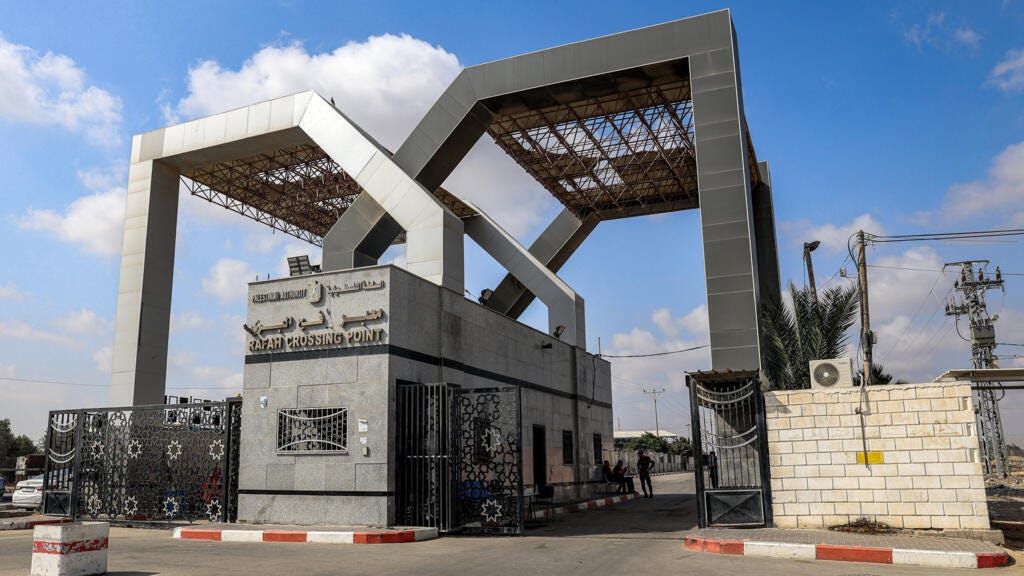
On the same day, I received two pieces of news that could not have felt further apart. First, I heard that the Rafah border would open the following day. Hours later, I learned that twelve people had been killed in a new ceasefire violation. Together, these headlines formed a familiar truth: for Palestinians in Gaza, any moment that resembles relief arrives only after a price has already been paid.
On February 2, I woke up in a peaceful place in Italy. Still, before starting my day, I checked the news from Gaza as I always do. That morning, I stared at the two headlines, unable to process them. I didn’t know how to feel. Confused, I called my family and asked how both things could be true at once: how news could be both hopeful and devastating. One of my eight family members answered quietly, “Sara, it is normal.” And sadly, it is. It has become normal for Israel to twist even moments that might appear to favour us. As if two years of genocide were not enough, even our smallest taste of “freedom” must be shattered.
I no longer live in Gaza – I was evacuated to Italy – but I follow every update as if I were still there, because my family is. Distance means nothing when your heart remains attached to the place that shaped you for 21 years. Every headline carries weight. Even though I am safe, even though I am technically free, the news reminds me that you can leave a place physically while your soul stays behind.
“Rafah border reopens.” Social media has been filled with this headline. People outside Gaza may read it and feel relieved, but only Palestinians truly understand the untold stories, the unbearable conditions, and the hidden restrictions behind those words.
Happiness, for Palestinians, is always incomplete. It always arrives missing something.
Returning
The first day of Gaza’s prison gates reopening—supposedly in both directions—has just ended. It is 2:20am in Italy, one hour later in Gaza, and I am still glued to the news, searching for any sign of a better future for my family and for Gaza. I watched a video of a woman returning to Gaza after being evacuated for medical treatment, along with fourteen others who had also been receiving care abroad. “Do not leave Gaza. Stay in Gaza,” she cried through tears. Israel had promised that fifty people would be allowed to return. Only fourteen were. In this place, promises are fragile. Israel’s promises rarely meet reality.
No one can judge them, and no one should blame them for choosing to return home. Home is home—especially for those who were injured and forced to leave Gaza for treatment while hospitals were being targeted. At least 115,000 Gazans were evacuated to Egypt in the early months of the genocide. They may have survived, but survival came at a cost—emotionally, physically, and financially. I know families among my relatives who were deeply affected. “The war left us with no choice,” one relative told me during a video call. “I can’t wait to go back. I love Gaza.”
Many people have clung to false hope as this news spread across social media. In reality, this reopening is only a drop in the ocean for more than two million people trapped inside Gaza. Anyone who looks beyond the headline, without filters, will see that this gesture is largely performative. Israel presents it as relief, while the truth on the ground remains painfully unchanged.
“We were informed today that only five injured people will be allowed to leave Gaza per day,” the director of Al-Shifa Hospital said, his voice filled with shock and grief. His words reflect what we all feel. Five people per day, while tens of thousands are wounded, and the number continues to grow.
Limited freedom
This reopening is extremely limited. Even reaching this announcement has cost us two years of our lives. Rafah border—Ma‘bar Rafah in Arabic—has been Gaza’s only outlet to the world since 2001, after Gaza’s airport was destroyed. It was fully closed 20 months ago, on May 5, 2024. I remember exactly how that felt. I personally lost a scholarship because of it. Families were torn apart. Food barely entered. The injured suffered in silence. And the world moved on.
And now, the world expects Palestinians to feel free.
But how can freedom exist when movement depends on lists and luck?
This is not freedom. It is calmer control.
Still, I hold on to the hope of reuniting with my family and loved ones. I may be free in Italy, but my soul is not. I see the same feeling reflected in my colleagues from Gaza, all of us living in exile. We share news the way children wait for a long-delayed reunion – counting days, clinging to fragments of possibility. “If this process continues at this pace, I will see my family in two years,” one colleague told me yesterday. And sadly, that is the truth.
With every trip I take here in Italy, I feel a quiet guilt. For hours afterwards, my mind wanders. What if life were this easy in Gaza? What if movement were unrestricted? What if every student could study freely? What if every patient received treatment? What if there were no occupation?
So no: this is not freedom. It is a tighter form of control, farther from the world’s eyes. We do not ask for the impossible. We ask for normality. And we hold on to the hope that one day—even delayed, even wounded—that normality will finally find us.
Sara Awad is a Palestinian writer who evacuated to Italy to complete her bachelor’s degree in languages and translation. Her work has appeared in The Intercept, Al Jazeera English, Palestine Deep Dive, TRT World, Drop Site News, The Independent, Truthout, PRISM, and other platforms. Passionate about capturing human experiences and shedding light on untold stories, and focusing on social issues, resilience, identity, and hope amid the ongoing realities of war and occupation.

Sara, our hearts bleed for all the Palestinians, those who are stuck in the genocide and those watching at a distrance as friends and family and strangers are targeted by the IDF and the racist jewish government and the racist USA/EU. How awful that a people who went through a holocaust would put others through a worse one. "Those to whom evil is done, do evil in return," as Auden said. Israel has no right to exist on Palestinian land. ANYONE WHO SUPPORTS ISRAEL IS A MONSTER.
Who is permitted to leave?
What is the process?
Can they return if they leave?
Is there a cost?
What reassurance IDF allows entrance or exit?
What protections are in place?
Where do people with no jobs or money go live?
So many unanswered questions?