


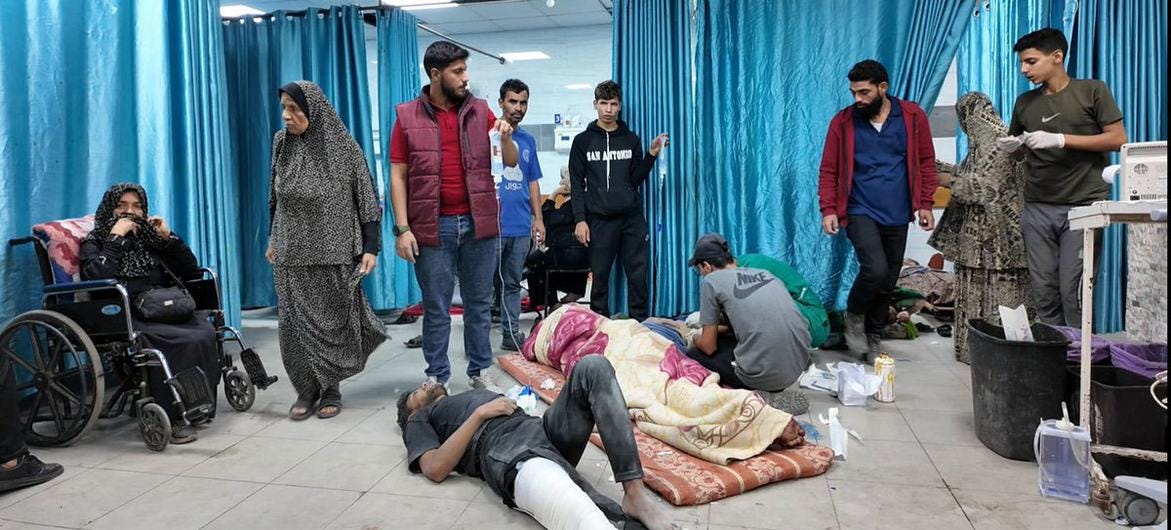
In Gaza, illness has become inseparable from waiting. Cancer patients and those suffering from life-threatening diseases are trapped between a collapsing healthcare system and an increasingly difficult path to treatment abroad. For many, obtaining permission to leave Gaza for urgent medical care can take weeks or months—or may never happen at all—turning treatment into a race against time and, sometimes, an unreachable dream.
For my uncle’s wife, Ruba, that dream never came true.
In early 2025, Ruba started experiencing persistent pain under her left arm. At first, she assumed it was fatigue caused by daily stress and the harsh conditions of life in Gaza.
The pain gradually intensified, spreading to her chest and shoulder. She visited several doctors and hospitals, yet diagnostic resources were extremely limited. Doctors initially suspected inflammation or a nerve condition and prescribed painkillers and antibiotics.
As the months passed, her condition continued to deteriorate.
Meanwhile, Gaza’s healthcare system was struggling with severe shortages of medical staff, equipment, and diagnostic resources. In December 2025, after further examinations and a biopsy, Ruba was diagnosed with advanced cancer. Doctors explained that her condition was severe and that she required treatment outside Gaza, where specialised cancer care was available. However, obtaining permission to travel remained difficult and complicated.
In Gaza, she received five chemotherapy sessions, but the tumour continued to grow. She lost a significant amount of weight, and the cancer spread rapidly, leaving her unable to eat or breathe properly. Doctors then stopped her chemotherapy and explained that the treatment she needed was unavailable in Gaza. Her only remaining option was medical evacuation and access to specialised care abroad.
Waiting for Evacuation
Ruba and her family spent six months waiting for permission to travel outside Gaza. She had obtained every medical referral, completed every required form, and taken every bureaucratic step needed for a transfer to a specialised cancer hospital. She continued to speak about treatment abroad as though it remained possible. In her imagination, the King Hussein Cancer Center in Amman, Jordan, became more than a hospital; it became a destination tied to survival itself. When the crossings briefly reopened, hope returned. Ruba believed her turn might finally come. But it never did.
On 9 May 2026, Ruba, aged 22, died after a painful battle with cancer, leaving behind her daughter, Tuhfa, and a family still struggling to comprehend her loss. For six months, Ruba had waited for the chance to leave Gaza and receive the treatment she believed might save her life.
Ruba’s daughter, Tuhfa, is only three years old. At this age, her understanding is still forming through fragments of words and gestures.
When her family tried to explain that her mother had gone to heaven, she smiled and said, “You are lying. My mum is in the hospital, and she will come back.” At other times, when Ruba’s name is mentioned in front of her, she becomes quiet for a moment and then goes back to playing, as if trying, in her own way, to understand absence.
Ruba’s story is not an isolated tragedy. It reflects a broader crisis facing thousands of Palestinians in Gaza whose conditions require treatment that cannot be provided there. Patients suffering from cancer, heart disease, kidney failure, and severe injuries find themselves trapped in a healthcare system devastated by war and repeated destruction.
For cancer patients in particular, the crisis is especially cruel. Gaza has long lacked adequate oncology services, forcing patients to seek chemotherapy, radiotherapy, specialised surgery, or advanced diagnostic care outside the territory. After months of war and the collapse of much of Gaza’s healthcare infrastructure, however, access to even basic treatment has become uncertain.
Hospitals have been damaged, medical supply chains have been disrupted, and many essential medicines have become scarce or unavailable. For patients whose conditions depend on continuity of care, an interruption can lead to the progression of disease, increased suffering, or death.
The Wider Crisis
According to Abdel Hakim Al-Batta, administrative director of the Gaza Cancer Center, around 11,000 cancer patients live in Gaza, including 4,000 who hold medical referrals and are in urgent need of medical evacuation but have been unable to travel for treatment. In an interview with Al Jazeera, he added that cancer-related deaths have risen sharply, from roughly one death per day in the past to nearly three deaths per day, largely because of the lack of medicines and radiotherapy services.
In Gaza today, illness carries another burden: waiting. Waiting for approval. Waiting for crossings to open. Waiting for referral coordination. Waiting for names to appear on travel lists. Waiting while pain worsens, medicines run out, and bodies weaken. For some, waiting becomes permanent.
The language often used to discuss Gaza’s healthcare crisis tends to rely on figures: the number of hospitals destroyed, the shortages of medicine, and the number of patients awaiting evacuation. But behind every number is someone like Ruba: someone who filled out forms, followed procedures, gathered medical reports, and believed survival might still be possible. Someone who made plans for treatment abroad. Someone who packed hope into conversations with family. Someone who imagined returning healthier to a child and a family waiting at home.
Tuhfa will grow up with stories about her mother’s determination, her suffering, and the months she spent hoping for permission to seek treatment that never came. Like many children in Gaza, her life has already been shaped by a harsh reality.
Ruba’s death raises painful questions that extend beyond one family’s grief. What happens when access to healthcare depends on freedom of movement that patients cannot control? What does survival mean in a place where medical treatment exists elsewhere but remains unreachable?
For Gaza’s patients, the struggle against illness is no longer purely medical. It is logistical, political, and deeply unequal. Recovery depends not only on diagnosis and medicine, but also on permits, border access, functioning crossings, and circumstances entirely outside a patient’s control.

I'm so sorry for your and your family's loss, Alaa. The barbarity is appalling and there are many of us fighting your corner here. Sending love and solidarity.
Such a sad story, but necessary to show how bad the conditions are. Thank you for sharing it Alaa, I'll share it around with people I know