


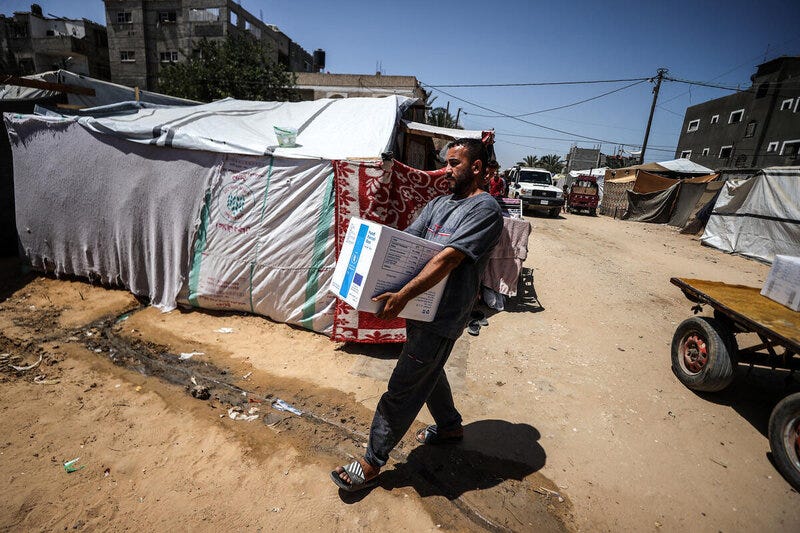
Every time aid trucks enter Gaza, people run after them with one simple hope: to find something that helps them survive. No one here is searching for luxury. People are looking for what makes life possible: flour, cooking gas, fuel for generators, or even a piece of plastic to protect them from the rain.
But the painful irony, repeated again and again, is that many of these trucks carry products like Nutella, chocolate, biscuits, and soft drinks, while fuel remains heavily restricted. Hospitals continue to report shortages, and families live in tents without electricity or proper ways to cook food.
No one in Gaza hates chocolate. But the question people keep asking is: what does Nutella mean in a place where hospitals cannot run neonatal incubators and families cannot cook properly?
I am an engaged woman from Gaza. At this stage of my life, I was supposed to be busy thinking about ordinary wedding details: a dress, a home, furniture, and maybe a small wedding hall. But the war changed the meaning of all these things. Instead of searching for decoration ideas, we now ask ourselves a different question: will we even find a place to live?
Because of the massive destruction and housing crisis, living in a tent has become a real possibility for us. The irony is that even tents themselves have become expensive and difficult to find. Everything here has turned into a crisis: tents, mattresses, bathrooms, kitchen supplies, and even small water pipes.
Tent Life
When we started thinking about life inside a tent, we realised it is not simply about finding a place to sleep. It is about trying to build an entire life from nothing. How will we cook? Where will we wash dishes? How will we use a bathroom? How will we access water? And how can a couple begin their married life in a place without privacy or stability?
One day after my engagement, we had to buy cooking gas just to make coffee quickly for guests who came to visit us. Using firewood would have taken too much time because there were many people. It may sound like a small detail, but for me, it showed how much life has changed. Even making coffee for guests now depends on whether fuel is available and affordable.
At the same time, aid trucks continue entering Gaza carrying products that do not solve any of these real problems. A family may receive chocolate, but they still cannot operate a stove. A child may eat biscuits while living in a tent without clean water or electricity.
The issue is not that food aid is being rejected. The issue is the painful feeling that the priorities have been completely turned upside down.
In Gaza today, fuel has become something people struggle for every single day just to stay alive. Hospitals depend on it to run their medical equipment and keep patients alive. Bakeries rely on it to bake bread for families. People also need it for basic things like cooking food and transportation.
Fuel First
When fuel is not available, it is not just about living in darkness. It means that many parts of normal life completely stop. Daily routines, basic services, and even the simplest needs become very difficult or impossible to continue.
This contradiction creates deep frustration among people here. It feels as though Palestinians are expected to survive just enough to stay alive, but not enough to live normally or with dignity.
Even marriage itself has become emotionally and financially exhausting. Wedding halls have become too expensive because of the economic crisis, and many families can barely afford basic necessities. Some families no longer think about celebration at all; they think only about finding a safe place to live.
This, in itself, feels like another form of war. The war has not ended for us; it continues in different shapes and details of everyday life. It is present in the shortages, in the constant uncertainty, and in the struggle to secure the most basic needs. We feel it in every small decision we make, in every absence, and in every restriction. It is a heavy burden that we carry every day, not only because of what has happened, but because of what is still happening now. Life itself feels weighed down by this ongoing reality, where survival has become a constant effort rather than a natural state.
Sometimes I feel the war has not only stolen homes and lives, but also stolen the shape of normal life itself. What should have been a joyful engagement has become connected to questions about displacement, tents, rising prices, and uncertainty.
Dignity Denied
Still, people continue trying to hold onto small pieces of normal life. Families still make coffee for guests. They still try to buy new clothes for Eid if they can. They still try to create small moments of happiness in the middle of overwhelming destruction.
But these efforts become even more painful when people feel the world responds to their suffering in shallow or symbolic ways. Chocolate cannot replace fuel. Nutella cannot replace electricity, treatment, or housing.
Gaza does not need aid that only creates temporary images of relief or moments that look good from a distance. What people here truly need are the basic conditions for life to continue in a real and dignified way: fuel to keep hospitals running, electricity to sustain essential services, clean water to drink, and medical care that saves lives instead of delaying death.
Without these basics, daily life becomes an ongoing struggle, where even the simplest tasks turn into heavy burdens. Chocolate may seem like a small detail in a place that is facing hunger, fear, and loss every day. But here, it has come to represent something much deeper. It reflects a painful contradiction, a reality where things that bring momentary comfort arrive while the essentials that keep life going remain missing or limited.
In a place like Gaza, how can we speak about normal life when even the most basic needs are still not guaranteed?

Another excellent piece - thank you. I'll be recirculating this to everyone I can. Keep up with the fantastic writing!
The irony