


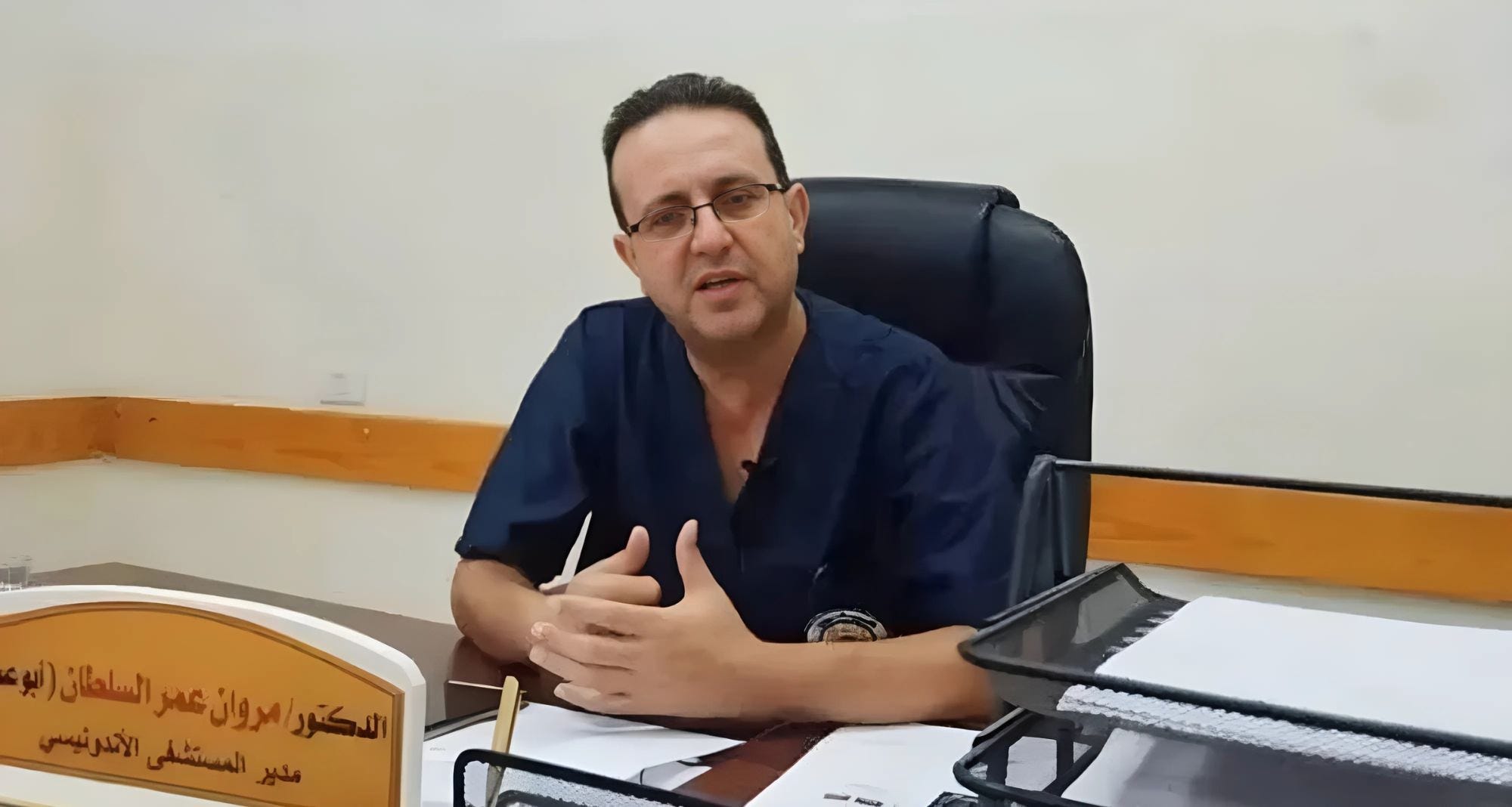
2 July 2026 marks the first anniversary of the martyrdom of Dr. Marwan Al-Sultan, one of Gaza’s most respected medical and academic figures. He was the Director of the Indonesian Hospital, but he was far more than his title. He was one of northern Gaza’s most respected cardiologists, a university lecturer, a mentor to generations, and a man whose life was devoted to serving his community.
Dr. Al-Sultan was assassinated when an Israeli missile was fired into the apartment in Gaza City where he and his extended family were staying after being displaced from northern Gaza. His wife, his sister, his daughter Lamis, and his son-in-law Mohammed were also killed in the attack.
His family says the Israeli airstrike “precisely” hit the apartment block where Dr. Al-Sultan and his relatives were staying. They believe he was deliberately targeted in the Israeli airstrike that killed him. His surviving daughter, Lubna, said the strike specifically targeted the room her father was in. “All the rooms were fine except for his; the missile hit it precisely,” she said.
During Israel’s war on Gaza, Dr. Al-Sultan became one of the leading voices documenting the collapse of Gaza’s healthcare system. As Director of the Indonesian Hospital in northern Gaza, he continued working despite repeated Israeli attacks on hospitals, severe shortages of medicine and fuel, and the overwhelming number of wounded patients arriving every day. While many medical workers were forced to flee or work under impossible conditions, he remained committed to caring for patients and speaking publicly about the humanitarian catastrophe unfolding around him. He worked tirelessly under unimaginable conditions, saving the injured without a single moment of rest.
Dr. Al-Sultan’s son, Ahmed, who is studying medicine to continue his father’s path, said: “For the first few months of the war, we did not see him except for a few hours of the day because he was always at the hospital.” He added: “Until the last minute of his life, he did not leave his job. He paid for this dedication with his life.” Ahmed also said: “My father had been besieged at the Indonesian Hospital and also at Kamal Adwan Hospital many times, but he did not leave.”
Dr. Munir Al-Bursh, Director General of Gaza’s Ministry of Health, explained that losing Dr. Al-Sultan created a gap that cannot easily be filled. Gaza did not lose only an experienced cardiologist. It lost a mentor, a hospital leader, and one of the medical community’s most trusted reference points.
Beyond the Hospital
Dr. Al-Bursh recalled that despite the overwhelming responsibilities Dr. Al-Sultan carried, he always made time for others. No matter how difficult the circumstances were, he never allowed his workload to distance him from those who needed his guidance, support, or simply a conversation. Dr. Al-Bursh also remembered him as someone who built lasting relationships wherever he went. He was respected not only for his medical expertise, but also for his humility, kindness, and genuine concern for everyone around him.
Beyond the hospital, Dr. Al-Sultan was a devoted father who took great pride in his family. According to Dr. Al-Bursh, he often spoke proudly of his children and celebrated the values he had worked to instil in them.
He was my family’s neighbour in Jabalia and one of the people who helped shape my future. I still remember the day he visited our home after my twin sister, Amna, and I received our Tawjihi results. It was a Friday. I remember him smiling as he told me that he never really had free time, but that he always made time for moments like this because he felt it was his responsibility to share in our joy, encourage us, and help guide us toward the future.
For Dr. Al-Sultan, nurturing young people and helping them move toward their potential was inseparable from his sacred duty to his community. He came carrying gifts, congratulations, and, more importantly, reassurance. Like many students, I was overwhelmed by uncertainty about choosing a university major. He sat with us, smiling calmly, and told me: “We don’t look for titles; we look for purpose.”
Those words have stayed with me ever since.
Encouraging Others
He encouraged me to study English language and literature because he believed language could become a bridge between Gaza and the world. He believed it had the power to carry Gaza’s stories beyond its borders.
I also remember another conversation that revealed how deeply he loved Gaza. He shared with me that while he was abroad, he had been offered prestigious opportunities to teach and practise at world-renowned institutions such as Cambridge and Oxford. Yet he said “no” to the world and “yes” to Gaza. He chose to return to the besieged Gaza Strip, determined to help build our collective future instead of seeking personal glory abroad.
By choosing Gaza, he chose to share in every struggle. Every patient he treated, every academic lecture he delivered, and every life he saved was a brick laid in the foundation of his homeland. For him, building Gaza’s future mattered more than building an international career.
Looking back today, I realise he was doing what he had always done: encouraging young people to believe they could make a difference through their own talents and passions. Today, as I stand on the verge of graduating with an excellent degree in English, I often find myself thinking back to that conversation in our living room years ago.
Dr. Marwan Al-Sultan encouraged me to choose this path because he believed language was more than a subject. It was a way to tell our stories, preserve our history, and carry Gaza’s voice beyond its borders. Writing about him now, one year after his assassination, is more than marking an anniversary. It is my way of honouring someone whose guidance helped shape my future.
His Legacy
The Israeli occupation ended Dr. Marwan Al-Sultan’s life, but it could not erase the impact he left behind. His students continue practising medicine, and his patients remember his compassion. They took his life, and they devastated our community, but they could never erase the profound sense of purpose he instilled in me. I carry his advice in every word I write. I do it to honour his memory, to give voice to his legacy, and to make him proud.
Dr. Al-Sultan’s death was not only a loss for his family, but for the whole of Gaza. He was one of only two remaining heart specialists in the territory, according to Healthcare Worker Watch, a Palestinian medical organisation.
The UN says that more than 1,400 healthcare workers have been killed in Gaza since the beginning of the war in October 2023. All of the directors of hospitals in northern Gaza have either been killed or detained by Israeli military forces. For example, the director of Kamal Adwan Hospital, Dr. Ahmed Al-Kahlout, and its acting director, Dr. Hussam Abu Safiya, are being held in an Israeli prison.
Dr. Marwan Al-Sultan’s life was taken, but his purpose remains. It remains in the hospitals he served, in the students he taught, in the patients he saved, in the family he raised, and in every person he encouraged to believe that their work could serve something greater than themselves. His assassination was meant to silence a doctor, a witness, and a leader. But one year later, his legacy continues to speak.

Thank you, Alaa, for your beautifully written account of the enduring legacy of the life of such a remarkable and towering example of humanity, Dr Marwan Al-Sultan. You describe with noble restraint what is in fact a story of the most terrible and almost unimaginable wickedness and cruelty that took Dr Marwan Al-Sultan's life and that of his wife, daughter and son-in-law for no other reason than that he was doctor and a leader. Just as he will always be remembered through those whose lives he saved or influenced, this crime will never be forgotten nor forgiven.
I am the son of a Jewish survivor of the Holocaust that was perpetrated in the middle of the last century in Europe, and live far from Gaza. I want to assure you that I and many, many, tens of thousands of people of Jewish descent around the world, including here in Britain, think of you every day and work as hard as we can to make your voices heard in the world and try to bring an end to what you are enduring. We totally reject the complete lack of human empathy of those who have for so long and with impunity destroyed or damaged countless lives of Palestinians and others in the name of an evil ideology.
But I also want to send a message of love and solidarity to you and to your family, and to express my hope that you will succeed with your studies and especially, that you will continue with your brilliant writing.
With best wishes, Richard Wistreich
Dear Alaa, thank you for your inspiring, heartbreaking story honoring the memory of Dr. Marwan Al-Sultan's beautiful, courageous life and for sharing his words of wisdom: look for purpose in life not titles. May your words wing across the world spreading light, love, compassion and understanding. May justice and humanity see Dr. Ahmed Al-Kahlout and Dr. Hussam Abu Safiya and all those held in Israeli detention released now.
Congratulations on your graduation, and especially so given such extremely difficult circumstances. Keep writing Alaa, humanity needs your words. Peace and goodwill.