

By Ohood Nassar
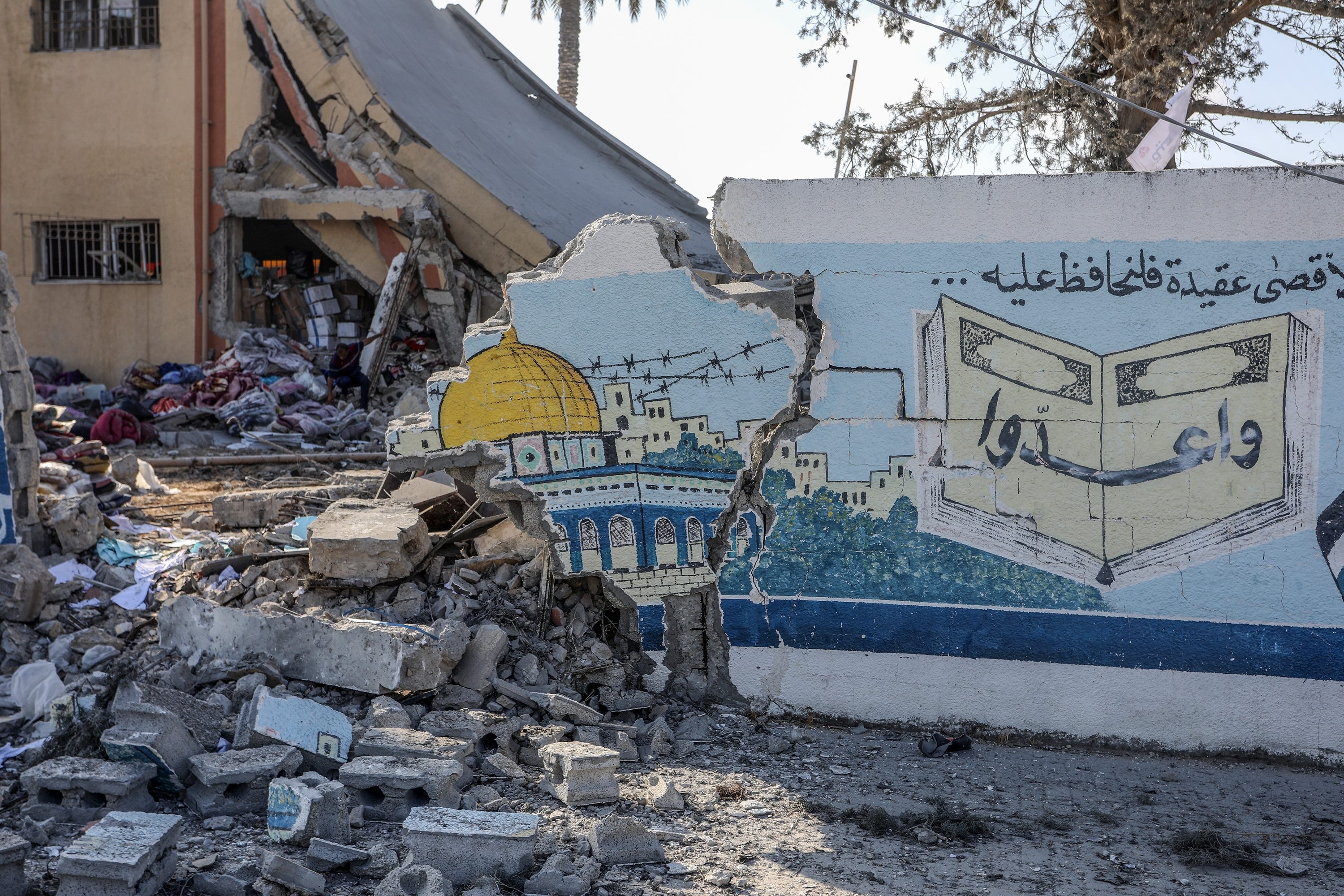
Since the outbreak of war in Gaza on October 7, 2023, the education system has been devastated on an unprecedented scale. Nearly 97% of schools have been either completely or partially destroyed, leaving more than 700,000 students without consistent access to education for three consecutive years.
Schools have not been spared from bombardment. Many have been damaged or burned, while others have been turned into overcrowded shelters for displaced families who have lost their homes.
According to UNICEF, around 60% of school-age children in Gaza currently receive no in-person education, as the system has nearly collapsed.
Broken Schools
The destruction of infrastructure has erased the foundation of formal education. What once functioned as a structured system of schools, teachers, and classrooms has been replaced by chaos and displacement.
The Palestinian Centre for Human Rights notes that while Palestinians have long faced restrictions on education, the scale of destruction in Gaza today is unprecedented.
For many children, school is no longer a place of learning—it no longer exists at all.
In response, local volunteers and international organisations such as UNRWA and UNICEF have created temporary learning spaces in tents.
These initiatives now reach approximately 625,000 students. However, this still leaves nearly two-thirds of Gaza’s students without access to any regular form of education.
Conditions inside these tents are far from ideal. Overcrowding, lack of materials, and constant instability make sustained learning extremely difficult. Still, for many children, these tents are the only remaining connection to education.
Digital Barriers
Online learning has been introduced as an alternative, particularly by UNRWA, but it faces major challenges.
Electricity in Gaza is almost entirely unavailable. Internet connections are weak and unreliable. To cope, families rely on solar-powered charging stations, where charging a single phone costs about $0.50 and often requires hours of waiting.
Some students pay for access to spaces with electricity and internet, but the cost—around $1.50 per hour—is too high for many families, especially those with multiple children. Even when accessible, limited time online is not enough to keep up with lessons.
As a result, thousands of students are effectively excluded from online education.
Contested Schools
Amid this crisis, a new initiative has emerged: the “Academy of Hope,” established in Gaza with coordination from the Israeli army.
According to its organisers, the academy is funded by Israeli sources and Jewish donors from Israel and the United States. It offers modified curricula, removing content considered “inciting” and emphasising what it describes as coexistence and peaceful engagement.
The project’s founder, David, says the goal is not to change politics but to “change minds,” arguing that teaching hatred only prolongs conflict. Surveillance cameras have reportedly been installed in classrooms to ensure teachers follow the revised curriculum.
The initiative has sparked deep division within Gaza.
Some families see it as a rare opportunity for children to return to structured learning after years of disruption. Others view it as an attempt to reshape education under external control, without approval from Palestinian authorities.
Critics question the legitimacy of the project, asking how education can be rebuilt by those associated with the destruction of the existing system. They argue that the priority should be rebuilding schools, restoring the Palestinian curriculum, and protecting educational institutions—not introducing new systems that may deepen social and political divisions.
As war continues and infrastructure remains in ruins, one question remains unanswered for hundreds of thousands of children:
When will education return to real classrooms - instead of tents and fragile screens?
Ohood Nassar is a journalist and teacher from Gaza. She has written for We Are Not Numbers, New Arab, Al Jazeera, Institute for Palestine Studies, Electronic Intifada, and Prism.
Unbelievable how a regime can kill, maim, destroy and suffer no consequences then that same regime then offer to educate the people they have oppressed and massacred. It appears destroy then brainwash the next generation is the game here. Why can’t the Palestinian people have control over their own destiny? I hope critical thinking will be on the curriculum.
These new "schools" are really Zionist centres for propaganda. They are a continuance of the genocide: murder the people, destroy the physical structures of the history and culture, indoctrinate the population into thinking Israeli's are the chosen people. Our governments in Canada did the same to the indigenous people: murdered thousands upon thousands, destroyed their communities and their culture, set up "Indian schools" to "take the savage out of the Indian". However you want to look at it, the truth is, it's genocide.