


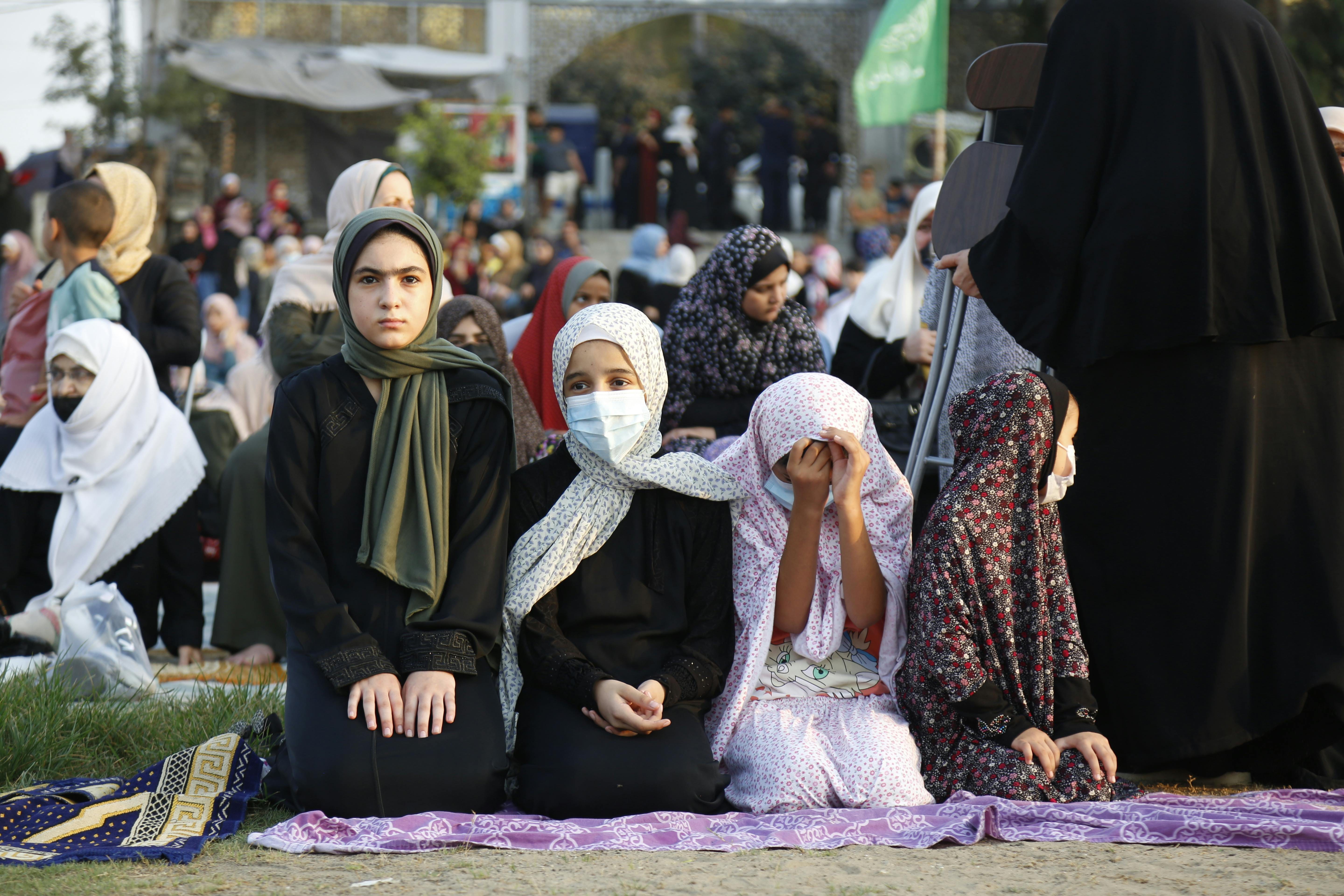
In Gaza, families cling to faith and fragile moments of joy while war strips away the rituals of ordinary life.
The streets that were once filled with children carrying balloons and families returning from morning prayers are now lined with rubble, tents and hungry faces. The smell that once marked Eid – grilled meat shared between neighbours and relatives – has disappeared, replaced by dust, smoke and the stench of destruction.
For the third consecutive year, many Palestinians in Gaza are being deprived not only of safety and dignity, but also of two of Islam’s most sacred traditions: Hajj and the Eid sacrifice.
Across the Muslim world, millions of pilgrims are gathering in Mecca dressed in white ihram, answering the call of God with the talbiyah: “Here I am, O Allah.” They circle the Kaaba, stand on Mount Arafat and pray for forgiveness, mercy and renewal.
In Gaza, we watch them through shattered phone screens under torn tents.
Many of us do not even have enough food to survive, let alone the ability to travel for pilgrimage. Border closures, siege and war have turned what should be a religious right into an impossible dream.
For years before the genocide, Palestinians in Gaza already faced severe restrictions on movement. Travelling to perform Hajj often depended on waiting lists, permits and border openings that could close without warning. Elderly people spent decades saving money for “the journey of a lifetime”, unsure if they would ever leave Gaza alive.
Now, after months of relentless destruction, the idea of Hajj feels even more distant.
Entire families who once hoped to perform pilgrimage together have been wiped out. Homes where relatives gathered to celebrate returning pilgrims no longer exist. Some who spent years saving for Hajj used that money instead to buy bread, medicine or tents for survival.
Others were killed before their names were ever called. In Gaza today, even grief has become unfinished.
Vanished Sacrifice
Eid al-Adha is supposed to commemorate sacrifice, faith and mercy. Families traditionally slaughter sheep and distribute meat to relatives and the poor so nobody goes hungry during the holiday.
But in Gaza, there are barely any sheep left to sacrifice.
The war has devastated agriculture and livestock. Prices for animals that survived became impossibly high long ago. Many families have not eaten meat for months. Children who once waited excitedly to watch the Eid sacrifice now stand in endless lines for water or flour.
This year, countless parents will once again invent distractions so their children do not ask why there is no meat and no celebration.
The deprivation cuts deeper because Eid in Gaza was never only about food. It was about community. About neighbours exchanging meat. About grandparents gathering grandchildren after prayer. About women preparing meals together late into the night such as Sumaqiyah. About hearing takbirat echo from mosques before dawn.
Now many mosques themselves lie in ruins.
There is a particular cruelty in being denied not only life’s necessities, but also the rituals that make suffering bearable.
Religion in Gaza has become one of the few remaining spaces where people try to hold onto meaning. Yet even worship is constantly interrupted by siege and violence. We pray beside destruction. We break our fast to the sound of drones. We celebrate Eid while counting the martyrs amid the so-called ceasefire.
Returning Life
And yet, this Eid carries something unfamiliar to Gaza after so much devastation: fragments of life returning.
The streets, though scarred, are filled with movement again. Lights flicker between broken walls, laughter rises hesitantly at first, then with growing courage. The air carries contradictions — the sweetness of baked maamoul intertwined with the lingering scent of smoke, joy brushing against grief, hope threading itself through exhaustion. It is not a perfect Eid. It is something far more profound: a stubborn, defiant Eid.
For the first time in what felt like a lifetime, we touched the essence of the holiday again. Not fully, not without ache — but enough to remember who we are. Markets open with fragile determination. Vendors arrange what little they have, stretching scarcity into abundance through sheer will. Families walk among the stalls calculating every coin, every purchase weighed not just in currency but in dignity.
The scent of kahk and maamoul drifts through alleys and broken doorways. Women bake with hands that had known both tenderness and loss, shaping dough into memory, into continuity. Recipes passed down through generations became more than food — they became resistance. Each pastry whispers: we are still connected to what came before, and no force can sever that thread.
Family Return
This Eid carries a rare and sacred gift: the return of togetherness. Families scattered by genocide and displacement found their way back to one another. Not all, not whole — but enough to fill homes and tents with warmth again. The embrace of a loved one after months, sometimes years, of separation carried a weight words could not hold.
Eid became an almost physical presence — something you can hear, smell and nearly touch. It lives in the distant echo of takbirat rising from damaged mosques, in melodies drifting through the night, in the hum of life returning, however briefly, to a familiar rhythm.
Everyone expresses joy in their own way, as though each smile itself was an act of healing. Children run through shattered streets in bright clothes that defied the greyness surrounding them. Their laughter rang out — pure, unburdened, miraculous. They clutch chocolates and sweets like treasures, their happiness unfiltered, their resilience instinctive.
The weight of reality never fully left us. The streets, though alive again, remain fractured. Transportation is scarce, movement limited not only by destruction but by unbearable cost. Prices have soared beyond reason, turning basic necessities into burdens. Even eidiya — the small gifts that once brought children such delight — feels painfully out of reach for many families.
Gaza lives in this constant tension: between what is and what should be. Between joy and grief, presence and absence, resilience and exhaustion.
Joy here is not accidental. It is deliberate. It is chosen again and again in the face of everything that argues against it. The smiles on children’s faces are not naïve — they are powerful. Family gatherings are not ordinary — they are sacred. The sharing of sweets and coffee is not simple hospitality — it is symbolism.
These are acts of defiance.
They are declarations that Gaza is more than its suffering. That Palestinians are more than victims. That life, even in its most fragile form, remains worthy of celebration.
Closed Borders
Faith persists, even when dignity is systematically stripped away. But faith should not require surviving starvation and bombardment.
Nor should millions of Muslims accept as normal the reality that an entire population remains cut off from pilgrimage and deprived of even the ability to perform Eid sacrifices.
Hajj symbolises equality among Muslims. Wealth, nationality and status disappear before Allah as pilgrims stand together in white garments.
Yet Palestinians in Gaza remain isolated behind closed borders and military siege, excluded not by faith, but by politics and violence.
There is deep pain in watching the Muslim world celebrate Eid while Gaza buries its martyrs and starves and struggles.
Not because we envy others their joy, but because we remember what joy once felt like ourselves.
I remember Eids before the genocide: my mother preparing food before sunrise, children wearing new clothes, families visiting one another after prayer. I remember the excitement when someone returned from Hajj carrying Zamzam water and dates from Mecca. Entire neighbourhoods would gather to welcome them home.
Today, many of those neighbourhoods no longer exist.
Human Continuity
What remains in Gaza today is not only siege, displacement and death, but the slow erasure of the ordinary rituals through which people remember they are human.
The destruction of homes can be counted. The number of martyrs can be counted. Even the starvation can be measured in statistics and aid reports. But there is another loss that escapes numbers entirely: the loss of continuity, of tradition, of the small sacred moments that once stitched life together.
When people are denied Hajj, denied Eid, denied even the ability to offer sacrifice or gather safely for prayer, they are being denied more than religious practice. They are being denied participation in the shared rhythm of the Muslim world itself.
And yet, despite everything, Gaza still whispers the talbiyah in its own way.
It rises from mothers baking what little bread they can over firewood. From fathers trying to buy second-hand clothes so their children can still feel Eid arriving. From displaced families gathering beneath tents to recite takbirat over the sound of drones. From survivors who continue praying over bodies pulled from rubble because there are no cemeteries left untouched.
This is what the world often fails to understand about Gaza: Palestinians are not only fighting for survival. They are fighting to preserve memory, faith and the right to remain human under conditions designed to strip all three away.
Endless Sacrifice
Eid al-Adha commemorates Prophet Ibrahim’s willingness to sacrifice what was most precious to him. But Gaza today has been forced into endless sacrifice without mercy, without relief and without end.
An entire population has sacrificed homes, families, safety, futures and now even the rituals meant to help endure grief itself.
Hajj teaches Muslims that no believer stands above another. Eid al-Adha teaches mercy, solidarity and the obligation to feed the hungry.
Yet as pilgrims circle the Kaaba and Muslims gather around tables heavy with food, Gaza remains sealed behind rubble, hunger and mass graves.
The contradiction should disturb the conscience of the world. Because what is unfolding in Gaza is not only the destruction of buildings and lives, but the forced isolation of an entire people from the collective rituals through which Muslims experience dignity, belonging and spiritual equality.
Still, Palestinians continue to pray. Continue to fast. Continue to whisper the talbiyah beneath drones and bombardment.
Not because life in Gaza is sacred to the world, but because it remains sacred to those forced to survive it.
And perhaps that is what Israel’s war has failed to destroy: the stubborn insistence of Palestinians on remaining human, faithful and visible even as everything around them disappears.

It is so blatantly treacherous that the Arab neighbours have courted the US and Israel who only shit on them anyway. If they joined forces and unified against Nazi Israel and kicked the US out then Palestine would have a chance to recover and rebuild. This region deserves peace and extending hands to each other.
This cannot stand. Palestinians deserve to live full lives in safety.