


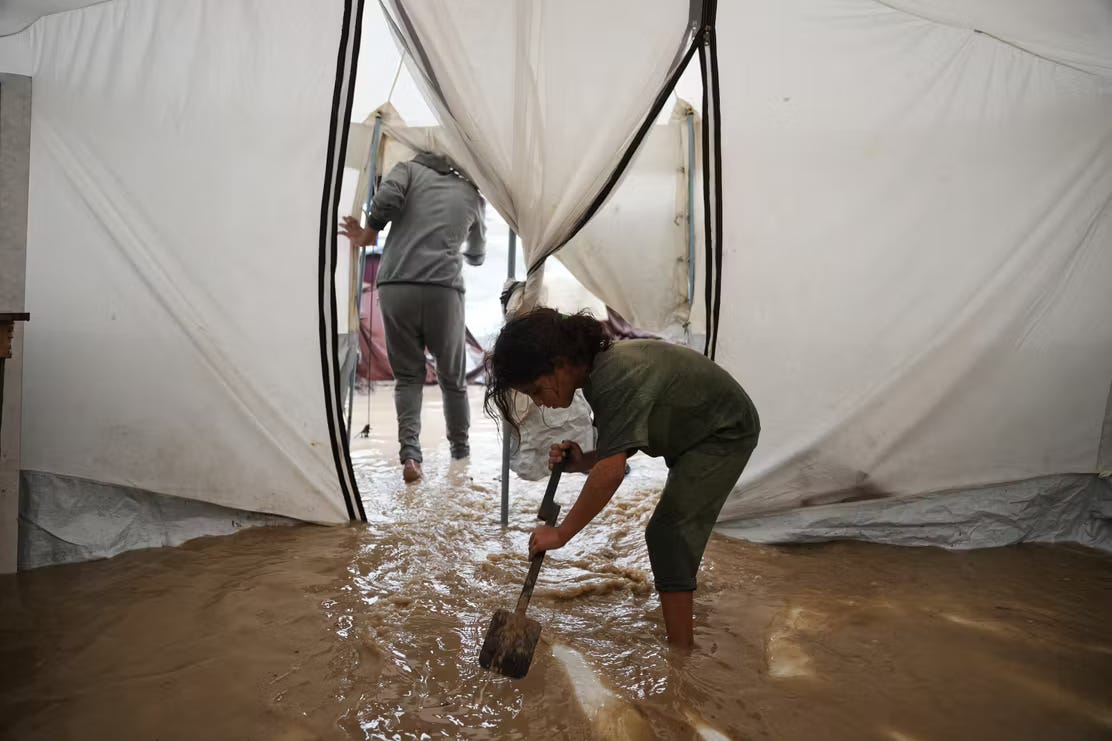
“Wa anta ta‘ūd ilā al-bayt baytak, fakkir bighayrak, lā tansa sha‘b al-khiyām.”
“And as you return to your home, think of others; do not forget the people of the tents.”
Mahmoud Darwish wrote these words, calling on the world to remember those forced to live beneath canvas and dust. I am sorry, Mahmoud, but allow me to clarify something important: I feel a deep anger toward the phrase; “people of the tents.” Palestinians were never meant to live in tents — we once lived in beautiful, dignified homes, filled with life and memory. We were pushed into tents by force. The tent is not who we are; it is not our identity. It is a temporary wound, a reality the occupation has imposed upon us, not a name we must inherit or accept.
In recent days, people across the World have seen shocking images of flooding and inundation in Gaza, heaping yet more misery on a whole people displaced. For two years, the people of Gaza have endured a genocide that tore apart their homes, schools, and neighbourhoods, forcing them into tents. No matter how much fabric is added, no matter how the edges are trimmed, a tent can never replace the solid four walls of a home.
Inside the tents, when it is not raining, heat burns the skin by day and cold bites at night. And then when it rains, the water seeps through the seams, wind rips the fabric apart, and every flimsy corner reminds families of what they have lost. Water must be fetched from far away, and despite the ceasefire, food arrives in meagre portions. Even in sleep, fear enters the very soul —the thunder of shelling, the rattle of machine guns, the grind of tanks rolling nearby.
What has been lived, and what continues to be lived, is akin to a wound that no shelter, no money, and no consolation can heal.
Aseel, a translation student at the Islamic University of Gaza, now lives in the south Gaza Strip after being forced to leave her home. She recalls the first days in the tents with a mixture of shock and exhaustion.
“At first, we found ourselves in the tents during a heatwave,” she says. “The heat inside was suffocating. Even when the sun was not at its peak, the temperature inside felt unbearable. I couldn’t stay in the tent for more than a few seconds. Most of the day, I had to sit outside, just trying to survive until nightfall.”
But the brief relief of night brought another challenge. “As soon as darkness fell, the cold was sharp and merciless. There was nothing to keep us warm. Dew would gather in the morning, and whenever the wind shifted the tarps, water would fall on us. When it rained, even lightly, the wind would tear at the tents. Winter in these tents is a nightmare,” she explains. “Every day, we hoped for relief, or at least for more tents, or for prices to be lowered so people could cover themselves from rain and protect the few belongings that may have survived the displacement.”
Even more frightening than the temperature extremes, she says, is the danger from nearby shelling. “The tents offer no real protection. Even a tiny piece of shrapnel can pierce the fabric and injure someone inside. I have seen fragments fall through the tents while people were sleeping. That fear never leaves you.”
Life in these tents, with the constant extremes of heat and cold, and the ever-present threat of shrapnel, has turned each day into a struggle not just for comfort, but for survival. “Every morning, we wake up knowing that simply staying alive is the first victory of the day,” Aseel adds, her voice heavy with the weight of experience.
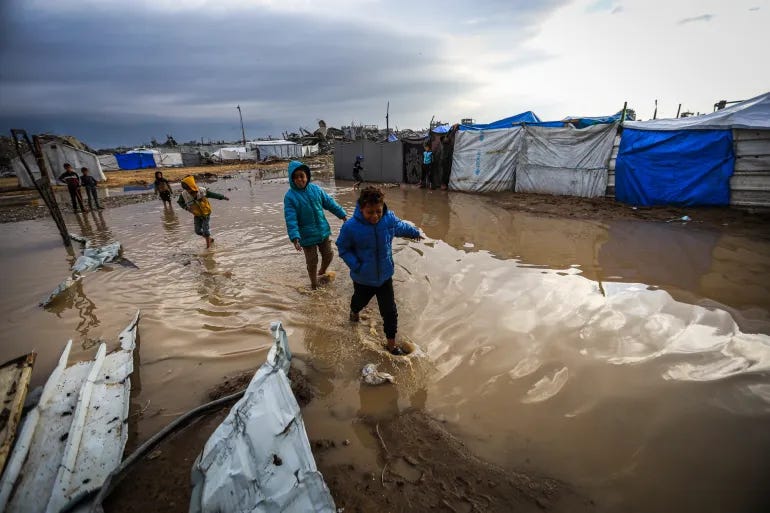
Jumana, a 20-year-old living now in Al-Mawasi, Gaza, describes her life in the tents as a never-ending nightmare.
But she says, “They are better than nothing. Many people around us don’t even have a place to sleep”
Jumana first had to leave her home on October 14, 2023, from Tel al-Hawa. “At first, we thought we would just go to my grandmother’s house in Rafah for a week or two and then return. But until today, we have not been able to go back,” she says.
Among the hardest losses, she recalls, was leaving behind the energy and life from their previous home in Khan Yunis. “We lost our house, our belongings, our sense of stability. Nothing remains.”
Aid from organisations has been limited. “No one really looked after us,” she notes. Now, all they hope for is some safety and a few solar panels to make the tents slightly more bearable.
Her message to the world is clear: “We are people like you. We had lives, ambitions, dreams. We lived comfortably once, more than many of you. We are not asking for just a little medicine or food—we want to be seen as human beings, not just numbers.”
Noor, a second-year university student, now lives in a tent in Al-Mawasi after a long and painful displacement that began in December 2023. She describes her daily life as “extremely difficult, each day much like the one before.”
“We had to leave our home after pamphlets were dropped over Khan Yunis on December 2, 2023. The experience was terrifying and difficult. We haven’t returned home since, even after Khan Yunis was considered relatively safe—the house was destroyed, unfortunately.”
“My home, which gave me a sense of safety and stability, my clothes, my memories, my university certificates—all gone. The hardest moment was when my cousin, who was like a sister to me, was killed. I still cannot get past that. Alhamdulillah for what remains.”
Since being displaced, Noor has moved several times: “At first, we stayed with my cousin for four months, then in a room with a kitchen and bathroom for a year, and now, for about five months, I’ve been living in the tents.”
“We cook, we organise the tent, and we try to protect ourselves from the heat during the day and the cold at night. There is no privacy at all. The divider between our neighbours and us is just a piece of cloth,” she says.
“Sometimes there isn’t enough water, and the places we buy it from are far away. We have to carry it long distances on foot. Food is very limited in variety, and everything else has become a struggle,” she adds.
“Sometimes, especially with the sounds of nearby explosions or shelling, I feel threatened. Some of our neighbours were injured, but thankfully, my family is safe.”
Yet she knows that tents are never truly secure: “There is no real protection, but we try to be careful and stay away from dangerous areas as much as possible—even though no place is completely safe.”
She recalls one of the scariest moments of her life: “When the land next to ours was bombed, my brother, my uncles, and their children were there. It was the most terrifying moment in my life. Thank God they all came out safe, but their bodies were covered in ash, and the smell of gunpowder was everywhere. I will never forget that day.”
Over the past few days, I reached out to everyone I had previously interviewed, wanting to check on them after the heavy rain and understand what they went through that night. Their responses revealed a mixture of exhaustion, acceptance, and a quiet resignation that words can barely describe.
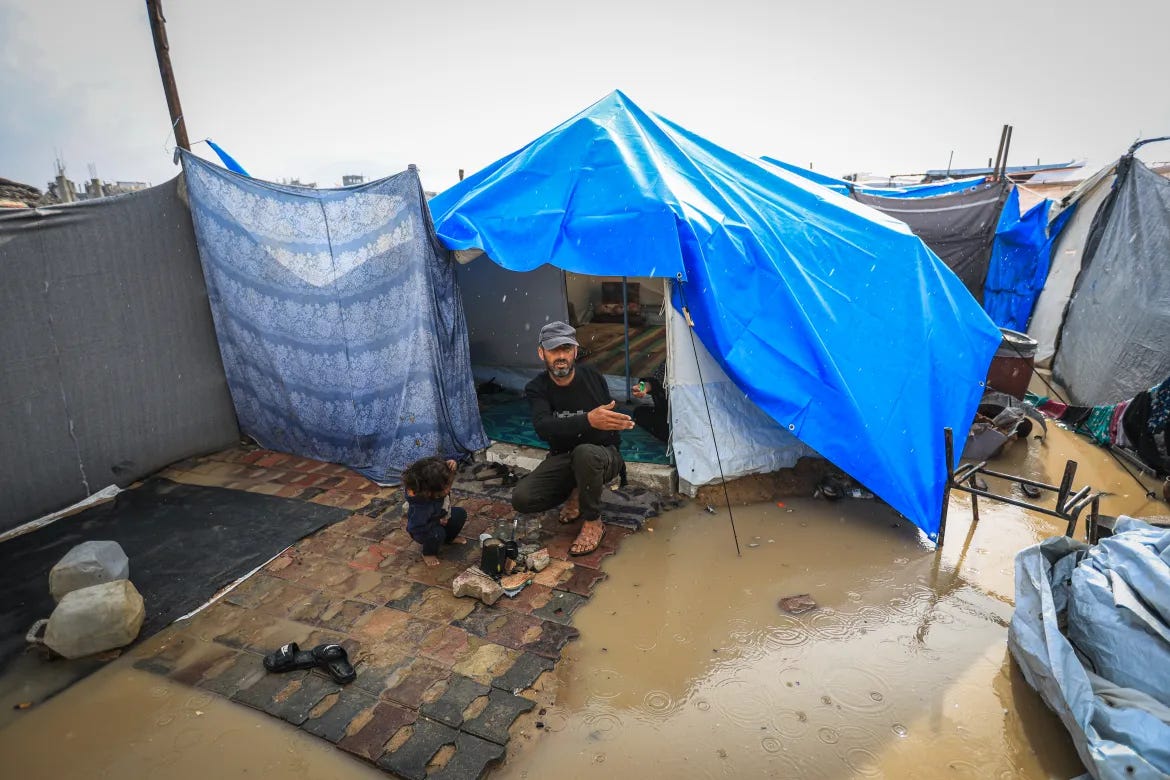
Aseel told me, “Alhamdulillah, we are okay. In the end, these are only tents and tarps — of course water will leak. You can’t sleep the whole night because when the water gathers on the tarp, the wooden beams can break from the weight. Still, we are better off than others, and others are better off than us. May God help the people. Hasbun Allah wa ni‘ma al-wakeel [God is sufficient for us, and He is the best disposer of affairs].”
Noor shared something similar: water had entered her tent too. In fact, everyone confirmed that their tents flooded, but what struck me most was their acceptance. They reminded me that despite their misery, others have no shelter at all — no tent, no tarp, no place to escape the storm.
I interviewed one more woman, Amina Jaser, about life in the tents. She begins quietly, “We are seven in this family. My mother and father are old and need care. I’m also responsible for the wife of a martyr. And today, after everything we’ve lived through—displacement, fear, hunger—we’re still here, trying to stay alive.”
“The constant displacement destroyed my health,” Amina says. “Each time we were forced to move, I felt my body collapsing. I reached a point where I couldn’t walk properly. I couldn’t breathe. And all our life became queues—bread, water, the charity kitchen. Even the bathroom has a line.”
“I need monthly medication,” she explains. “I haven’t been able to buy it for a long time.”
Then winter arrived, and the tent became a trap.
“That night when the heavy rain came,” she says, “we woke up in the dark to find everything soaked—our blankets, our clothes, the few things we kept with us. The cold hit us like a knife. The phone broke from the water. We stayed up until morning because there was nowhere dry to lie down.”
She looks away for a moment, then speaks again; “Tell me—where do we go? At night, in winter, the tent feels like a grave.”
“We don’t have enough bedding,” she says. “We don’t have transportation to return to Gaza City. And with the prices so high, food is barely available. I became malnourished. My whole family did.”
“Rents are impossible,” Amina tells me. “There’s no income. Everything depends on aid. And even that is not enough.”
Yet she speaks without anger, only with a voice worn by months of hardship.
“We try to stay patient,” she says softly. “But there is a limit to how much a person can bear.”
Her final words are simple, but they carry the weight of an entire life overturned:
“We are not asking for much. Just safety, medicine, warmth, and dignity. We are human beings—nothing more, nothing less.”
A tent cannot replace the ground where families built their lives. It cannot carry the weight of memory or shield children from fear. For two years, the people of Gaza have endured burning heat, freezing nights, hunger, and the constant threat of death.
But it has not only been the tents that are flooded. In my own neighbourhood, five houses were completely submerged, along with the streets—everything was underwater. This is our reality: at 3 a.m., the neighbourhood was not asleep; it was drowning in water and sewage, and the streets had turned into rivers.
The world has witnessed these horrors for more than two years without intervening. The question is not whether Gaza’s people are suffering—that is clear. The question is: what does it mean for humanity if no one takes meaningful steps to bring this genocide to an end?

Achille Mbembe said international law is necropolitics codified—an apartheid system where the power to dictate who lives and who dies is institutionalized through legal and political structures of the UN and the Security Council veto to permit the five colonial powers to shield the axis of genocide since 1948. We need the reforms advocated by Nandeli Pandor and the Council of Elders.
This is unbearable reading. What can we do? I am despairing!