


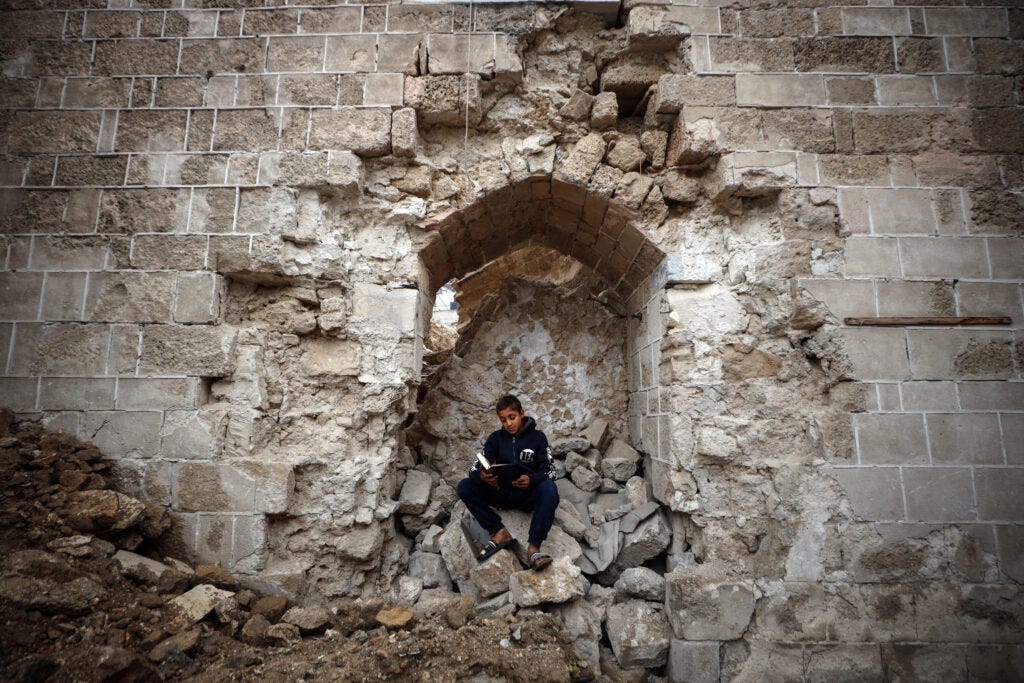
While walking through Gaza City’s Al-Rimal neighbourhood, a green street sign catches my eye: Al-Thawra Street, or Revolution Street. It was named to honour Egypt’s 1952 revolution, when Gaza was under Egyptian administration — part of a broader effort to give the city historical and Arab identities. Nearby, Wehda Street, meaning “Unity,” recalls the brief union of Egypt and Syria in 1958. Further along, Omar Al-Mukhtar Street stretches from Palestine Square to the seafront, its name reaching back to the Ottoman era. The street is largely in ruins now. But it still runs in the same direction it always did.
Israel has stolen or destroyed every home that was ever mine to claim: my grandparents’ village of Deir Sunaid, the house in Jabalia refugee camp where I grew up, and most recently my family’s home in Gaza City. The homes of my uncles, my aunts, my friends are gone. The kindergarten I attended. Every school I knew. Even the university.
UN agencies estimate approximately 61 million tonnes of rubble across the Gaza Strip. UNOSAT satellite imagery shows that around 81 percent of all structures have been damaged — of the 198,273 affected buildings, 123,464 have been destroyed. The destruction, however, is uneven: some areas suffered near-total devastation, while some neighbourhoods in the Strip were less affected.
Erased Landmarks
The destruction has not spared the city’s oldest layers. The Great Omari Mosque is severely damaged. The fourteenth-century Hammam al-Samra is gone. The Church of Saint Porphyrius, one of the oldest churches in the world, was struck in October 2023, along with many other buildings that stand as physical evidence that Gaza has existed, continuously, for millennia.
This scale of destruction creates a dangerous illusion: that Gaza is an empty landscape waiting to be redesigned. It echoes a familiar colonial logic, the idea that devastation creates the right to reinvent a place.
I recently visited a work hub that was previously a house on Al-Thawra Street itself, the same street whose sign had caught my eye. The house was old, and inside I saw floor tiles I had never seen anywhere else in Gaza. When I called someone living in Ramallah, we realised we had the same tiles. They had traveled from Hebron to both cities, from a time when Gaza was still connected to the rest of Palestine.
It is a connection that no reconstruction plan has thought to preserve. Most of Gaza’s residents are Palestinian refugees or descendants of refugees displaced from lands that are now Israel, people whose history does not appear in any of the proposals being drafted on their behalf.
Eternal Visions
The reconstruction plans being drawn up in Western capitals treat the city as a development site. Tony Blair has called for rebuilding Gaza “not as it was but as it could and should be.” Jared Kushner has framed Gaza’s reconstruction as an economic opportunity, describing it as “a hope, a destination” where industry, commerce, and employment could thrive. The “Project Sunrise” vision, a roughly $112 billion proposal drafted in 45 days and presented in a 32-slide PowerPoint to Gulf investors, outlines tourist districts, industrial zones and “smart” infrastructure intended to transform Gaza into a high-tech coastal metropolis.
Who gets to decide what Gaza “should be”? These proposals say little about where two million people would live while their city is being redesigned, how surviving neighbourhoods would be integrated, or what should happen to the buildings that still stand. This reflects what Palestinian sociologist Sari Hanafi calls “spaciocide,” the systematic destruction not only of buildings but of the spatial conditions that allow a people to live, remember and sustain their identity. In these visions, Gaza appears not as a city of lived experience but as empty land waiting to be filled with someone else’s idea of progress.
We have been looking at the rubble. We should also be looking at what is still standing. In Al-Rimal, houses and shops that have stood for decades remain. In the middle areas of the Strip, entire neighbourhoods are still there. Many historical sites can still be restored. People still return to these places, because some things do not need reconstruction. They only need the chance to survive.
What Remains
Across Gaza, ordinary people have already begun. Windows are sealed with plastic sheeting. Where walls once stood, canvas tarps and curtains mark the boundary between inside and outside. Doors hang crooked, held shut by a dozen nails. Families live in the one room that still has a ceiling, or in the shell of a house that no longer has walls. These small acts are attempts to keep life tethered to place — a refusal to be erased.
Not long ago, I saw a video online of two young men in Gaza carefully arranging books in the damaged historic library. The shelves were dusty, and some volumes were damaged. I thought not about how they found the energy, but how they still believe that order is possible, that a book placed on a shelf still matters, and that someone, someday, will come to read it.
Residents and volunteers have been collecting stones and fragments from destroyed sites, salvaging manuscripts, and rescuing what they can. In the old Qissariya bazaar of Gaza City, teams removed around 240 tonnes of rubble by hand to recover 20 tonnes of historic stonework. These efforts show that what remains of Gaza’s heritage is worth preserving, and that the city cannot be reduced to a “new” version of itself. The violence inflicted upon it does not erase that history. It only makes the demand to remember it more urgent.
Kushner’s hope is contingent on investment. But hope after genocide belongs to the people who lived it — not to those who arrive with plans. While planners look at Gaza as real estate, Palestinians look at an old tile beneath the rubble as an act of existence. Before Gaza is a destination, it is a home. True reconstruction begins with recognising that they already know something the PowerPoint slides do not: a city is not built from scratch—it endures.

Beautifully written. Stay strong Malak.
Well said, Palestinians know what is good for them.