


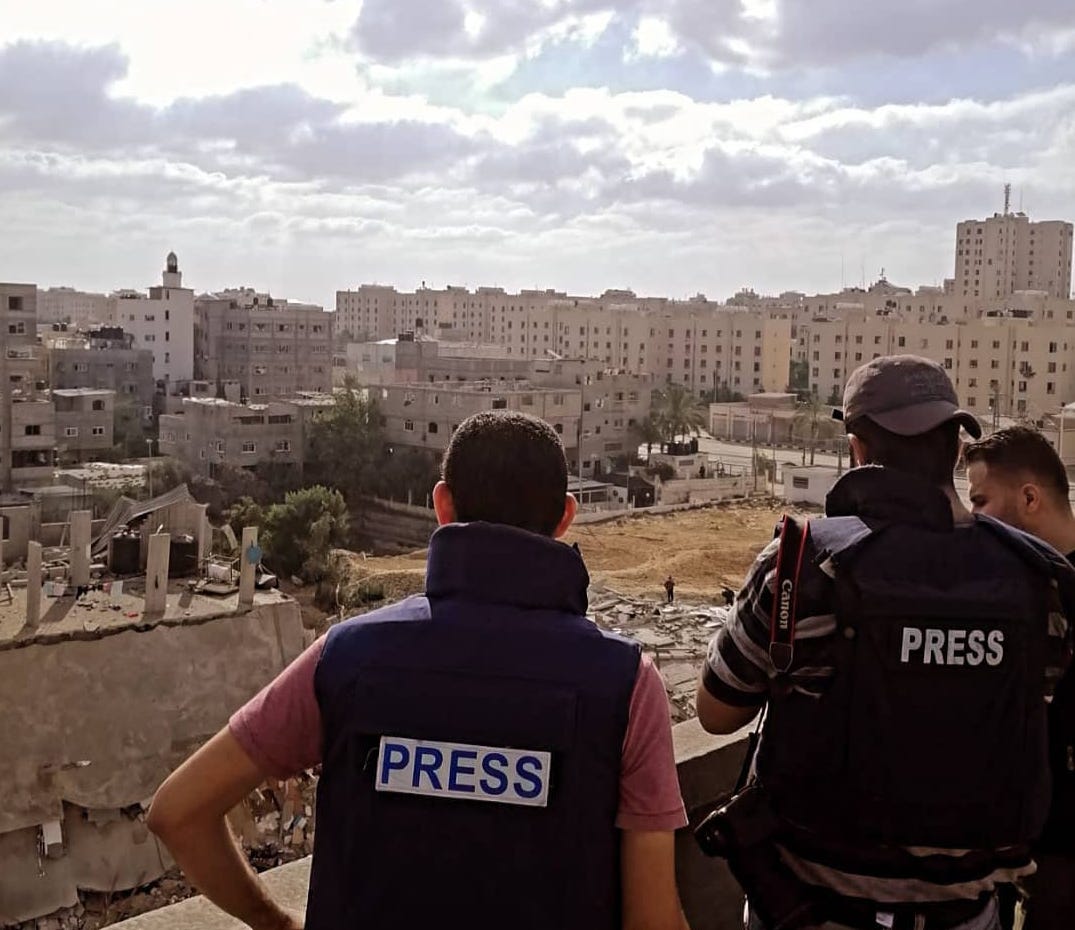
“I’ll buy it from you for $30. I swear, I’m only making two dollars on it.” That was my 21-year-old brother Anas making his pitch to someone leaving an aid distribution centre. Around him, hundreds of exhausted people stood under the relentless sun, sweat streaming down their foreheads as they waited for their turn. Anas paced along the line, scanning faces and asking the same question over and over: “Are you selling? Anyone want to sell?”
Three years ago, at 18, Anas began the programme he had dreamed of joining for years: Journalism and Media. It was the spark that changed everything for him. A boy who had never cared much for his studies suddenly became driven, passionate, and eager to learn, determined to graduate as an exceptional reporter.
He used to picture himself stepping out of a television studio after a long day at the news desk. Above the study table in his bedroom, he had hung a sign that read: Journalist Anas Abu AlShaikh. Back then, there was no sign that this dream would be shattered, that life as he knew it would collapse, or that sunburn and dust would become the defining marks of his daily work.
The war that followed 7 October 2023 forever altered the meaning of dreams for the people of Gaza. Homes were destroyed, families were displaced, and nothing was left but memories. Universities were flattened, education ground to a halt, and the rubble of campus buildings became makeshift shelters for displaced families.
With each passing day, the war levelled more buildings and buried the ambitions of countless students. As the oldest son, Anas fled with our family from Gaza City to the south, and then to central Gaza, carrying the heaviest burden of our survival. Instead of attending journalism lectures, he spent his days standing in endless lines to fill a jerrycan with clean drinking water. Instead of walking into an exam hall, he gathered the family’s phones and walked miles to find a solar charging station.
Fragments Remain
Eventually, local universities tried to recover a fraction of their capacity, launching online portals so students would not lose years of their lives for nothing. Despite having no electricity, no home, no reliable internet, and barely any food, Anas decided to try. He resolved to chase whatever scattered fragments of his dream remained.
He began making the long trek to a private co-working space with internet access, sitting through lectures and slowly feeling that familiar spark of passion return. One night, he stayed up until dawn studying for his first midterm exam in “Introduction to Journalism”. The next morning, he woke up filled with enthusiasm. Life was devoid of colour, yet for a fleeting moment, it felt as though it was returning. But just an hour after leaving for his exam, he walked back through the door, his face pale and drained, as if the entire world had suddenly shrunk around him.
His phone - the only tool he had to continue his university education - had been stolen on his way to take the test.
With that loss, Anas gave up on his studies. He set out to find any work that could cover his basic daily expenses. But without a completed degree or vocational training, finding a job was almost impossible.
“Instead of sitting around doing nothing, come with me to the aid distribution centre. We can make a bit of money,” a friend told him one day. The idea weighed heavy on Anas’s heart and was agonising to even contemplate. How could someone whose dream was to report the news suddenly find himself buying and reselling aid packages? But there was only one real question: What was the alternative?
Survival Trade
He went to the site with his friend. Outside, crowds of people stood waiting for their turn in the blazing sun. Dozens of young men, their faces weathered, their exhaustion visible, pleaded with people to sell them their supplies. On his first day, Anas was overcome with embarrassment. He stood quietly, waiting for someone to approach him first, and went home at the end of the day without earning a single cent.
The next day, he forced himself to endure it. He began walking through the crowd, approaching people one by one, asking whether they wanted to sell, and bargaining over prices. He now buys these packages and resells them to merchants at a slightly higher price. Although the aid packages were valuable, families have more complex needs; children needed fresh food and medicine, not just another bag of flour or sugar. Parents therefore sold their aid packages to buy other essentials for their children.
“Five dollars in profit today. Alhamdulillah, it’s good—better than nothing.” That phrase came to define Anas’s days. From 7am to 3pm, he stands in the middle of the street alongside dozens of young men just like him, all for five dollars or less.
Anas often says that as he stands in those crowds, he looks at the young men around him and imagines that every single one of them once had a dream. Many of them, he knows, were probably training to be journalists too, preparing to report the news, instead of being forced to become it.
The war did not just shatter existing dreams; it destroyed the very capacity to dream at all, forcing young people into a relentless search for anything that simply keeps them alive. It stripped away their ability to plan for a future, leaving them trapped in a reality where tomorrow is entirely unknown, shaped only by fear of what comes next.
And tomorrow at 7am, Anas will be standing at the gates of the distribution centre once again, not with a reporter’s notebook, but striving for five dollars, without any idea left of what it means to dream.

So many dreams and future plans have been dashed by the ugly devastation of Israel. I hope and pray that when all this madness is over that everyone has a chance to dream again. In the meantime, the determination your brother has shown only proves he will be successful at whatever he wants.
The reality of Palestinians on the ground is so stark and painful... But everyone there is still so determined to live and do well