


In the courtyard of Al-Shifa Hospital in Gaza, the scene in December 2025 was almost unimaginable. The smell of death still hung over a place marked by destruction, yet so too did an extraordinary determination to survive. Two hundred and fifty doctors stood together dressed in graduation robes. They called themselves the “Phoenix Batch”, a name chosen to represent their rise from the ashes and despair.
These young doctors had studied medicine amid explosions and volunteered in operating theatres before they had even graduated. By completing their studies, they were fulfilling their own dreams while also paying tribute to the professors and colleagues who had been martyred. It was as though the place itself refused to forget. This was the same ground where the Israeli war machine had destroyed stone and tree alike. Yet from among the ruins and charred buildings, the Phoenix Batch emerged.
Despite the joy of the graduation ceremony, Dr Adnan Al-Bursh’s seat remained empty. He should have been there among his students on their graduation day, but his body is still being withheld. His absence left their happiness incomplete. The sense of loss could not disappear while his martyred body has still not been returned home.
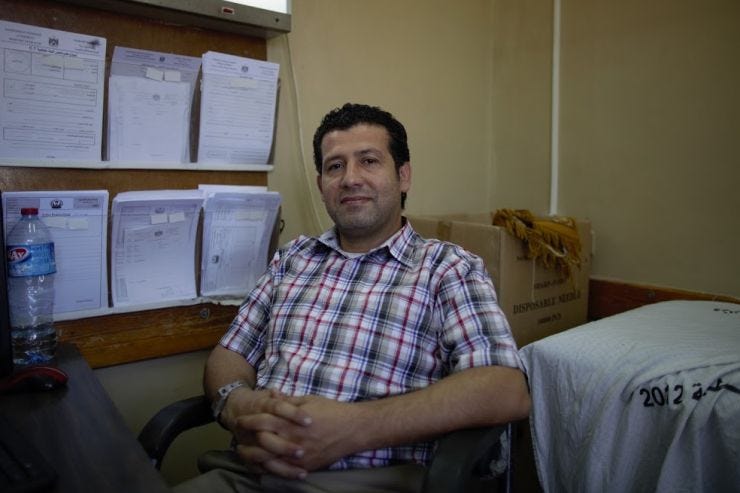
Dr Adnan Al-Bursh stood out as an exceptional medical figure. He served as a senior consultant orthopaedic surgeon and head of the Orthopaedic Department at Al-Shifa Medical Complex. He was also a lecturer at the Faculty of Medicine at the Islamic University.
According to his wife, Yasmin Hamada, Dr Adnan possessed advanced and rare medical qualifications that were unmatched in the Gaza Strip. They made him one of Gaza’s irreplaceable medical and academic pillars. His cousin, Dr Munir Al-Bursh, the director general of the Ministry of Health, also confirmed the exceptional importance of his expertise.
Beyond Medicine
Dr Adnan’s ambitions extended far beyond his daily work. He carried within him a much greater dream for Gaza and its people. His wife remembers the vision that remained with him throughout his life: “He dreamed of building a private, independent orthopaedic hospital—the first of its kind in the Gaza Strip. He wanted it to bring together the most skilled surgeons and be equipped with the latest medical technologies.”
He did not simply want to construct another building. He imagined a fully equipped medical centre staffed by a highly capable team, one that would spare patients in Gaza the hardship of travelling abroad to receive treatment. He hoped that this medical institution would elevate the standard of medicine throughout Palestine. But the hands of betrayal moved faster than the realisation of his dream.
Dr Adnan’s generosity extended far beyond the operating theatre. It was also reflected in his love of sport. He served as head of the Medical Department of the Football Association in the Gaza Strip.
Adnan was a lover of life. He regarded the sea as his “first friend” and visited it every morning. On the football pitch, he chased the ball with the spirit of a child and the passion of a devoted player.
At home, he was a tender father who could never say no to his children’s requests. His wife described the affection he showered upon them: “If one of our children asked for a toy they already had, he would buy it again just to see their joy. If his daughter wanted a birthday cake at any time of the year, he would bring it immediately. He lived just to make his family happy.”
His wife also recalled Dr Adnan’s gentle artistic side. He loved playing the piano and played it beautifully. It was a talent that revealed another dimension of his warm and caring personality.
Final Duty
Dr Adnan never abandoned his duty. After the Indonesian Hospital was bombed, he moved to Al-Awda Hospital in northern Gaza, determined to remain beside the wounded. On 19 December 2023, he was arrested from inside the hospital. Dr Munir Al-Bursh recalled the dramatic events surrounding his detention: “The phone rang. It was Adnan. He said, ‘Hello, Dr Munir. The occupation has just released us.’”
The joy lasted only a few minutes. The quadcopter drones soon returned and began calling out his name: “Adnan… come down, or we will demolish the hospital over everyone’s heads.” Dr Munir continued: “I screamed at him, ‘Don’t go down! Escape to the roof!’”
But Adnan would not allow the hospital to be destroyed over the heads of its patients. In an act of ultimate self-sacrifice, he surrendered himself in order to protect those who remained inside.
His wife recalled the final conversation she had with him: “He called and asked me, ‘Should I go down to them?’ I said, ‘Yes, put your trust in God.’ I was confident there were no charges against him. He had spent his life between books and operating rooms. He handed his papers, identity card and passport to another doctor and said, ‘Give these to my wife if I do not return within 24 hours, because the situation will be dangerous then.’”
Convinced of his innocence, his wife immediately arranged for a lawyer from within the occupied territories. The news she received was grim. Dr Adnan had been placed under administrative detention for 45 days, accompanied by a cruel order prohibiting him from receiving visits from a lawyer for 90 days. She spent those nights counting the hours and praying that his detention would not be extended, unaware of the trap that awaited him.
The targeting of Dr Adnan was not a coincidence. It was part of a systematic strategy to strike at the pillars of Gazan society. As his wife explained: “Adnan was not an ordinary surgeon. He was a symbol of steadfastness. He refused to leave the hospitals in the north, even under fire. His presence gave hope and life to the wounded. When the occupation sought to destroy every sign of life in the north, it arrested its source: Dr Adnan.”
Prison Defiance
Inside the darkness of the prison cells, Dr Adnan transformed his cell into a place of culture and solidarity. He recited Arabic poetry and encouraged his fellow prisoners to exercise in order to raise their morale.
His wife recounted vivid testimony given by one of his fellow captives: “Adnan disappeared into the interrogation rooms for six hours. When the door finally opened, he returned with a noble, mocking smile. We asked him, ‘What did they do to you?’ He replied with the calm confidence of a master: ‘They were asking me about a complex medical case they had failed to treat, so I sat down and lectured them on how to cure it.’”
For a moment, the captors appeared to forget that they were executioners. They became students sitting before a brilliant medical mind. They attempted to reward him for his consultations by offering him cake and fish. But he refused to accept anything for himself alone. “Bring nothing for me alone,” he told them. “Bring something for everyone in the section.” In doing so, he transformed the prison cell into a day of Eid for all those detained alongside him. Even inside captivity, he achieved a moral victory over his torturers.
Adnan did not die a natural death. He was martyred under torture. His wife, quoting one of his colleagues who witnessed the events that led to his death, described the deception that preceded his transfer to Ofer Prison: “After three months in Al-Jalamah Prison, the interrogators tried to break his spirit using a trick. The interrogator asked him, ‘What do you wish for? Take the phone and call your family.’”
Adnan, intelligent and cautious, feared that the telephone call might be used to track his family or place them in danger. He therefore refused. Instead, he made a simple humanitarian request. He asked to be transferred so that he could stay with his lifelong friend and colleague, Dr Mohammed Abu Salmiya, the director of Al-Shifa Medical Complex, who was being held in another prison.
Fatal Deception
The interrogator pretended to agree. But the promise was nothing more than a cruel deception. Rather than reuniting Dr Adnan with his friend, the authorities transferred him to Ofer Prison. There, guards were waiting to subject him to a brutal reception. It marked the beginning of his final moments.
His wife continued with the horrific details: “They placed him in a narrow iron cage and then took him into a corridor 350 metres long. His hands were tied, and his neck was chained to his legs, forcing him to remain bent over. They beat him severely on the head and back.”
She continued: “A guard called over a colleague who was described as huge and broad and said, ‘This is Adnan.’ The guard then pulled his chains with such force that Adnan fell and his head struck the ground. The other prisoners heard the impact so clearly that they were certain he had died.”
The guard then summoned two prisoners and instructed them: “Take him to the fourth floor, and do not call a nurse unless you are certain that he is dead.” Less than an hour later, Dr Adnan was martyred as a result of internal bleeding, following four months of heroic endurance inside the occupation’s prisons.
Dr Adnan was martyred on 19 April 2024. His family did not learn of his death until early May. He left behind a legacy of resilience and humanity, while his body remains withheld at the Abu Kabir Forensic Institute and kept within the so-called “cemeteries of numbers”.
During the darkness of captivity, Adnan began imagining a novel titled The Valley Stones. It would tell the story of the courage and resilience of Gaza’s doctors. He did not know that he himself would become its hero.
His wife made a vow: “I have decided to collect everything his companions narrated and publish the book in his name. I will complete the story as a tribute to his spirit.”
She concluded with a message addressed to their six children: “Adnan hoped that one of his children would succeed him and inherit the secrets of the orthopaedic craft. Today, I say to him: your children will continue the journey. They will grow up to say, ‘We are the children of the Healer, the continuation of the hand that never stopped giving.’”
Body Withheld
Dr Adnan’s wife repeatedly stood outside the offices of the International Committee of the Red Cross, taking every available opportunity to demand the return of her husband’s body so that she might see him one final time. She did not ask for compensation. She asked only for a shroud.
The withholding of his body is a form of continuing torture inflicted upon the living. She cried out: “We are living in the 21st century, and a doctor is still being denied the right to a funeral and a grave.” She searched for his face among the unidentified bodies that were returned, while the occupation continued to fear him even in death.
She told me that she would be present everywhere: outside every institution and in every place where her voice might be heard. She declared clearly: “I am not only the wife of a martyr. I am now a revolutionary woman.”
The Phoenix Batch of doctors stands as the pinnacle of defiance. Adnan Al-Bursh left behind 250 “Adnans”, carrying forward his scalpel and his message. His body remains a prisoner, and his novel has not yet been committed to paper. But its story is lived every day in every hospital and every tent across Gaza. Dr Adnan did not die. He became a “Valley Stone”: solid, eternal and deeply rooted in the land he died trying to heal.
Today, the tragedy is being repeated through the imprisonment of his colleague, Dr Hussam Abu Safiya, the director of Kamal Adwan Hospital, who is currently being held in occupation prisons. The fear for Dr Hussam’s life mirrors the pain and dread that we once felt for Dr Adnan. Both men carried the burden of northern Gaza. Both refused to abandon the wounded. Both remained at their hospitals until the moment they were arrested.
With reports that Dr Hussam’s health is deteriorating inside prison, the world must act. We cannot allow the events at Ofer Prison to happen again. We cannot lose another hero to torture as we did Dr Adnan.

Dr. Adnan Al-Bursh’s commitment to his patients, his colleagues, his students, his family and friends, and his fellow hostages, will live on in glory, for as long as “we” tell his story. I hope for his “remains” to be returned to his loved ones with Godspeed, that they may be interred with all due dignity. His murder is a tragedy, but his life and his deeds are a light, and a lesson, for all with a brave and kind heart to see. The stories of my Palestinian brothers and sisters are causing me to see the power and the beauty in martyrdom, instead of fearing the end of life on this troubled sphere.
From the River to the Sea, Palestine will be Free.
The world watches from afar, wearing a thread worn shroud of civilization. Nothing is done