


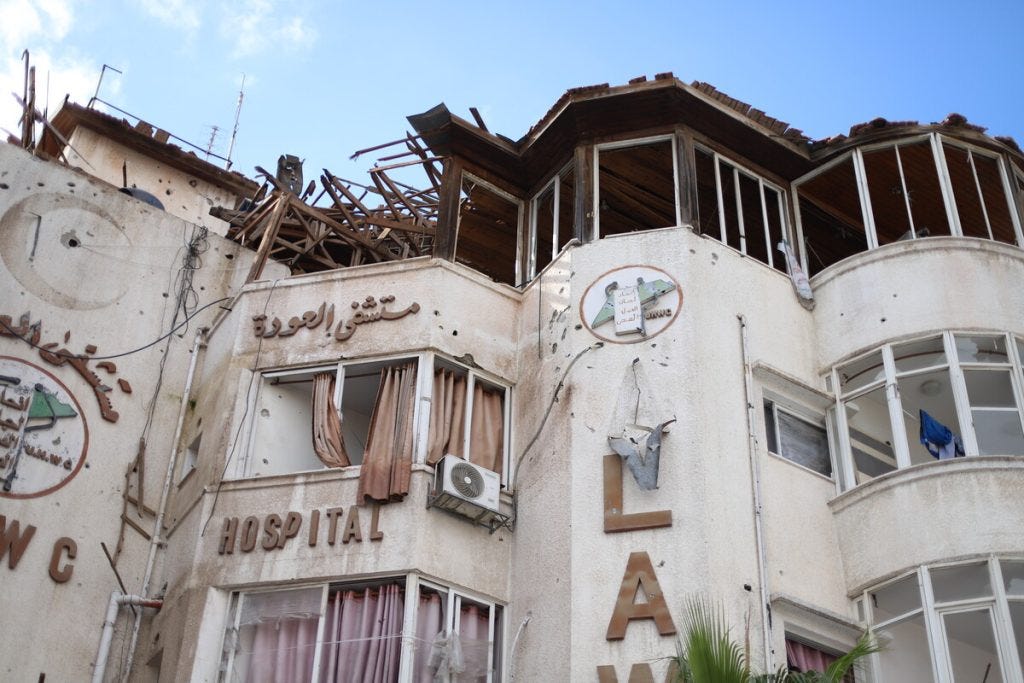
Thursday morning in the Nuseirat refugee camp in Gaza was not an ordinary day. It wasn’t the roar of fighter jets that gripped our hearts this time, but a more terrifying sound: the silence creeping from behind the walls of Al-Awda Hospital in our camp. As a resident of this besieged and exhausted camp, I didn’t need to read the official press release saturating the news to understand the scale of the catastrophe. The power to the hospital had been switched off.
I went along the road to the hospital, where I normally see people rushing along to find a sanctuary for survival. Along the roadsides, sewage water overflowed, a grim reminder of what is causing an invisible enemy which is infiltrating the bodies of my neighbours: Hepatitis A. Upon arrival at the hospital, the massive roar of the generators we had grown accustomed to was gone, replaced by an eerie stillness. I entered through a gate that usually bustled with life, stepping into a reception hall swallowed by gloom, lit only by the faint beams of mobile phone flashlights held by nurses.
In the corners, I saw children whose faces had turned a sallow yellow, as if a premature autumn had struck their fragile bodies. This is Hepatitis A, the “yellow plague” gnawing at the livers of the displaced in nearby tents. They came here seeking a miracle, only to find that the miracle now depends on “litres of fuel” that had been withdrawn. I saw a mother clutching her jaundiced child. His eyes were dim as he stood bewildered before the reception desk, only for a nurse to tell her with profound sorrow: “There is no fuel for the laboratory to run the tests.” In that moment, I realised the true meaning of “slow death”: to have the cure existing just behind a door, but the key, a litre of fuel, is held captive behind borders by the Israelis.
No power
I approached one of the mothers who was holding her whimpering child. Her voice trembled as she asked me: “We fled death in the tents only to die here because the power is out?” I had no answer. I simply recorded her words in my journal, which was by now full of tears rather than ink. Inside, the air conditioning had been cut. The elevators had stopped working entirely. I saw patients being evacuated from the general and specialised surgery departments in a scene resembling a forced displacement. They had to be moved from their hospital beds because the operating rooms had shut down. As a result of the lack of fuel, more than 50,000 life-saving surgical procedures have been postponed, turning time itself into another weapon against the wounded.
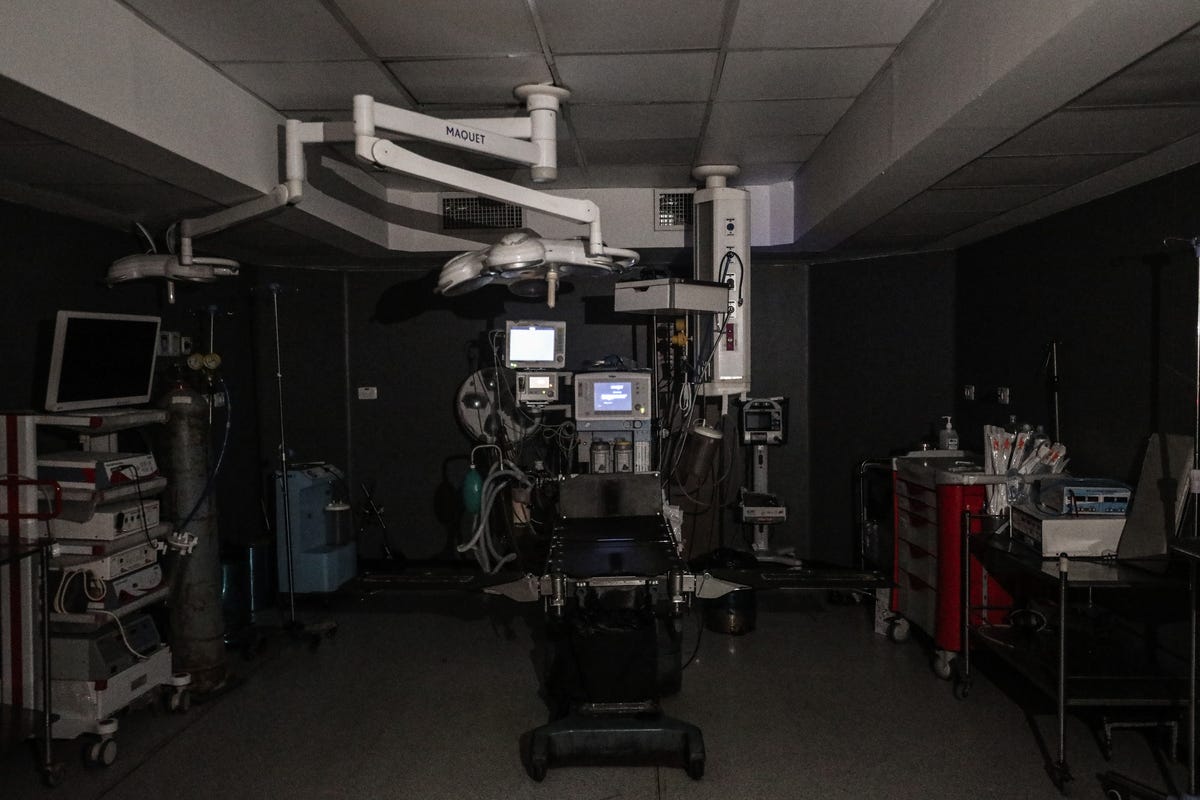
In another dark corner of the maternity ward, a woman was in labour and groaning. The hospital is now forced to prioritise patients among the dying: it shuts down entire vital departments just to get hold of a small generator to light a single bulb over a midwife’s head. Other women in labour are taken to different hospitals, while paediatric admissions are sent to Al Aqsa Martyrs Hospital in Deir al-Balah.
I heard the medical staff whispering about the “black market”. Can the world imagine a hospital that saves lives being forced to hunt desperately for fuel from traders at $12 per litre? This means Al Awda Hospital needs $12,000 every single day just to operate. This is a state-level budget needed by a besieged hospital while international organisations close their operations and offer nothing but apologies. It is an impossible amount for a facility that survived 26 months of relentless bombardment, only to be stabbed in the back by a “fuel siege”. Many medical staff, those who haven’t left the field for 600 days since the start of the genocide, have been forced into “involuntary leave”.
Engineered annihilation
What is happening within the halls of Al-Awda Hospital is not a passing fuel crisis: it is a new chilling chapter in Israel’s process of “engineered annihilation,” practised against the Palestinian population in Gaza. Then, while the world was pushing the narrative about “calm” and 2026 heralding a so-called “recovery”, Israel chose to inaugurate the new year with its most lethal move since the start of the aggression: the announcement of a plan to end the international humanitarian presence in Gaza.
This scheme, which aims to expel more than 37 international organisations, led by Doctors Without Borders, goes beyond a mere administrative decision: it is a death sentence for our remaining, stricken medical facilities. We are talking about organisations whose tireless efforts and essential supplies have literally kept us alive throughout more than two years of relentless slaughter and destruction. By expelling them now, the primary goal is to silence international witnesses and strip Al-Awda Hospital and other steadfast institutions of their last chance at survival.
We are facing a process of institutional uprooting aimed at turning Gaza into an uninhabitable space. Israel, which has already banned UNRWA and attacked many of its facilities, is expelling international organisations in order to complete a war of starvation and annihilation. We are witnessing a systematic medical strangulation where hospitals are left coping with an explosion of epidemics, with bleeding supplies suffering a 60% deficit. Medical stocks now cover only 10% of the minimum requirements for life in Gaza. All this amidst a shameful international silence.
I left Al Awda Hospital wondering: if the artery of Nuseirat has stopped, how much time do we have before the heart of Gaza stops entirely? How cruel is the moment when a doctor is forced to choose which of the dying deserves the least pain, or which life-saving surgeries must be delayed? In Gaza, we have had to learn resilience, but today we discover that resilience can be killed by an empty fuel tank.
***
Rawan Wajdi Jouda is a writer and a translation graduate from the Islamic University of Gaza. She is a member of WANN, with contributions featured in WRMEA and Al Jazeera Blogs. She seeks to bear witness to the daily suffering of Gazans and document their lived realities through storytelling.

Ahh, a terrible reality that is Jewish Supremacy. Imagine, drinking, eating, fornicating on the beaches near Tel Aviv, as this Jewish perversion allows for extermination miles away in Gaza. These people are sick in the head, collectively.
It is a sick people, and the Diaspora fuels it. Imagine, 130 Jewish Billionaires and millions of Jewish millionaires fueling this Dystopia, this final solution, all the while smiling as military murder stocks are gaining in value and the world just valorizes this neuoiperverse clan in every aspect of Western culture.
A good one here: To Understand How Dead in the Water resistance is in the West.
https://imanishere.substack.com/p/the-time-has-come-to-break-these
Since October 7th and perhaps from the inception of Jewish supremacy in the levant, almost every intervention made by Jewish anti Zionists on the Western left has corroded the movement not strengthened it. These figures like the JVP, Jewish Currents, Jews Against Social Economic Injustice, and 99.9% of anti Zionist Jews at large position themselves as moral custodians of acceptable discourse. Token schoolmarms chiding everyone that a particular word, phrase, or framing carries historical baggage, resembles something once said by a white supremacist, or simply makes them uncomfortable.
What makes this fixation intolerable is the context in which it unfolds. An ongoing “Final Solution”, one in which entire Palestinian lineages are annihilated in real time, half of them children. Tone and wording being treated as urgent moral crises is not merely absurd, it is obscene in the face of Palestinian blood. After more than a century of dispossession and three years of intensified destruction, demanding that Palestinians and their allies prioritize Jewish comfort over Palestinian survival represents a profound moral inversion. It reverses the reality of victim and offender.
Israel has flattened entire neighborhoods and erased generations, yet our Jewish allies continue to center language, optics, and propriety. In doing so, they make genocide secondary to the management of discourse. The result is a political culture in which fear of being labeled “anti-Semitic” or “extreme” outweighs concern for human beings being exterminated before our eyes.
Jewishness nominally a religion, in Israel an ethnicity is the central identity at the heart of the Israeli project in Palestine, both in its raison d’etre and modus operandi via Jewish settlement. Being Jewish regrettably has to be treated as a potential source of threat and cooption in the Palestine solidarity movement, and understood and screened accordingly. Anything less than this vigilance represents a clear risk to the ultimate aims of the movement. The Jewish people most effective in their work for Palestine have retired their Jewish identity from their public identity. Anti Zionist Jews are often treated as token arbiters who determine whether critiques are acceptable or labeled antisemitic. This is utterly absurd, consider the historical parallel with Jews and Nazis. No one would suggest that “good Germans” could police Jewish opinion on the Holocaust. The comparison makes clear just how illogical and inappropriate the current arrangement is. In practice, Palestinian voices and analyses are subordinated to the comfort and validation of those whose political project is directly responsible for the violence being resisted.
It just gets worse and worse perpetrated by the sick psychopathic Nazi Israeli genocidal scum and the west that supports them. The human race is going over a precipice