


“Every person here has a story, and these stories deserve to be told,” Dr Refaat Alareer once said.
Inspired by his words, I felt called to compile diverse voices from Gaza. These are not stories of numbers, but of people—surviving, remembering, and hoping.
Heba, a medical student at the Islamic University of Gaza, lived in the Al-Nasr neighbourhood in northern Gaza. She remembers the early days of the military operations with a mix of shock and fear.
“Anyone who has experienced displacement once knows what it feels like,” she recalls. “You tell yourself you will never leave your home again, no matter what happens. At first, we thought the occupation wouldn’t reach our area—that someone would see what’s happening to us and the world would intervene. But the world remained in deep slumber.”
While initially they planned not to leave, as shells hit houses on their street and sent fragments into their home, it became impossible to ignore the danger.
“The feeling was unbearable,” she remembers. “I understood for the first time what displacement really means. I wasn’t mentally ready for these emotions, especially not knowing if we would ever return home, or if the house would even still be standing.”
Each item they packed—their belongings, furniture, and everything they had held dear—felt newly significant in the shadow of surrounding destruction.
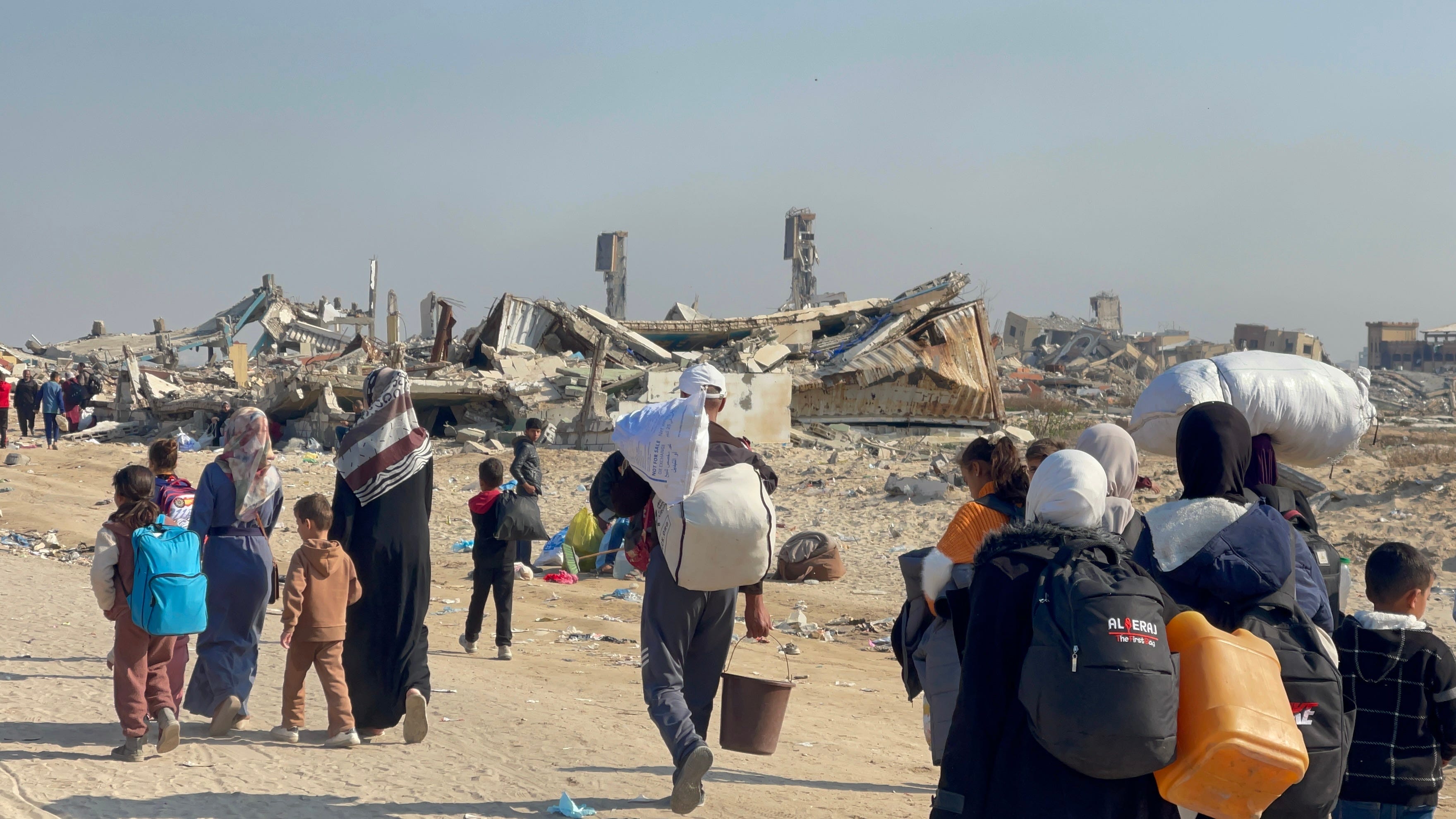
They left in the afternoon. The journey itself was another ordeal. Thousands of displaced people were on the roads—some walked because transport was impossible; others faced broken vehicles and no way to fix them.
After five hours, they finally reached the southern Gaza Strip. “We pray that one day we can return safely, that our house will still be there, that we will be reunited with the life we were forced to leave behind.”
Breaking Point
Mariam, a translation student at the Islamic University of Gaza, still remembers the moment she realised her home in Tel Al-Hawa was no longer safe.
“Just a week ago, I was living in Gaza City,” she says. “Everything changed so fast. Almost immediately, the Israeli threats began—against towers, schools, and entire neighbourhoods.”
Tel Al-Hawa was overcrowded, full of displaced families from the north, all trying to survive in tents and the ruins of buildings.
Her family’s house was near Al-Quds Hospital. At first, they tried to stay. “We watched as buildings fell one after another—the Mushtaha, Al-Roia, and Al-Sosi towers were demolished. Even the Islamic University, where thousands sought refuge, was struck,” Mariam recalls.
“Every morning we woke to the sound of robots—machines carrying explosives, capable of destroying an entire block. They were getting closer and closer. It became unbearable.”
“It wasn’t an easy choice to leave,” she says. “When we climbed into the truck, our eyes were full of tears.”
On Al-Rashid Street, Mariam saw a sight she will never forget: “It felt like all of Gaza had fled. There were so many vehicles, I couldn’t even see where the line began. The congestion was endless. We spent twelve hours on the road.”
Eventually, they arrived in Mawasi Khan Younis. “It was not a journey, but another form of death,” she says quietly. “A tent awaited us, just as it did so many others.”
Enduring Survival
Heba Ahmed, 36, has lived with combined visual and hearing impairments since birth. She holds a degree in English Language Education and has faced increasing health challenges during the ongoing genocide.
She describes her life before as manageable, but everything changed as access to treatment collapsed.
“I have a condition that increases heart rate, which worsened because medications were unavailable or cut off for long periods. The power outages forced us to wash by hand, which worsened my chronic eczema because the cleaning products weren’t suitable for my skin.”
These limitations affected her mobility and care. “I was limited in leaving the house to seek treatment or find sufficient medication. Many essential nutrients were missing, and it was difficult to get enough calories.”
During sudden heart palpitations, she could not move or help herself. “I felt a deep sense of ‘Ajz’.”
Rimah Adnan, 24, is deaf and has been displaced repeatedly—around seven times—since October 7. Her early life had been stable; she excelled academically, graduating top of her class in Multimedia.
But the war disrupted everything. Her family of nine struggled with severe food shortages and lack of medicine. Many lost weight, and skin conditions spread due to poor hygiene supplies.
Despite this, Rimah continues to focus on her future. She hopes to take design courses and is seeking support, including a laptop, to resume her work.
Sudden Loss
Aya shared the story of her aunt, one of the first to be displaced from Sheikh Radwan in northern Gaza. She left early, knowing transportation would soon be impossible, shortly after her husband was killed.
Now in Deir al-Balah, she lives in a tent on rented land, raising three children alone.
“She is doing her best to manage life,” Aya says. “She is constantly worried about their safety. All the responsibility falls on her now—may God give her strength.”
Her children, aged two and a half to ten, depend entirely on her perseverance. Despite grief and displacement, she works tirelessly to create stability.
Even after the so-called ceasefire, everything remains uncertain. No one truly feels safe. After two years of genocide, trust is unstable, almost impossible.
Here, everyone repeats the same truth:
“The end of the genocide is only the beginning of allowing grief to take its course—grief for those we lost, and for those we never had the time to mourn.”
***
Taqwa Ahmed Alwawi (born 2006) is a Palestinian writer, poet, and editor based in Gaza. She studied English Literature at the Islamic University of Gaza. As a dedicated chronicler and custodian of her people’s memory, she amplifies Gaza’s voice, illuminating stories that are often overlooked or silenced. Her work has been featured on more than 30 leading international platforms and prestigious publications and she currently serves as an editor at Baladi Magazine. Her Portfolio: https://tqwaportfolio-project.netlify.app/

Thank you for sharing this powerful and moving tribute. I am deeply struck by, yet proud of, how perfectly these women embody the virtues of faith, benevolence, and strength. Our women in Palestine are a complete manifestation of noble, dignified, caring, resilient, and faithful souls. They have shown all of humanity the true meaning of being heroes.
The handiwork of the world's most degenerate army. Video footage says it all.