


“I am very proud to announce that Israel and Hamas have both signed off on the first phase of our Peace Plan,” Donald Trump wrote on his social media, Truth Social, on the 9th of October.
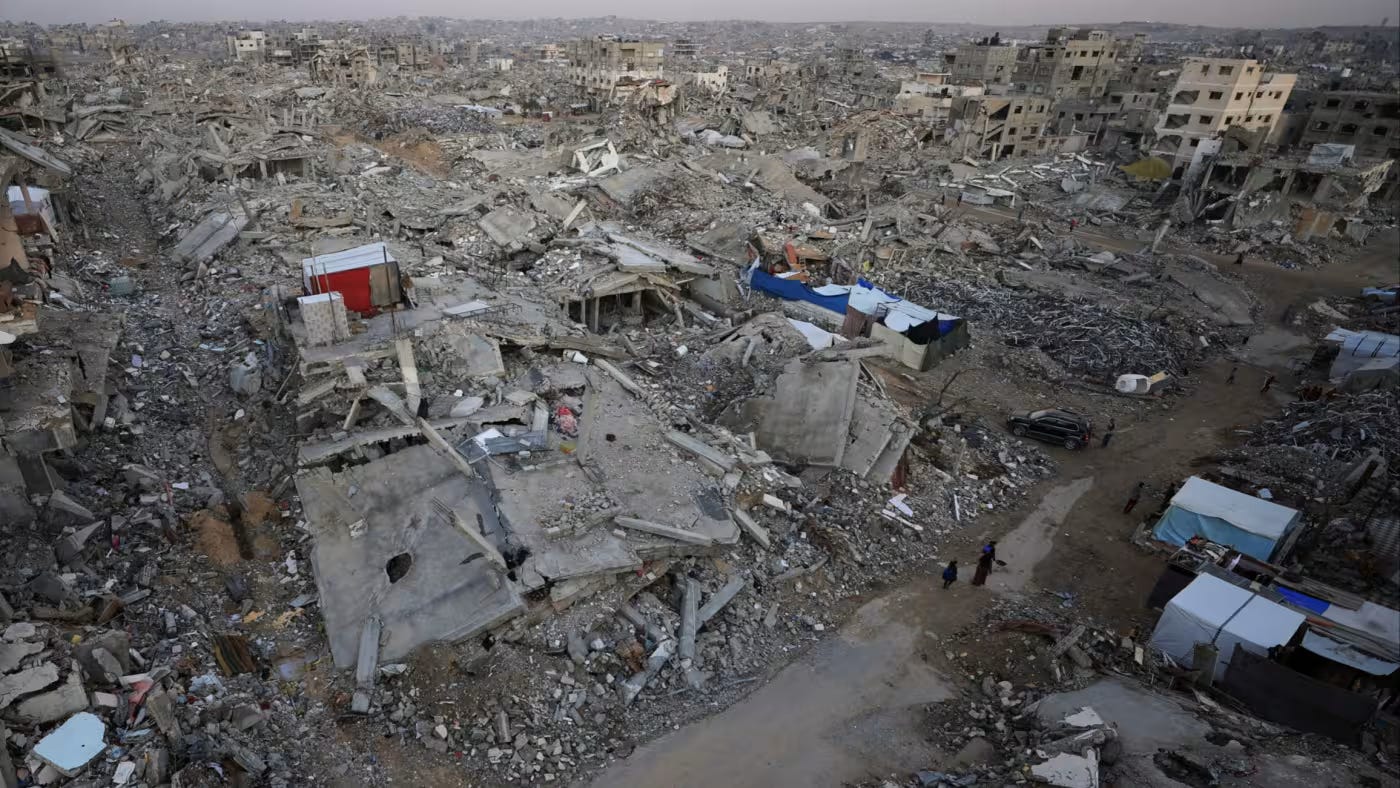
Yet, on the ground in Gaza, the reality tells a different story. After two years of sustained attacks by the Israeli occupation, the wholesale slaughter in Gaza has ended, leaving widespread destruction and trauma in its wake. Northern Gaza, once home to hundreds of thousands, is now in ruins, with entire neighbourhoods demolished and thousands of families internally displaced. More than 250,000 residents of Gaza City fled south, only to face continued danger and privation.
There is no real ceasefire. The Israeli occupation strikes whenever and wherever it pleases, and then announces that the truce has been renewed. Well over 200 Palestinians have been killed and over 600 injured since the ceasefire was declared by Trump. No one here truly believes in a ceasefire, yet life goes on.
Families whose homes were bombed live in tattered tents that are barely habitable. Others are completely homeless, crowding together in makeshift shelters or even sleeping on the street. Prices are slightly lower than they were during the two years of devastation, but they remain unaffordable for many who have no income at all. The Israeli occupation deliberately allows sugary and starchy foods to enter Gaza, not the nutritious fruit, vegetables, and proteins that people need, thereby masking the reality of hunger and malnutrition.
I spoke with two displaced Palestinians who described their journeys from the north to the south, recounting daily hardships and the ongoing efforts to rebuild their lives amid the destruction.
Ahmed Ashour, a 23-year-old artist from Tel Al-Hawa, remembers the moment he realised that staying in his home was no longer possible.
“At first, we didn’t want to leave,” he recalls. “But suddenly, the shelling intensified. Explosions were happening just fifty meters from our home.”
Eventually, they had no choice. The family secured a temporary spot in Deir al-Balah in Central Gaza, but reaching it was a nightmare. “Even when we found a truck to move our belongings, the price was unreal—we spent nearly a thousand dollars just to move our things 15 kilometres from Tel Al-Hawa to Deir al-Balah,” Ahmad says.
The evacuation itself was exhausting. Ahmad, his older brother, and a friend carried much of the burden. “My family is eleven people: five children, my elderly mother, my sister, whose husband had been killed at the beginning of the attacks, and her children. My mother was injured in November 2023—fragments hit her back during the shelling—and her mobility is limited,” he explains.
They began the journey late at night, around 11 p.m., under heavy shelling. “The roads were chaotic. Explosions, flying debris, traffic jams…it was terrifying. We walked and ran, trying to protect the children, while the elderly and the wounded struggled behind us.”
After ten gruelling hours, they finally arrived at the temporary shelter in Deir al-Balah. “The road was full of suffering. Everything in Tel Al-Hawa had been turned upside down in just a few hours. Yet, we survived. We left our home standing, but we heard later that it was destroyed or severely damaged—about seventy percent ruined,” he says.
Despite the loss, Ahmad holds on to a simple wish: “I hope one day we can return to our home, to the life we were forced to leave behind. God willing, we will return to our land.”
Then, on October 12, Ahmad sent me another message: “Al-bayt raah ya Taqwa raah. The house is completely gone — reduced to rubble under Israeli bombardment, Taqwa. Gone.”
Somaia, my friend from the north in the Al-Nasr area, was forced to relocate to the south as the situation deteriorated. She is currently staying in Al-Zawaida. She told me: “We left the house and took almost everything we could, because we expected we might not find it again..”
When the family fled, there were reports that the house had been looted, but nothing was confirmed. Yesterday, her uncle visited the property and discovered that it had completely collapsed, leaving only the street-facing door standing. He took photographs to document the damage, but Somaia admitted, “I haven’t looked at the pictures yet—I just can’t.”
Reflecting on the loss, she said, “We can only leave matters in God’s hands, hoping for patience and for better days ahead.” At present, there are no plans to return, as the house is uninhabitable, and the family is relying on God’s guidance for what comes next.

Gaza needs to be rebuilt from the ground up. It has been made into an unrecognisable moonscape littered with rubble and debris. Agricultural land has been bulldozed and is now polluted with toxic substances. Supplies of potable water are insufficient, and Israel has repeatedly damaged the pipes and other water infrastructure in Gaza. The destruction of educational institutions, the hospitals, and the electricity network was part of an effort to make Gaza uninhabitable. This has been compounded by the devastation of the entire environmental infrastructure in what experts call an ecocide. Soil and air are contaminated with toxic and radioactive materials, and more than 60% of desalination plants are non-functional. This environmental ruination has created a severe public health crisis, with residents facing widespread disease and hospitals struggling to operate without sufficient water.
There are no peacekeepers; the repeated breaches of the truce speak for themselves. How can there be talk of peace under these conditions? Electricity is unreliable, and while some have access to solar panels, the approaching winter reduces sunlight and limits their ability to charge devices. Lately, as the air grows colder, images of families in tattered and flooded tents and children sleeping on rain-soaked mattresses show the continuing desperation and misery.
People are exhausted. They want peace, reconstruction, and the fulfilment of their basic rights: living safely, having homes, access to food, freedom of movement, and independence. These most fundamental rights remain inaccessible. And now there are reports of plans to divide Gaza into a “green zone” of safety and reconstruction controlled by the U.S. and the occupation and a “red zone” where all the people of Gaza are now corralled, and no reconstruction is foreseen.
My dream is to wake up one day to see Gaza rebuilt and habitable — with schools reopened, hospitals functioning, safe homes standing again, and basic infrastructure restored. This is not just a hope but a responsibility that the international community, global institutions, and humanitarian organisations must urgently fulfil through long-term reconstruction plans, sustained funding, and real accountability.
Taqwa Ahmed Al-Wawi is a 19-year-old Palestinian writer, poet, and editor from Gaza, studying English literature at the Islamic University of Gaza. You can find more of her work here.


This account provides information on Israeli bombing outcomes. Murdering residents is routine if they happen to get close to where the bombs land. Residents that leave may survive but face the danger on getting murdered en-route to where they seek "shelter." Israel drops more bombs to demolish any remaining buildings.
This murder strategy means the Zionist never has to look the subject in the face - the Zionist remains "clean".
There is a different strategy in the prison rape dungeons.