


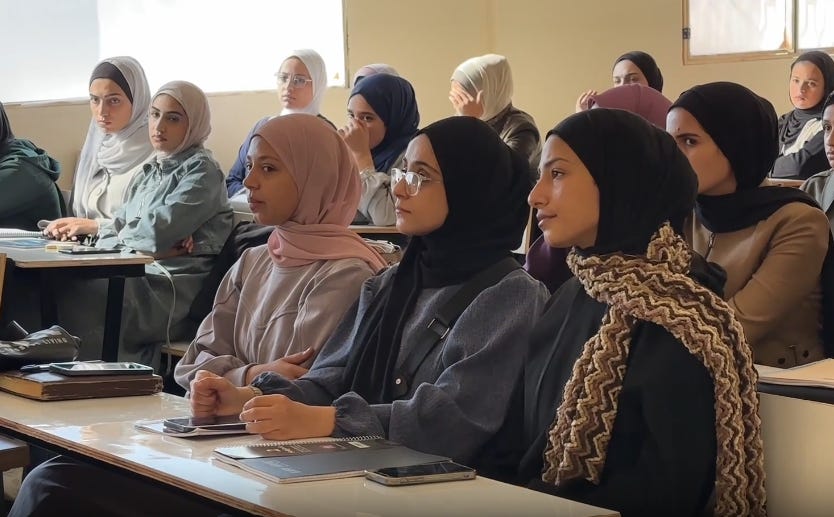
Living in Gaza, surrounded by genocide, hunger, relentless bombing, unreliable internet, and the scarcity of even basic necessities, including access to phone charging, many might think that pursuing education under such conditions is impossible. Yet, despite these overwhelming challenges, I refused to give in to the occupation and managed to participate in many incredible international courses—courses that became my sanctuary, a window into a better world, and a source of hope.
Instructed English Language Learning (IELL) – Islamic University of Gaza & Northumbria University, UK
The first course was taught by the brilliant Prof. Nazmi Al-Masri from the Islamic University of Gaza and Dr. Bill Guariento from Northumbria University in Newcastle. Every Friday for ten weeks, I eagerly awaited every session despite the unstable internet. Sometimes, my phone battery was critically low, and I had to balance charging it with joining the session, but the thirst for knowledge always outweighed these difficulties.
We learned how to learn a new language, focusing especially on motivation, meaningful interaction, and consistent practice. These lessons changed the way I approach language learning; instead of worrying about making mistakes, I became more confident in communicating and practising regularly.
In the last session, we had the honour of hosting Professor Rod Ellis in a joint session involving students from the Islamic University of Gaza and the students from Northumbria University. It was a unique opportunity to engage directly with an expert in language learning. I was the first student to ask him a question, encouraged by Dr. Bill, who said, “Be the one to get the ball rolling…” This moment allowed us to connect across borders through academic dialogue.
Despite my desire to contribute more, the genocide and poor connectivity limited my ability to engage fully. Still, the atmosphere Dr. Nazmi and Dr. Bill created made even partial participation feel meaningful.
English Speaking Practice – Mr. Anas Mansour, alongside students from Saudi Arabia and Jordan
This course was taught solely by Mr. Anas Mansour, with Esraa as an amazing assistant trainer. Our group was small, consisting of only five students from different countries, including Saudi Arabia and Jordan. An intimate environment made it easier for us to communicate confidently. We discussed everything from simple daily conversations to cultural and global issues. Speaking freely in this supportive setting allowed me to improve my fluency and confidence.
Every day at exactly 6.45pm, I looked forward to the session. It felt like stepping into a new world, one full of hope, life, and dreams, far away from the destruction and despair surrounding me. Mr. Anas was patient and encouraging, gently correcting my pronunciation and grammar mistakes, guiding me to improve bit by bit. His careful attention boosted my self-confidence.
I sadly missed the final session due to bombings and internet outages. Nevertheless, this course showed me that even in hardship, learning can flourish. I am proud to say that my English is nearly fluent, and I will work even harder to reach the level of excellence I believe I’m capable of.
Critical Pedagogy and Curriculum – University of Malta/IUG
Organised by the University of Malta, LINEs4Palestine2 was more than a series of Zoom lectures; it was a living connection—a window to the outside world, even while we remained caught in a cycle of stillness and waiting.
Guided by distinguished scholars—Prof. Carmel Borg, Dr. Joseph Gravina, Dr. Maria Brown, and Dr. Maria Cutajar—we explored Critical Pedagogy and Community and Intergenerational Learning, examining how education can promote justice, strengthen communities, and continue even in times of disruption. These ideas resonated deeply with me because I have seen how learning can persist beyond classrooms during periods of crisis. The course helped me view education not only as a system, but as a source of connection, empowerment, and hope.
I experienced first-hand how education and ideas can cross physical barriers, even when people cannot.
Sci-Fi Filmmaking Workshops – University of Porto & University of Glasgow/IUG
This course was part of the inspiring “LINES for Palestine” project—a sci-fi film-making workshop connecting students in Gaza with students in Porto, Portugal.
Each workshop was packed with fascinating content: storytelling, character creation, production, filming, editing, and finally screening our films. The teamwork across countries was breathtaking. Communicating with students and lecturers from Portugal was a reminder that life continues beyond Gaza’s borders.
Each of the seven groups created unique sci-fi films, and our team’s film was considered the soul of the project, creatively blending all ideas into one narrative.
Dr. Damian Ross, Dr. Nazmi Al-Masri, Sahar Alshobaki, Giovanna Fassetta, and Maria Grazia Imperiale were central to fostering encouragement, confidence, and belonging, with their dedication standing at the heart of the project. David Gerow strengthened my writing through valuable feedback, while Ali Makki made film-making engaging by linking theory with practice.
The Portuguese students impressed me with their kindness. Through our collaboration, what began as a university project became a meaningful cross-border connection built on shared hopes, mutual support, and genuine human understanding.
Education in Genocide and Displacement – Örebro University, Sweden
Created through a collaboration between pro-Palestinian activists and European universities, this volunteer-based project had two goals: first, to help break our isolation here in Gaza by connecting us with the outside world, and second, to explore how international universities might be able to support us—now or in the future.
The format was simple: each student from Gaza was paired with a student from abroad, and I was paired with a wonderful girl named Charlie Elvander. From the start, she was clear: “This is not about grades or formal requirements. We are just supposed to talk, connect, and once I report back to my university, you will have completed this course.” That felt liberating—what mattered wasn’t academic credit, but human connection.
Our conversations went far beyond sharing experiences—they became deep, solution-oriented dialogues. Together, we reflected on how international universities could move from sympathy to tangible action in supporting Palestinian students.
We spoke about how exchange opportunities could offer Palestinian students a chance to study abroad, to learn in stable environments, and to bring back knowledge that could rebuild what has been lost.
We also discussed how access to international research databases and digital libraries could transform our educational reality, allowing us to participate in the global academic community and respond to how our struggles are studied. While students in universities like Örebro can instantly reach thousands of academic resources, students in Gaza are cut off from these essential tools.
In the absence of physical libraries destroyed by bombardment, online access is not a luxury—it is survival.
Digital Storytelling – Resilient Voices Project, British Council
The Resilient Voices programme—a project supported by the British Council under the SARD (Stories of Adversity, Resilience, and Determination)—gave Palestinian students in Gaza a platform to tell our stories and to break through our isolation.
Using English as a bridge, we transformed our lived experiences and pain into narratives that resonate beyond Gaza’s borders. Through visual, audio, and written forms, we learned to tell stories that reveal not only what we endure, but also how we continue to dream, resist, and create. It was a space where language became connection, storytelling became survival, and our voices found their way to the world.
The course was guided by four inspiring mentors: Martin in storytelling, Gerhard in clarity and precision, Ahmed in English communication, and Auxi in psychosocial support. Through these sessions, we learned to share our own perspectives as well as draw inspiration from others, fostering a sense of connection and solidarity across borders.
I saw how storytelling goes beyond documenting the past; it builds bridges of communication and hope, affirming Palestinian students’ right to participate in global academic and human conversations despite genocide and destruction.
In the end, these workshops reminded me that even in Gaza, even amid darkness, something beautiful can still grow. These courses were not just lessons, but lifelines amidst genocide. Each opportunity reminded me that education can open new paths, connect us beyond borders, and give us the tools to shape a future we believe in.

What a thoughtful essay on these academic lifelines, very valuable !
It’s a perfect example of how Palestinians persevere and continue to move forward in spite of both bombs dropping around them. So inspiring!