


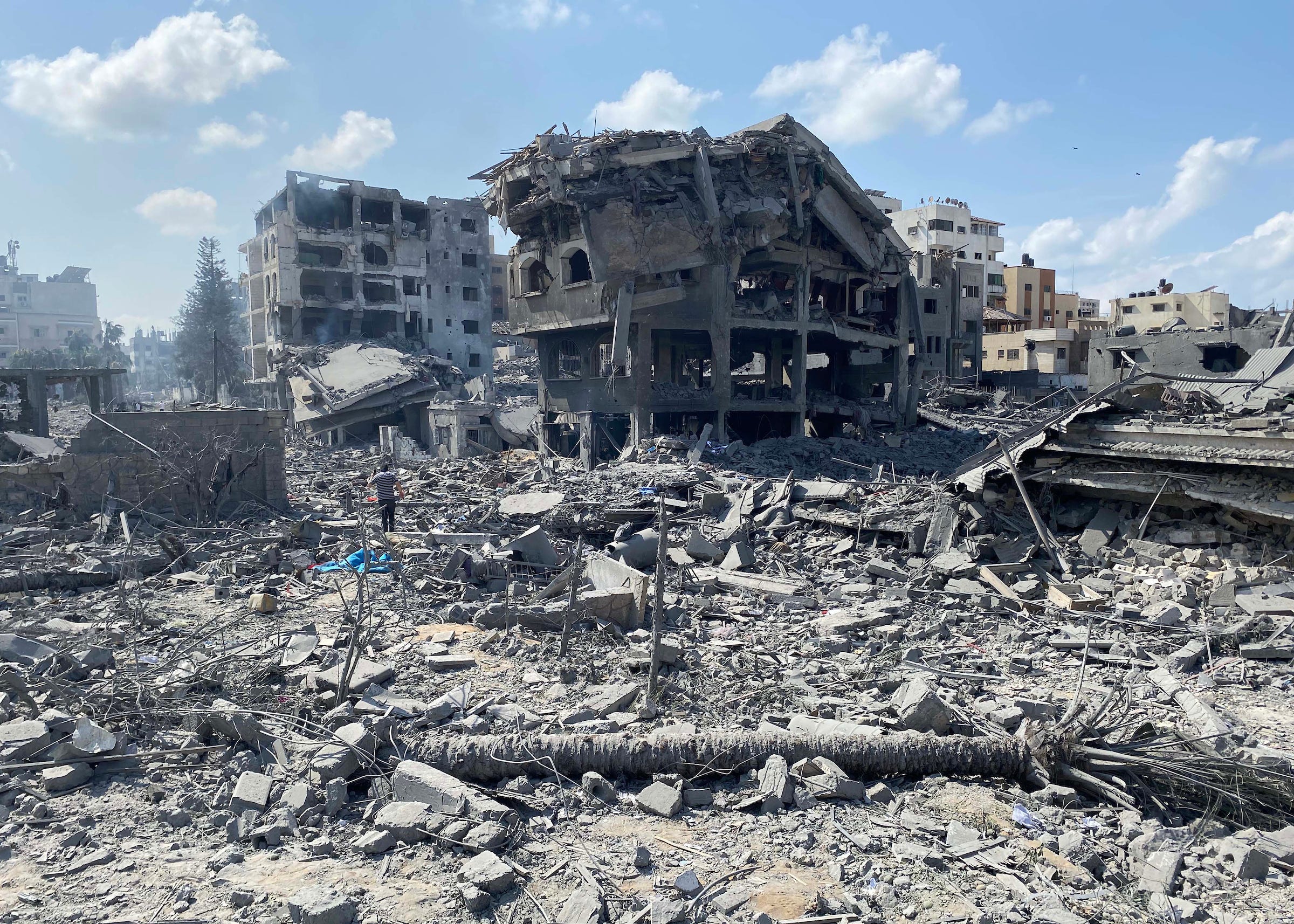
I had not stepped outside my home since 18 March 2025. The day before – 17 March, the final day of the ceasefire – I went on a drive with my father, my sister, and my brother. We drove across Gaza, stopping at every relative’s home, knocking on doors, visiting tents, seeing everyone we could squeeze into a single day. The streets were alive then—the smell of fresh falafel frying in corner shops, the sweetness of knafeh being pulled hot from the oven, the sounds of children kicking a half-flat football down the dusty alleys, girls skipping rope and counting in loud cheerful voices, and the chatter of neighbours passing teacups across their balconies.
I remember the voices of street vendors selling chips, instant noodles, and snacks, their calls echoing through the neighbourhood. We laughed with our cousins, exchanged old family stories, and snapped photos on our phones. That day, the world seemed ordinary, almost safe. By the time we pulled up in the driveway of our home, night had already covered the streets. We were exhausted, but our hearts were light. I never imagined that only a few hours later the massacre would resume, tearing apart the city, our families, and the rhythm of our days. From that moment, I did not leave home for six months.
During all these months, I had no energy to talk to anyone, to listen, to walk. My only remaining strength was barely enough for my university courses. I study English literature at the Islamic University, which now exists only online, its buildings having been destroyed. Any leftover fragments of energy went to my writing, which is my private therapy. Writing is how I survive. It is where I speak when my voice cannot leave my lips, where I release the grief that the walls of my home absorb silently.
Then, in August, my teeth forced me to leave our home.
I had hidden the pain for a week, refusing to admit it, but for three days, I could not close my eyes. The pain was unbearable, a constant pressure that throbbed in rhythm with my heartbeat. On top of this, I was suffering from a severe flu with bone-deep aches, which made everything worse. My immunity was almost zero. Anyone who knows me knows how I struggle with illness, how it takes forever for my body to recover. Every night was a battle between my aching body and my restless mind.
Finally, after enduring days and nights of pain, I surrendered. I agreed to go to the dentist.
Outside Again
That morning, I had no energy even to dress. I forced myself to shower, to put on my black abaya and hijab. My mother disapproved of wearing black on black, but my hands chose it automatically. It felt right, as if my mood, heavy with grief, demanded it. My mother and I stepped outside, and I was immediately met with the first shock: there were no vehicles on the street. Not a single car. The city felt like a graveyard, silent except for distant echoes of destruction.
Every step was heavy. Every street told a story of destruction. Homes I had known, streets I had walked a thousand times, were now shattered and unrecognisable. Dust and rubble clung to my shoes, the heat of the sun pressing down on my shoulders, and every corner whispered of death. I asked my mother, again and again, “When did this happen?”
On the way, I passed the house of my dearest friend Shimaa Saidam, the girl who accompanied me in studying and memorising the Quran. Her house was destroyed. I stopped, frozen. I took a photo only to convince my mind that this was real. I wondered: did she survive, or is this a memory I will never touch again? I remembered her gentle family, our last visit just a week before the genocide, one of the happiest moments of my life. My feet did not want to move, and my heart weighed me down. My mother turned to me, silently urging me to keep walking.
We came to the cemetery, the resting place of my grandparents, my aunt, my uncle’s wife, his children, and my close friends. I stopped. I wanted to cry, but the tears would not come. The wind whispered among the graves, carrying dust into my eyes. All I could do was pray for them, my quiet words ascending to the sky, as I kept walking.
Graveyard Streets
Further along, on the right, I saw my uncle’s house, bombed by Israeli forces on 29 November 2023. I remembered my aunt Asmaa, my uncle’s wife Neeven, and their baby daughter Fatima, only two months old when the genocide stole them. I prayed silently and took another heavy step forward. My legs felt as though they would give up, refusing to carry me further.
Then came the hardest sight of all: my grandfather’s house. Four floors filled with memories, the home that embraced me from birth until the age of fourteen. It had been completely destroyed by multiple missiles from the Israeli occupation on 30 December 2023. Rubble and twisted metal filled the space where walls, floors, and my family once stood. Dust hung thick in the air, and the once-spacious garden was reduced to shattered trees, broken branches, and upturned soil, the trees my grandfather used to water with his own hands now charred and lifeless.
My uncle Abd al-Salam, my cousin Huthaifa, and his daughter Hala were killed there by Israeli missiles. As I stared at the ruins, memories flashed before my eyes like a relentless, painful film. I remembered the sound of laughter, footsteps across the wooden floors, the smell of maqluba cooking in the kitchen, the warmth of family hugs. My chest felt crushed, and the weight of everything made my steps slow and heavy.
We walked for an hour and a half, making our way through the streets of Gaza, until we reached Abu Amra — a small shop that sold almost everything. It was located on a busy main street; people used to stand at its entrance, hoping to catch rides with passing cars. We were desperately searching for any form of transport that could take us further. Finally, we found something: a small car towing a wooden cart covered by a makeshift roof. I did not know what to call it, but I knew it was an invention born from necessity. After we climbed into the cart, I held onto my mother’s abaya tightly. I had never ridden in anything like this before.
Market Road
The cart dropped us off at the edge of the market. We walked three more streets to the dentist. He was late, so we waited for about an hour and a half. I was in the middle of my midterm exams, so I opened my Translation II course on my phone. The pain was too intense to focus properly. I had hoped to use studying as an escape, a way to distract my mind from the painful scenes we had passed on our journey, but I couldn’t concentrate and my thoughts kept returning to what I had witnessed and what we had lost.
Finally, the dentist arrived. He was in his late forties, and ever since I was a child, we had always gone to his clinic — he was our family’s dentist, the one we all trusted for our dental care. The clinic looked the same as it had before the genocide, except for the glass door, which had been broken and was now patched up. His demeanour, although serious, was kind and gentle—he knew I was afraid of dental work and treated me with calm care. He examined my teeth and told me that I had infections caused by my wisdom teeth, which were pushing and carving a space for themselves in my gums, and that was the reason for all the pain I had endured for days.
We left, walking again until we found another cart. I had no energy to protest. I collapsed onto the wooden seat, completely drained by the sun, the walk, the memories. The market was full of faces etched with fatigue, grief, and loss. There were vendors calling out their wares, small stalls filled with goods, and children playing in the streets. The children’s faces haunted me the most — tired before their time, worn down by the weight of a world they should not have inherited.
As the cart moved, my mind did not stop. Everywhere I looked, I saw the people I had lost, the houses I had known, the mosques turned into rubble. Even Al-Farouq Mosque, once so beautiful, was now only a pile of stones. I wanted nothing more than to return home, to lie down, to try to forget what I had seen. I had gone out to fix my teeth, not to carry the burden of an entire city of memories.

Thank you for writing!
Thank you for this piece, translated in French here : https://zanzibar.substack.com/p/voix-palestiniennes-and-voix-du-monde-723