


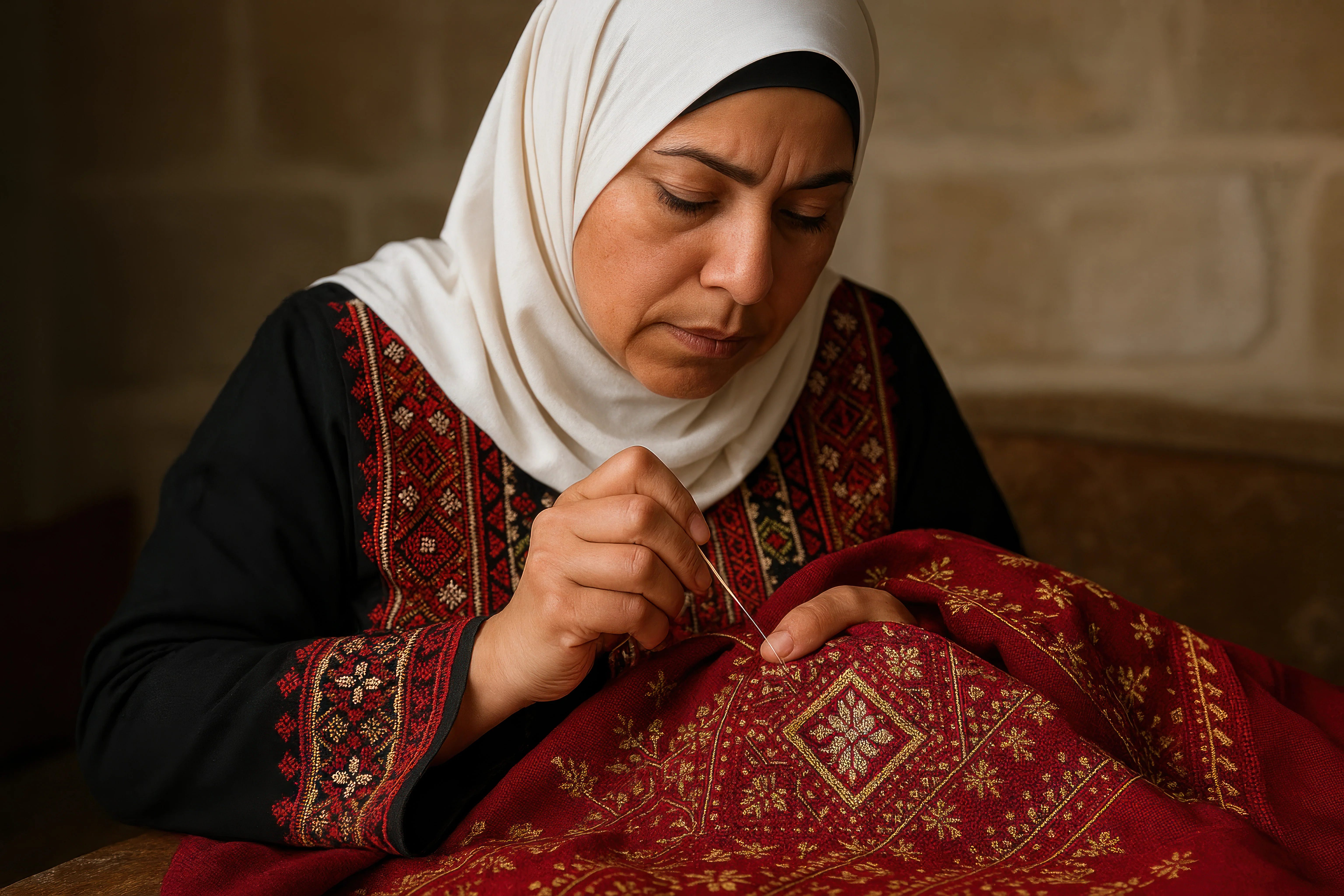
Palestinian embroidery, known as tatreez, is not a souvenir, nor a folkloric performance staged for cultural consumption. Tatreez was never meant to be enshrined behind glass nor reduced to an aesthetic object estranged from lived experience. It was created to be worn, to move with the body, to absorb sweat, dust, and time. To be washed, repaired, and passed from generation to generation.
Because tatreez lives on the body—particularly on the bodies of Palestinian women—it has survived what archives and written histories have often failed to protect. Embroidery stitches threads into patterns, in the way a poem stitches words into meaning, weaving memory, identity, and resistance onto cloth. Tatreez and Palestinian poetry share a common purpose: to preserve what colonialist history has tried to erase.
Long before Palestine was reduced to a political problem or an international dispute, it existed as a space of community and continuity. Generations lived and died on the same land. History did not arrive as a single narrative but as accumulated layers—Canaanite, Roman, Arab, Ottoman—each leaving traces without erasing what preceded it.
Tatreez developed within this layered time. Its motifs did not record rulers or dates but documented presence. Embroidered dresses, shawls, blouses, belts, and other household accessories and objects were made using different patterns from village to village, documenting an intimate, sustained relationship with the land. To study the various styles and stitches illuminates geographies of belonging and remembrance. Today, tatreez continues to parallel the Palestinian voice: each stitch is a part of a larger narrative, each motif a verse in an ongoing poem of survival. This echoes the craft of poets like Mahmoud Darwish and Fadwa Tuqan, whose words are enshrined in memory.
Living Maps
For Palestinian women, embroidery accompanied domestic labour, seasonal rhythms, and social structures. Women embroidered inside homes, between agricultural tasks, during gatherings, and across generations. Tatreez embodied knowledge passed from hand to hand through repetition and observation. Each region developed its own combinations of stitches, reflecting a different relationship to land, labour, and environment. Coastal cities produced patterns shaped by trade and openness; mountainous villages favoured dense, symmetrical designs reflecting settled agricultural life; desert regions allowed freer lines shaped by mobility and harsh conditions.
A Palestinian dress was an emblem of social knowledge: region, marital status, wealth, and community were all readable by the knowledgeable at a glance. Geography was carried on women’s bodies, turning them into living maps. Colour, density, placement, and motif all carried meaning. Unmarried women wore vivid colours; married women softened the palette while increasing the complexity and precision of the stitches; widows wore muted colours to express mourning and restraint. Red signified strength and vitality, black conveyed dignity and gravity, green conveyed land and fertility, and blue served as an amulet of protection. Each stitch had a purpose.
This tradition takes on new weight given the systematic disruption of Palestinian history. Empires ruled and fell, but the most violent rupture arrived with modern colonialism. Land became property; presence required proof. Under the British Mandate, systems of ownership selectively recognised presence. What could not be bureaucratised was erased. Women’s labour, oral knowledge, and domestic practices were rendered invisible within official records.
Then came 1948.
With the Nakba, Palestinians were expelled from their homes. Their history and connection to the land were called into question. Entire villages were destroyed, names erased from maps, archives burned or rewritten. A population with continuous presence on the land was described as temporary or invented. History was not only interrupted but overwritten.
Tatreez responded the only way it could: with quiet persistence.
Stitched Exile
Palestinian women embroidered images of the villages they could no longer return to. Dresses transformed into peripatetic archives. Symbols of the living world became symbols of what was lost. The cypress spoke of endurance in the face of drought. Grapes recalled abundance, generosity, and ancient cultivation. Horses evoked dignity and resistance. The placement of these motifs—whether on the chest, sleeves, or hem—reflected their importance within women’s lives and imaginations.
In refugee camps, embroidery shifted from an embellishment on everyday clothing to an act of intentional preservation. Tatreez became a method of holding onto place when the place itself was inaccessible. Palestinian women learned that erasure occurs through violence and through language—through reframing and denial. What is stolen is labelled as “disputed.” Colonisation is “conflict.” Lives are reduced to “numbers.”
Today the erasure of Palestine is algorithmic. Palestinian grief is flagged as “graphic” or “inflammatory,” while the violent structures producing that grief remain obscured. The story is rarely denied outright. It is atomised and exhausted into silence. Palestinian women especially find that their voices are unheard as they continue to carry memory and care under siege.
Tatreez stands in direct opposition to this logic.
It does not ask to be believed nor require institutional permission. It carries its truth through its patterns. When a stitch is removed, the fabric retains its trace. Knowledge here is not declarative—it is practised.
Threaded Resistance
In contemporary contexts, tatreez continues to evolve. Artists integrate tatreez into metal, sound, installation, and digital forms. These practices do not detach embroidery from its roots. They extend its vocabulary and its reach, reaffirming it as a tool of resistance and continuity. In this way, contemporary artists reimagine embroidery as a living language rather than a static artefact.
However, tatreez is not immune to appropriation. Palestinian patterns are frequently extracted from their context and marketed as “Middle Eastern,” “Mediterranean,” or simply “ethnic.” Aesthetics are preserved but people are removed. This too is erasure.
Yet, the thread resists. Those who carry the knowledge recognise the patterns. Memory circulates outside official recognition, passed from mothers to daughters, from communities to diaspora, beyond the reach of institutional denial. Much like poetry—especially in its oral traditions—these stories are carried in voices as much as in hands, recited, remembered, and reshaped across generations. What cannot be archived in institutions continues to live in rhythm, repetition, and breath.
Tatreez teaches a fundamental truth: history does not survive only in documents. It survives in practice, repetition, and care—the refusal to abandon form when its function is under attack. Tatreez does not offer closure, but continuity. In Fadwa Tuqan’s iconic poem, Enough for Me, she expresses the desire to “melt and vanish into her soil / then sprout forth as a flower.” Her words preserve memory by transforming the physical bond with the land into a cycle of eternal return and rebirth, ensuring that the connection to Palestine is perpetually renewed.
As long as Palestinian women stitch poetry onto cloth and into memory, the story will continue. In a world committed to our obliteration, their hands, continuing to work, make tatreez a beautiful form of resistance. Like poetry, tatreez creates where erasure seeks to undo; both transform absence into presence and silence into something that endures. As Refaat Alareer wrote, “If I must die, you must live to tell my story”—a reminder that survival itself becomes an act of narration and that carrying the story forward is a continuation of both poetry and resistance.

What a beautiful and moving tribute to Palestinian women’s art. Thank you.
Taqwa ❤️
Thank you so much for your beautiful article on the ancient history of tatreez. The poetic nature of each stitch - women stitching and creating an ongoing forever remembering
But so much more
So much more
So much more
🇵🇸🇵🇸🇵🇸🇵🇸🇵🇸