


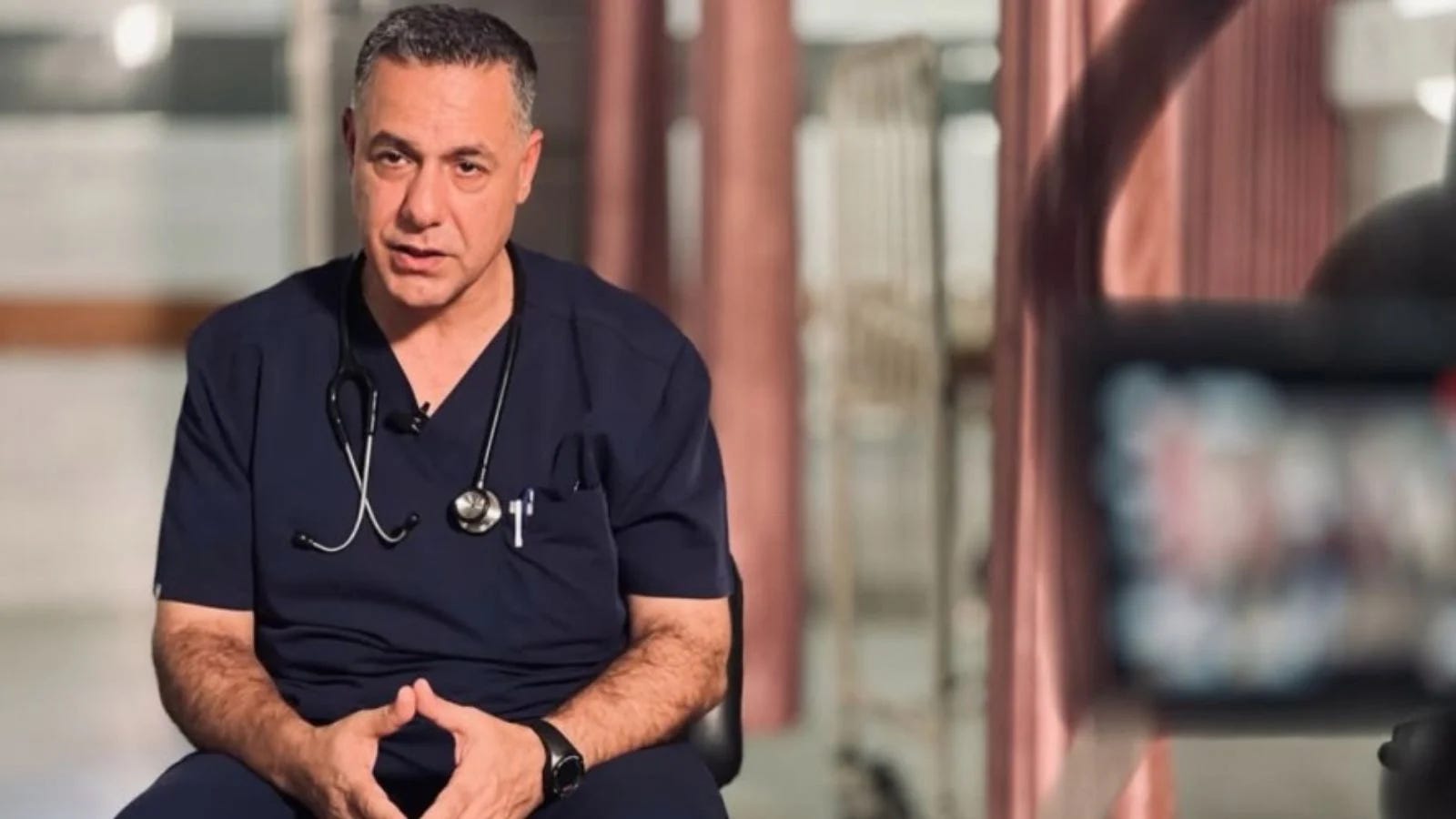
The last time I saw Dr. Hussam Abu Safiya, it was through a screen shaking with war.
He was standing inside Kamal Adwan Hospital, moving between wounded children and exhausted medical staff, his white coat no longer a symbol of calm professionalism but of endurance under fire. Around him, the hospital was no longer just a place of healing—it had become a shelter, a battlefield, and a final line of survival.
Dr. Hussam Abu Safiya is not only a hospital director; he is a paediatrician at Kamal Adwan Hospital in northern Gaza. His medical work was centred on children. According to accounts from his family and legal representatives, the only “charge” repeatedly attributed to his detention was that he remained at his post, refusing to abandon his patients while the hospital itself was under siege. In this sense, his arrest becomes not an exception, but a reflection of a broader pattern: the criminalisation of care itself in a place where healing has been turned into a form of resistance.
In Gaza, we learned to measure time differently. We did not ask what day it was—we asked whether the hospitals were still standing, whether the doctors were still alive, whether someone like Dr. Abu Safiya was still speaking. His presence meant that something in the system had not yet completely collapsed.
Then even that voice disappeared.
The last message we received about Dr. Hussam Abu Safiya did not come from the doctor himself. It came through a lawyer. A lawyer who described Dr. Hussam as being placed in solitary confinement, deprived of essential medication, cut off from the outside world and punished, reportedly, for daring to challenge the extension of his detention. Relying on fragments carried through legal visits should alarm anyone who still believes that medical personnel are protected in war.
For Palestinians, however, his story is about more than one detained doctor. It is about what happens when those who heal become targets.
More Than a Doctor
I remember watching his video messages during the war. Amid the devastation, his face became one of the few constants. He moved through hospital corridors surrounded by wounded children, speaking calmly about shortages, attacks, and impossible choices. He looked exhausted, but he remained.
He first became widely known as the director of Kamal Adwan Hospital in northern Gaza. During some of the most intense phases of the war, he became a familiar presence: exhausted but determined, documenting the collapse of a healthcare system under relentless pressure. While many institutions were destroyed, he remained. While bombs fell, he remained. Even after losing his son on 25 October 2024, he remained.
For many of us, he came to represent something larger than a hospital director. He represented the refusal to abandon life itself. In a place where death had become routine, he insisted on saving lives. In a place where hospitals were being dismantled, he insisted on keeping one alive.
Those inside Kamal Adwan recall that his presence, alongside the medical staff, was not symbolic—it was strategic. Their decision to remain, despite repeated evacuation pressure, helped sustain one of the last functioning medical facilities in northern Gaza and contributed to preventing the complete depopulation and forced displacement of northern Gaza. In that sense, the hospital became an anchor for civilian life in a collapsing system.
Imprisoned Healer
Against this backdrop, his detention since December 2024 is widely seen as part of a broader effort to dismantle not only Gaza’s health system but also the remaining structures that tether people to place and survival.
That is what made the image of his detention so striking: a doctor in a white coat moving through rubble toward military vehicles. A healer walking into captivity.
I remember seeing that image and wondering what it said about our world. What does it mean when a doctor becomes a prisoner while those responsible for destroying hospitals act with impunity? What does it mean when the people trying to save lives are treated as threats?
Since then, months have turned into more than a year.
According to his lawyer, Dr. Abu Safiya has been transferred to solitary confinement and denied necessary medical care despite chronic illness. His isolation appears designed not only to confine him physically but to sever his connection to the world beyond prison walls.
Solitary confinement is often described as a prison within a prison. The use of solitary confinement in his case, according to critics and human rights observers, reflects a severe form of dehumanisation. It is seen as part of a wider trend in which Palestinian medical workers are not only detained but isolated in ways that strip them of dignity and visibility. In this context, the targeting of doctors is widely interpreted as an attempt to silence those who could testify to what has taken place inside Gaza’s hospitals.
Reports from former detainees and human rights organisations describe Palestinian prisoners being held in cells measuring roughly two by two metres, often without windows or natural light, and with minimal bedding. Allegations of beatings, electrocution, rape, and other forms of ill-treatment have also been documented. Within such conditions, detainees are said to be deprived of basic dignity and due process.
Targeting Doctors
Cases such as that of the late Dr. Adnan Al-Bursh, who died in custody under circumstances described by rights groups as involving torture and medical neglect, are frequently cited as warnings about the risks faced by detained medical professionals. These accounts have intensified urgent questions among rights groups and observers: how many more doctors must suffer or die before effective international action is taken, and before safeguards for medical personnel are meaningfully enforced?
In his most recent communication, the doctor—through his lawyer—was said to have sent a message to his son, Elias, urging him to contact the Palestinian journalist Anas al-Sharif. Yet what makes this message deeply tragic is that Dr. Abu Safiya was reportedly unaware that Anas had already been killed in August 2025. The journalist had been assassinated by Israel months earlier. The result is a devastating rupture between memory and reality under conditions of total isolation.
According to his son, Elias Abu Safiya, the 52-year-old doctor has been enduring severe and deteriorating conditions in detention, including deprivation of medical care and food. He said that after prolonged isolation, his father was only able to meet his lawyer after around 90 days, with the family receiving no direct updates in between. Each message, he added, is received as though it may be the last.
The detention of Dr. Abu Safiya cannot be viewed as an isolated case; rather, it reflects a wider pattern involving the systematic weakening of the medical personnel and institutions that are responsible for keeping Palestinians alive.
The case of Dr. Abu Safiya also reflects trends documented by human rights organisations and journalists, in which detainees describe prolonged isolation and extreme restrictions. One striking example is that of Palestinian journalist Mohammad Arab, detained since March 2024, who reportedly asked his lawyer to describe his own facial features after more than two years without seeing himself in a mirror. Such accounts illustrate not only physical confinement, but a deeper form of erasure—where prisoners are deprived even of the most basic connection to their own identity.
Struggle to Survive
International humanitarian law explicitly protects medical workers and hospitals during conflict. Yet in Gaza, hospitals have been bombed, medical staff killed or detained, and the health system pushed to the brink of collapse. These developments have raised serious questions among observers about the gap between legal protections and reality on the ground.
In a place where every remaining doctor is urgently needed, the loss of medical leadership carries consequences far beyond any single case. This is not the removal of an individual from a functioning system, but the weakening of a system already struggling to survive.
And yet Dr. Abu Safiya has become more than a physician in detention. He has become a symbol—not because he sought it, but because his presence represented something increasingly rare: the refusal to abandon care amid overwhelming destruction.
Perhaps that is why his story resonates so deeply. Dr. Abu Safiya reminds us that even amid genocide, there are people who choose humanity. Even amid destruction, there are people who choose care. Even amid despair, there are people who refuse to surrender their moral responsibility to others.
It is also a reminder that behind every headline, there is a family waiting. A son, such as Elias, waiting for news of his father. A family forced to interpret silence as information. And a doctor who, even in detention, remains defined by the same identity that placed him at risk in the first place: not a combatant, but a healer.
And if the world remains silent while a doctor is denied freedom, medical care, and basic human dignity, then it is not only Dr. Abu Safiya who is being abandoned. It is the principle that those who save lives should never become targets.
And until he is free, the questions his case raises will not go away.

This is just inhumane and unbelievable that we're living in such horrific world. May Allah ease his and his family's pain and give him peace. Why is the world still silent?
yes,
here in my home no day goes by without prayers for this courageous doctor and his colleagues, his family, those with whom he suffers under brutality, the journalists everyday reporting yet more horrors, the intrepid ambulance drivers and the brave civil defense people rescuing victims of yet another bombing......may there be PEACE AND RESTITUTION NOW.