


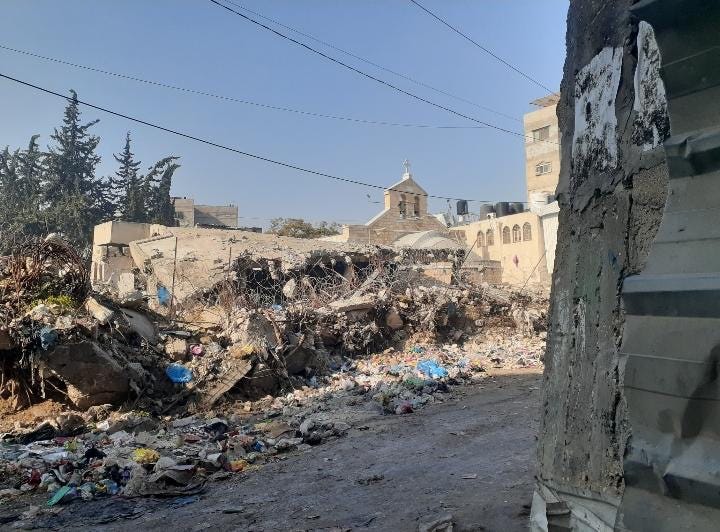
According to UNESCO, 164 cultural sites across Gaza have been damaged by Israeli strikes since 7 October 2023. Each site tells part of a larger story. Together, they tell the story of a people whose presence on this land stretches back millennia.
That is why the destruction of these places feels so devastating. It is not simply that Gaza is losing ancient churches, mosques or markets. It is that Palestinians are being forced to watch the physical evidence of their history disappear before their eyes.
The first time I visited Gaza City’s old quarter after months of displacement, I found myself searching for landmarks that had guided me my entire life. The Great Omari Mosque. Saint Porphyrius Church. Al-Zawiya Market. The gold market. For generations, these places were more than buildings. They were points of reference in our daily lives, repositories of memory and reminders that Gaza’s story stretches far beyond the wars that have come to define it in international headlines. What I found instead were ruins.
Since October 2023, the world has witnessed Israel’s destruction of homes, hospitals, schools and universities across Gaza. Less attention has been paid to another target of this genocide: the cultural and historical landmarks that connect Palestinians to their past. This destruction is often discussed as collateral damage. It is not.
Cultural Erasure
What has happened to Gaza’s churches, mosques, markets and archaeological sites is part of a broader assault on Palestinian existence itself. A people can be displaced. They can be starved. They can be killed. But they can also be erased by severing their connection to history, memory and place.
The Orthodox Church of Saint Porphyrius, believed to be the third-oldest church in the world, stood for centuries in Gaza City’s al-Zaytoon neighbourhood. It survived empires, invasions and wars. There are approximately twenty Christian homes standing around this church.
At Saint Porphyrius Church, more than 400 people crowded into the ancient stone halls, hoping the walls that had stood for so many years would hold. Just a few hundred metres down the street, the Latin convent next to the Catholic Holy Family Church offered refuge to another 500. Two communities, two churches, the same desperate search for safety.
That safety did not last. The church was targeted by an Israeli strike on 19 October 2023, killing 17 Palestinian Christians who were sheltering there. It was the first time in history that this church had been targeted.
On 16 December 2023, gunfire cracked through the courtyard of the Holy Family compound. An Israeli sniper shot and killed two Christian women as they moved inside the church grounds where they were sheltering.
The violence returned 19 months later. On 18 July 2025, an Israeli artillery shell hit the Holy Family Church directly. Three Christians sheltering there were killed in the strike: Saad Salama, 60, who had worked for years as the parish janitor; Fumya Ayaad, 84, an elderly woman who was receiving psychosocial support in a Caritas tent on the grounds; and Najwa Abu Dawood, 71. What began as sanctuaries for Gaza’s small Christian community turned into places marked by loss, twice over.
Sacred Ruins
For many outside Gaza, churches and mosques represent separate communities. In Gaza, they often represent something else: coexistence. Saint Porphyrius was not merely a Christian landmark. During previous wars, it opened its doors to displaced Muslim families. It was a symbol of a city whose social fabric was woven from shared suffering and shared survival. When such a place is destroyed, the loss cannot be measured only in stones and walls.
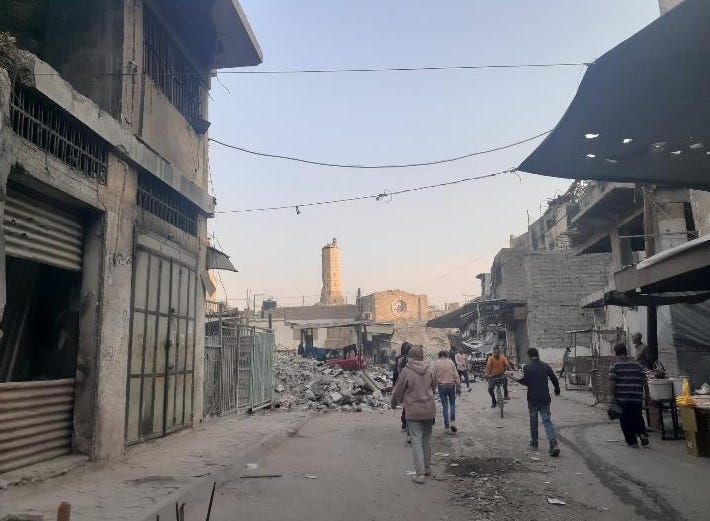
Just a short distance away stood the Great Omari Mosque, Gaza’s most important mosque and one of the oldest in Palestine. For centuries, its minaret dominated the skyline of the old city. Generations learned to pray there. Children played in its courtyards. Families arranged their lives around it.
The Great Mosque of Gaza — al-Omari Mosque, a 1,400-year-old landmark named after Caliph Umar bin al-Khattab — was struck twice in late 2023. It sustained partial damage to its minaret on 19 November, then was left in a near-ruinous state after further bombardment on 8 December.
Nearly two years later, on 6 November 2025, crews began clearing rubble from the site in Gaza City. Salvaged stones were set aside for future restoration, and the courtyard was reopened for worship. For Palestinians, places like the Great Omari Mosque are not tourist attractions. They are living institutions that carry the memories of countless lives. To destroy them is to attack the continuity between past and present.
Living Markets
The same is true of Gaza’s historic markets. Without the Omari Mosque, the market loses its spirit. Long before Gaza became synonymous with siege and war, al-Zawiya Market was the beating heart of the city. Its narrow alleys connected traders, craftsmen and families across generations. Since October 2023, al-Zawiya Market has been hit again and again. Israeli airstrikes and artillery pounded the market until entire rows of buildings and shops collapsed into rubble. Today, about 75 percent of it is gone.
This was not just any market. Al-Zawiya used to hold everything. It was a cluster of smaller markets inside one: grain stalls, spice souqs, apothecary shops. It was where people bought their daily bread, their medicine, amid the smell of cumin that told you that you were home. It was where Gaza shopped, traded, and lived its daily life. What’s left now is a skeleton of what it was.
Tucked into one corner of al-Zawiya Market sits Gaza’s gold market. It contains 120 jewellery shops beneath arches that look as though they were carved to last forever. It is an architectural masterpiece and the only one of its kind in the Strip. It’s called Qaysariyya, a name borrowed from the Roman era for industrial and commercial arcades. Local history says it was built in 1476.
But like so much in Gaza, it has lived many lives. After the Nakba in 1948, when Zionist militias and later the Israeli state expelled most Palestinians from their land, the gold market was emptied. It sat quietly. By the 1950s it had been turned into a shoemakers’ market. That lasted until 1968, when Gaza’s economy started breathing again and gold slowly found its way back.
The real shift came in 1970. Palestinians from Gaza were allowed to work inside occupied Palestine. Wages came home. But there were no banks, no stable currency to trust. So people did what people have done for centuries: they saved in gold. That’s what turned Qaysariyya around. By the early 1980s it was Gaza’s central hub for jewellery. There was nowhere else like it. No gold market in the north, centre, or south. Just this one. More craftsmen came. Renovations were made. By the 2000s the market gleamed again. Then the genocide began in October 2023.
Against Oblivion
The gold market was hit repeatedly. The worst came on 4 July 2024, when an Israeli strike bombed the arcade. The blast tore through the shops and even damaged the nearby Great Mosque of Gaza. Today, around 30 jewellery shops have been completely destroyed or burned out. The rest are being patched up by the traders themselves, with their own hands, under the same arches that have stood for more than 500 years.
These places remind Gazans of their fathers and grandfathers, and of their childhoods spent among the market’s alleys. They reminds us how we lost part of ourselves after so many of these places were destroyed. That is because heritage is not separate from human life.
Too often, discussions of cultural destruction create a false choice between people and buildings, as though concern for one diminishes concern for the other. But the destruction of heritage matters precisely because it affects people. Buildings become meaningful because generations fill them with stories, traditions and memories.
Yet even amid the rubble, people continue to pray at the Great Omari Mosque. Merchants continue to reopen damaged shops. Christians continue to gather at Saint Porphyrius. These acts may appear small, but they carry enormous significance. They are declarations that Gaza’s history cannot be erased as easily as its buildings can be demolished.
Israel may destroy stone, wood and marble. It may reduce centuries-old landmarks to rubble. But memory survives through the people who carry it. And as long as Palestinians continue to remember these places, tell their stories and rebuild what has been destroyed, Gaza’s history remains alive.

Destruction of architecture, communities, institutions, and homes is an important to the Israeli genocide as the murder of Palestinians. Israel wants all history of Palestine gone so the only story left will be the lie about an Israeli homeland, 3,000 years old. Truly an evil culture.
I actually just wrote something eerily similar, but through a different historical lens—the Roman practice of "damnatio memoriae". Thank you for highlighting the broader implications of erasing Palestinian history and their connection to the past.
To me, the attempt to erase Palestinian culture and memory is one of the most horrfic forms of violence. It's an attempt to erase not only people, but the stories, places, and history that prove they were there. That's why preserving those memories matters so much.
If anyone is interested, I'd love for you to check out my latest post on "Damnatio Memoriae" and how this ancient Roman practice reverberates in modern realities of suppression.