


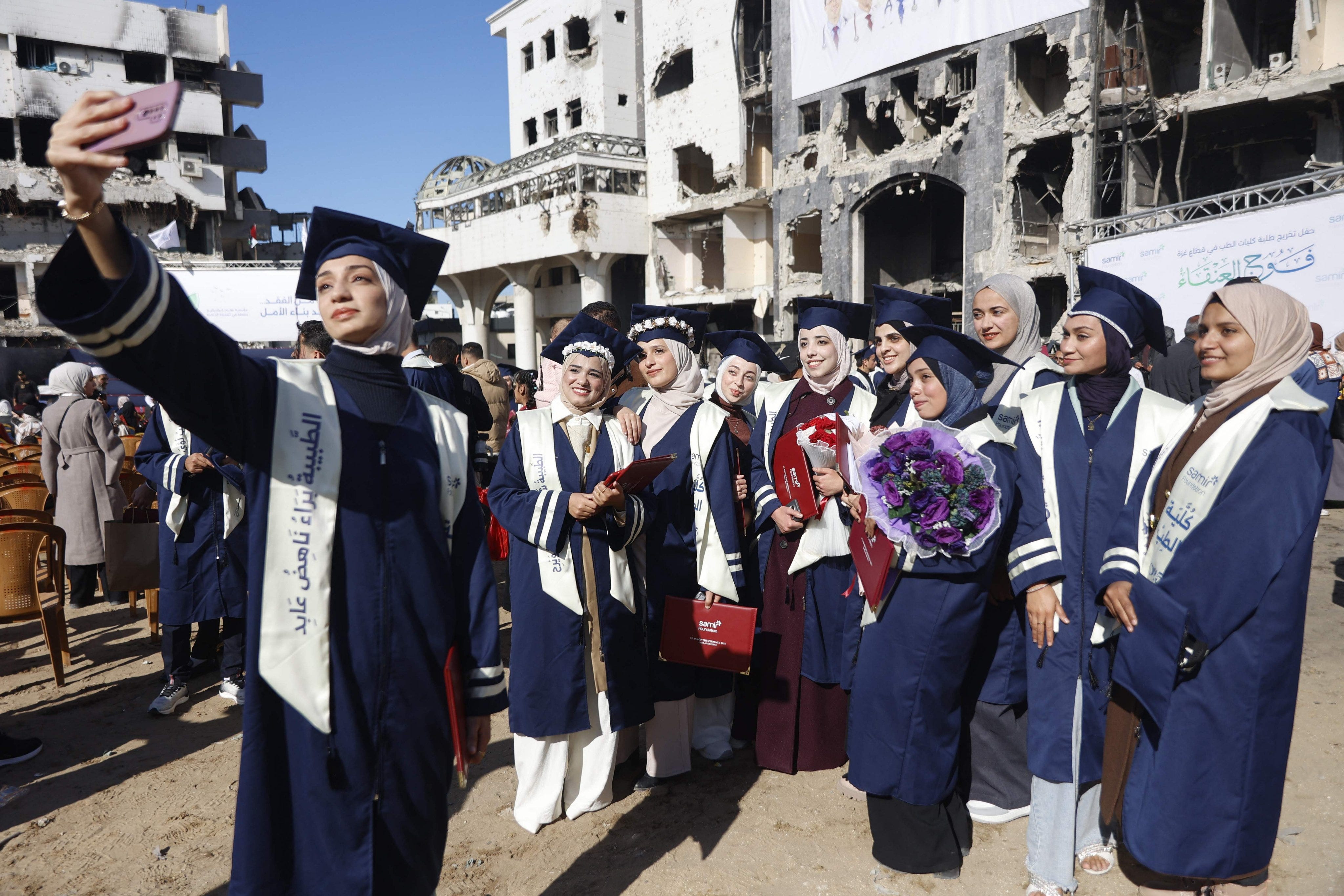
On Saturday morning, 3 January 2026, my family and I set out early for Al-Shifa Medical Complex in Gaza. The journey felt heavy with contradictions. We were heading toward a place that once symbolised healing and survival, but was now surrounded by ruins and charred buildings - the remains of incessant Israeli bombardment. Burned wards and collapsed walls stood as undeniable evidence of ruthless Israeli attacks on healthcare infrastructure, amounting to medicide under the conditions of the ongoing genocide. We were not heading there in grief or for treatment; we were going to celebrate life.
On that Saturday morning, families filled the courtyard of that devastated space. Their faces were radiant, hands clasped, shoulders brushing, eyes searching the stage. Jubilance surfaced where silence had long lived. Tears came, but this time, they carried pride. Across the rows, parents straightened their posture as graduation gowns appeared against the rubble, phones raised, breaths held. Pride did not need to be named; it rested openly on faces that had learned how to survive loss. The graduates moved forward carefully, step by measured step, their gowns sweeping ground still scarred by destruction. My sister was among the graduates.
I attended the graduation ceremony from its first moment to its final oath. I watched it unfold slowly, deliberately, as if time itself had decided to pause and pay attention. What I witnessed went far beyond a graduation—it was an act of collective resistance, memory, and hope—a declaration that Gaza’s future would not be written solely by those who sought to destroy it.
The ceremony marked the graduation of 230 medical students—men and women—who began their studies in September 2019 and completed them in September 2025. Their education was stitched together across years shaped by siege, repeated military escalations, wars, collapse, and genocide. While medical students elsewhere measured their progress by exams and rotations, these students measured theirs by survival.
They studied while bombs detonated. They revised lecture notes during displacement. They trained in hospitals operating far beyond capacity, without sufficient electricity, medication, or safety. They learned medicine amid emergencies rather than controlled environments, a reality that blurred the line between classroom and battlefield. Some lost homes. Some lost family members. All buried classmates before earning their degrees.
Yet they persisted. As one graduate said: “We didn’t just learn medicine—we practiced it while losing people we loved.”
The Phoenix Cohort
The graduation ceremony was organised and supervised by the Samir Foundation, an institution established in memory of Samir Lulu, the martyred father of its Executive Director, Dr. Ezz El-Din Samir Lulu. Rather than allowing loss to end his father’s story, Dr. Ezz El-Din transformed it into a mission: supporting medical students and strengthening Gaza’s healthcare system through scholarships, mentorship, and essential resources.
The foundation’s work is rooted in a belief that medical education is inseparable from dignity, and that sustaining healthcare in Gaza is a form of resistance against erasure.
Unofficially named “The Phoenix Class of 2025,” the graduating cohort included students from Al-Azhar University and the Islamic University of Gaza. In its statement, the Samir Foundation declared: “Their journey, marked by perseverance and excellence despite extraordinary challenges, stands as a testament to their commitment and to carrying forward the legacy of their fallen colleagues.”
The word fallen was not symbolic. It was literal.
The ceremony opened with remarks by Dr. Abdul Karim Samour, who welcomed the audience with language that captured the gravity of the moment: “We welcome you all to the graduation ceremony of the medical faculties—The Phoenix Cohort. A cohort that chose to rise from beneath the rubble, to make pain a beginning rather than an end.” This was no rhetorical flourish—it described reality.
Dr. Rania Mansour followed, grounding the ceremony in faith and ethical responsibility: “Praise be to God who never abandons a patient heart, who does not waste sincere effort. Praise be to God who heals, through His grace, those who have lost hope in medicine and remedy. He honoured physicians so that through them, suffering may be lifted.”
A Qur’anic recitation by Dr. Ziyad Al-Shawa followed. His voice filled the open courtyard with verses from Surah Al-Hashr: “Not equal are the companions of the Fire and the companions of Paradise. The companions of Paradise—they are the successful.” The words echoed against damaged walls, offering a moral contrast between atrocities and perseverance—between those who annihilate and those who heal.
When the announcer called the graduating doctor, Dr. Sojood Ahmed Al-Wawi, the moment felt suspended between the personal and the collective. She was my sister—but she was also one of hundreds who had refused to disappear. She moved forward with the procession of graduates, her name called among hundreds of others. From where we sat, we watched her step ahead with the others, and our faces radiated with smiles we could not hold back. Pride passed quietly through us. She had earned this moment through years of effort and persistence; she was someone who had worked diligently, endured, and arrived.
The Wreckage of Days
I recorded a short video when her name was announced and shared it on my Instagram story, a small act of documentation for a memory we knew we would want to return to. In the final part of the ceremony, we joined her beside the stage and took a family photograph together—images that felt almost unreal in their beauty. These were moments we had waited for a long time, and when they finally arrived, they carried more meaning than words could fully hold.
As I stood among families clutching certificates, photographs, and memories, it became clear that the ceremony honoured both those present and those who should have been there.
The Palestinian national anthem followed—an anthem for a homeland occupied for decades, besieged for nineteen years, subjected to two years of systematic genocide, and yet still insisting on life. As President of the Samir Foundation, Dr. Ezz El-Din Samir Lulu delivered one of the most emotionally resonant speeches of the day. Turning to his mother, Ms. Hanadi Skaik, he said: “She is my mother—the lady of my heart and the refuge of my soul. She strengthened me and made me lean on her determination, not on the wreckage of days.”
The audience understood immediately: this was not only a personal tribute. He was revering Palestinian mothers everywhere—women who have held families together under bombardment, displacement, and grief.
Speeches followed from Dr. Raghad Hassouna, representing the graduates, and from medical faculty members Dr. Anwar Sheikh Khalil and Dr. Adnan Al-Ajrami. Their words emphasised that these graduates emerged as both doctors and witnesses—trained under conditions that demanded moral clarity as much as technical skill.
Dr. Youssef Abu Al-Reesh, representing the Ministry of Health, spoke of a generation shaped through catastrophe rather than stability. As one faculty member put it simply: “They were students and first responders at the same time.”
Passion of the Heart
Between speeches, traditional dabke performances by Asa’el Troupe erupted into the space—an insistence that joy, culture, and heritage remain alive. One of the most haunting moments came through an AI-produced video honouring martyred medical workers—doctors, nurses, paramedics killed while saving others.
Around the destroyed surgical building, organisers had written: “We walk in your footsteps and continue the path of medicine and humanity.” Photographs of fallen medical students surrounded the ceremony under the words: “They were with us on the road, but absent from the graduation stage.”
The absence was tangible.
A special musical tribute by Hamoud Al-Khudher followed. His voice carried across the ruins:
“Welcome, dream—where have you been all this time?
How beautiful you are, fulfilled in my hands…
Between you and me there was a test—
Its hardship passed, and everything endured.”
One line lingered above all others: “A Gazan never fails when passion lives in their heart.”
Then, the ceremony’s grand surprise was announced: The Samir Foundation, in collaboration with HCI, said it would support the Phoenix Class throughout their internship year with a comprehensive program, including monthly financial assistance starting after Ramadan. The initiative is rooted in sustainability, not charity—ensuring that Gaza’s doctors can continue their mission and rebuild a devastated healthcare system.
Across social media, images of the ceremony spread rapidly. Commentators described it as “an unbelievable miracle.” Gaza’s official symbol—the phoenix—was invoked repeatedly. The phoenix, it is said, burns only to rise again from its ashes. And there, in the ruins of Al-Shifa, Gaza rose once more. This moment was a declaration of continuity. A refusal of erasure. A promise that Gaza’s future remains its own.

Beautiful!🤩
“To God Be The Glory..”
…”Pray Without Ceasing.”—-1st Thessalonians
…”DEFEND YOURSELVES, ATTACK, ATTACK, ATTACK.”
…”When “God”.”…tells You.”…”Move.”….
…”MOVE YOUR A$$!