

By Ahmed Dremly
For the past two weeks, 18-year-old Mohammed Alaa has been walking for more than three hours each day to reach a café with a reliable internet connection so he can sit his final high school exams online.
Mohammed lives with his family of six in their partially destroyed home in the Al Sahaba neighbourhood in eastern Gaza City. Like most families in Gaza, they have had no electricity or stable internet connection since the Israeli military campaign in Gaza began in 2023.
“I always thought the final year of high school would be the most important year of my life because it would help me achieve my dream of studying business administration at university,” Mohammed said. “But with the ongoing Israeli war on Gaza, studying has become another kind of suffering.”
His father, Alaa, who used to help him study every day, was killed in an Israeli airstrike in December 2024.
“My biggest supporter was my father. He even used to teach me. Losing him made everything much harder.”
Besides losing his father, Mohammed has lost more than 25 relatives during the war, including his grandfather, cousins and three close friends.
He was also injured in an Israeli airstrike while fetching water during the first days of the war, although his injuries were minor.
Against Everything
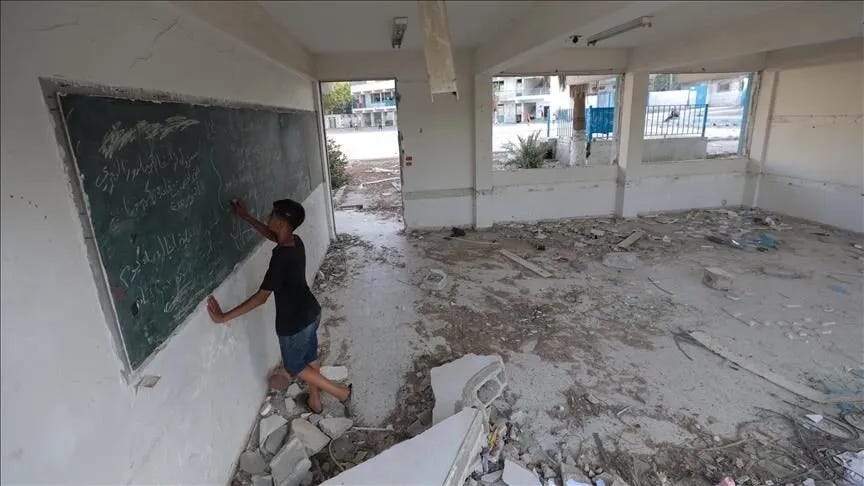
Despite everything, he has continued studying, carrying his textbooks with him through repeated displacement while constantly searching for somewhere quiet enough to prepare for his exams.
His family’s 80-square-metre apartment has become home to three families after two of his uncles lost their houses earlier in the war. The overcrowded conditions make it almost impossible for Mohammed to find a quiet place to study.
“Most of my studying happened after midnight, when everyone else in the house was asleep,” he said. “I studied by the light of my phone’s flashlight or a candle. During the day, I was always exhausted because I couldn’t sleep properly with the constant noise and the buzzing sound of the drones overhead.”
Although his family tried to make studying his priority, Mohammed insisted on helping them with daily survival.
“My family always wanted me to rest and eat well because I was studying, but I still fetched water and collected firewood. I have one brother, and my three sisters are younger than me.
“Sometimes I was studying while hiding my tears because I was hungry, stressed, missing my father, or thinking about our financial situation. Sometimes I needed to buy books or paper, but they were too expensive. Still, I knew I had to continue because my whole family had placed their hopes in me.”
Mohammed used to go to a café or visit friends whose homes have solar panels to download his online lessons or study for a few hours.
“Every time I walk through the streets, I’m afraid I could be killed in an airstrike before I even reach the café. But I have no other choice.”
Alongside his studies, Mohammed works part-time in his cousin’s accessories shop to help support his family. The income also allows him to pay for private tutoring, educational centres and internet access in cafés or temporary learning spaces powered by generators or solar energy, where students can connect to online classes and exams.
Online Exams
The Ministry of Education in Gaza announced that this year’s final high school examinations would begin on 20 June. This marked the first time since October 2023 that students in Gaza were able to sit the exams alongside their peers in the occupied West Bank.
Because most schools in Gaza have been destroyed or damaged by Israeli attacks, students completed their examinations through the online platform Wise School.
For the third consecutive year, the examination process is taking place under the shadow of war. Thousands of students have faced displacement, electricity cuts, unreliable internet access and constant security risks while trying to complete their exams.
Mohammed is one of more than 37,000 students in Gaza sitting this year’s examinations. According to the Ministry of Education and Higher Education, another 1,941 Gaza students are currently abroad, while 51,499 students are taking the exams in the occupied West Bank.
Not everyone managed to finish.
“Some of my friends were unable to complete their exams because the internet disconnected while they were taking them,” Mohammed said. “I walked for miles and hours to sit in a café with a better connection, but even there the internet sometimes failed. I also kept my mother’s phone with me on standby in case mine ran out of battery.”
“I was taking my exams while worrying about the questions, worrying about my family, and wondering whether I would even make it back home alive. The bombing never stopped.”
Raghad’s Dream
Those fears became even more real after Mohammed learned that 17-year-old Raghad Ashour had been killed in an Israeli airstrike while walking to study at an educational institution along a route similar to the one he regularly takes.
Raghad was on her way to study at an educational centre near her family’s makeshift tent in central Gaza City on Monday, 22 June, when an Israeli airstrike killed her.
Displaced from Beit Hanoun in northern Gaza, Raghad had always been an outstanding student. Shortly before her death, she had earned first place in a competitive scholarship programme in artificial intelligence.
“Her education was always her highest priority, despite the fear, displacement and constant airstrikes,” said her uncle, Jamal. “She dreamed of going to university and finding a job so she could help support her family financially.”
Raghad grew up without her father, who was killed in an Israeli attack in 2011 when she was nearly two years old.
Jamal visited the family’s tent at least once a week. The day before the strike, he had spent the afternoon with them.
“She made us mint tea, and we sat together talking about ordinary things,” he recalled. “Now I visit her mother and four brothers every day. We talk about our memories of her because we still cannot believe she is gone. We miss her deeply.
“Raghad was the princess of our family, like a daughter to me. She was kind-hearted and sensitive. She was always helping her family and was not only a loving daughter but also one of her mother’s closest friends.”
According to the Palestinian Ministry of Education, Raghad is among at least 19,100 school students and 1,379 university students who have been killed in Israeli military attacks since October 2023.
Jamal said the family hopes the international community will act to end the war.
“We want the world to put pressure on Israel’s far-right government and Netanyahu to stop this genocidal war. The people being killed in Gaza are innocent civilians. We don’t want to live through any more war; we want to live in peace.
“We want to return home in peace and rebuild Gaza, Beit Hanoun, Rafah, Al Shujaya and every part of Gaza.”
At least 1,052 Palestinians have been killed and 3,406 wounded in ongoing Israeli military attacks on Gaza since the ceasefire agreement on 11 October 2025.
Narrow Escape
Alongside Raghad, other people were also on the same street when four Israeli airstrikes hit the area, including eight-year-old Reta Ajour and her five-year-old cousin, Naya, who were standing just a few metres from one of the cars that was hit.
The girls, who are displaced and living on Al Wihda Street, about a kilometre away, walk every day to a nearby school in the Al Rimal neighbourhood with one of their relatives. On that day, Reta’s 10-year-old sister, Lolo, had come to walk them home.
“A parked car happened to be between the girls and the vehicle that was struck, shielding them from most of the shrapnel. If it hadn’t been there, they would almost certainly have been killed,” said Sami Ajour, 35, Reta’s father. “Lolo was injured by shrapnel in her leg, while Naya suffered shrapnel wounds to her head.”
Sami was at work as an accountant for a company in the southern Gaza Strip when his wife called to tell him what had happened. He paid a tuk-tuk driver three times the usual fare to take him back to Gaza City so he could reach his daughters.
“When I arrived and saw the site of the strike, I couldn’t believe they had survived something so close,” he said. “At the same time, I kept thinking about the girl who was killed. She could have been any one of our children.
“They are still living in fear after everything they experienced. Every loud sound, a passing car, gunfire or the constant buzzing of drones, terrifies them. They refused to leave their mother’s or my side, and they refused to return to school for several days.”
Sami’s wife now spends the entire school day with them.
“My wife stays with them at school until the end of the day because it helps them feel a little safer. We encouraged them to go back because the war has already caused enormous disruption to their education. There is no real difference in safety between school and home; danger is everywhere.
“What have our children done to deserve this? They deserve to live safely, to play, to learn, and not to be killed.”
Teaching Hope
For Arabic language teacher, Saja Hijazi, 28, who has worked at an educational institution for the past seven years, both the education system and the role of teachers have changed dramatically since the war began.
“Before the war, we helped students understand the curriculum alongside what they learned at school and supported them in their daily lives. Now, for many students, we have become their only source of education because most of them have no mobile phones or reliable internet access to study online.
“We also have to support our students psychologically and encourage them to keep learning and hold on to hope despite the constant loss, fear, hunger and displacement that we, as teachers, are also living through.”
Saja teaches more than 200 students. She says many are struggling with serious disruptions to their education and difficulty concentrating, particularly those who have lost family members or been injured in Israeli attacks. Despite these challenges, she says most students and their families remain determined to continue learning.
“My house was bombed; I have been displaced several times, and I have lost many relatives, just like so many other families in Gaza; so I understand what my students are going through. I try to be patient with them, give them the space to express themselves, and remind them that they deserve a better future.
“Each student in Gaza has a story of loss and hardship, but they still want to learn.”
Saja believes that continuing to teach despite the ongoing Israeli war is itself an act of resilience. She says her students, family and colleagues give her hope that education can help build a better future.
“Education is the foundation of every society. Entire generations of children and young people in Gaza are being deprived of their right to education and to live in safety because of the ongoing war.”
Ahmed Dremly is a journalist from Gaza whose writings have appeared in Middle East Eye, Mondoweiss, The Electronic Intifada, Palestine Deep Dive, The Intercept, Al-Monitor and others. He is currently studying in Italy after leaving Gaza in May 2026.
Hi
I saw the interview about the Sanad initiative for the education for Gazas student to continue learning. It would be great to know how and where to send funding to help with this.
Thank you for your excellent work towards us understanding the situations for the people subjected to this horrific human created suffering.
This article made me cry for all Gazzans especially the children who deserve better lives and better future. May Allah grand them victory, may Allah wipe out all and everyone who caused pain and suffering on this earth. God is watching 😡😡😡