


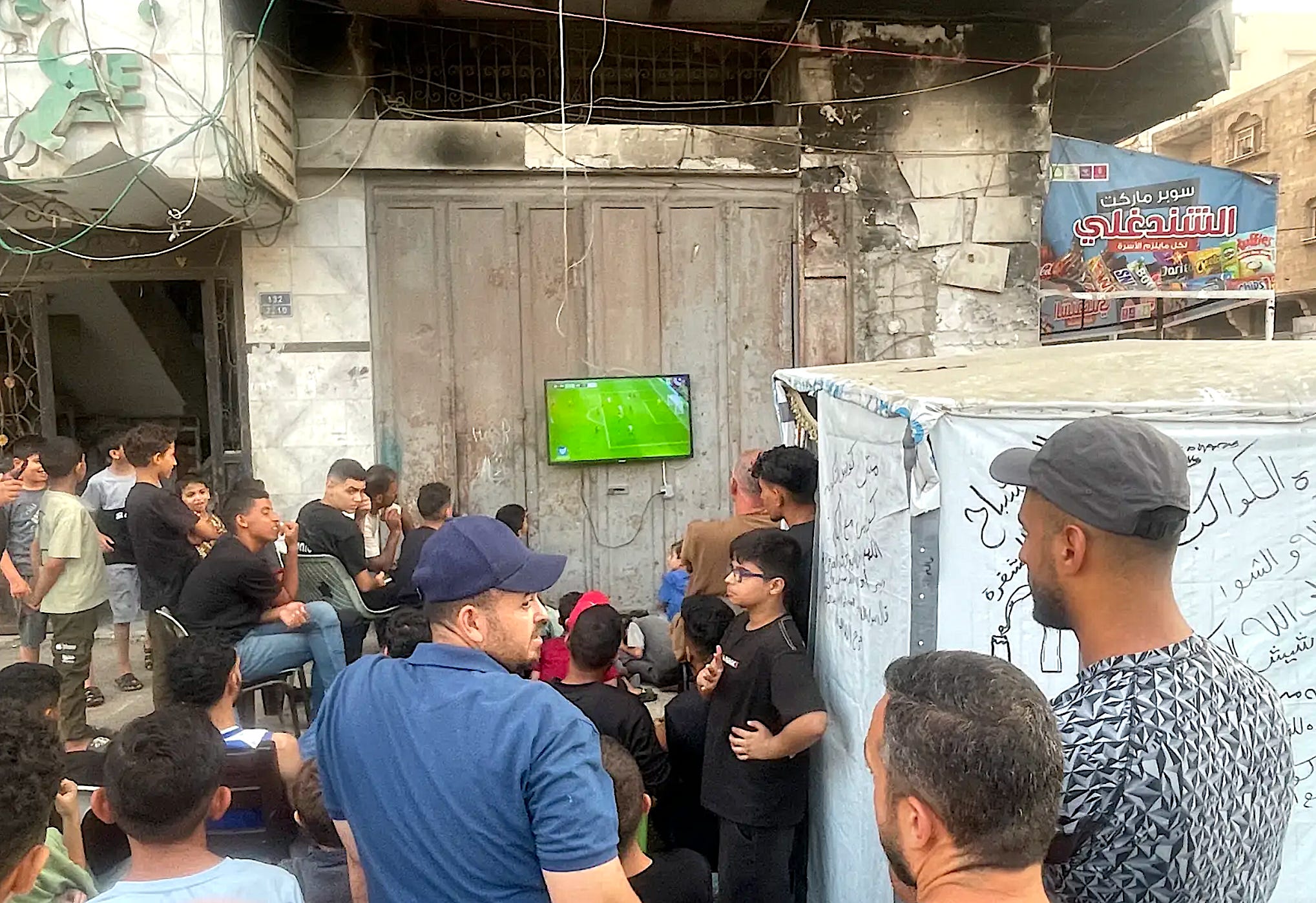
For as long as I can remember, football has been more than a sport in Gaza. Families gathered around television screens to watch the World Cup, children spent hours playing in neighbourhood streets and on local pitches, and aspiring players dreamed of representing Palestinian clubs and the national team. Since the beginning of the genocide, however, those routines have been profoundly disrupted. Football pitches have been destroyed, players have been displaced, and even watching a match has become difficult amid the daily struggle for survival.
Mohammed Hatem Taher Aliwa, 24, is the founder of Gaza Al-Irada, Gaza’s amputee football team, and is part of a ten-member family. Before his injury, Aliwa was a football player living in the Shejaiya neighbourhood in eastern Gaza City.
“Football has been part of my life since I was a child; it was my life and soul,” Aliwa recalled. “On 9 September 2018, I participated in the Great March of Return protests and was shot in my right leg by Israeli occupation forces.”
“When I was shot, I entered a coma for a few days, and when I woke up, I didn’t find my leg,” Aliwa continued. “My whole life changed, and it took me more than four months to get used to the crutches and walk again.”
Despite losing his leg, Aliwa refused to leave football behind. He continued playing for several clubs and represented the Palestinian amputee national team in international tournaments.
“I proved to myself that losing my leg would not stop me from playing football,” Aliwa said. “I even played in the Turkish amputee football league when I was able to travel. However, since the beginning of the genocide, I have not been able to travel and continue my career.”
When the genocide began, Aliwa was displaced more than twelve times. After fleeing his home in Shejaiya, he moved between different areas across Gaza. “My family could not bear the life of tents, so we risked our lives to live in the Al-Daraj neighbourhood near the yellow line,” Aliwa added. “During the genocide, we could not practise and everything stopped.”
Playing On
When a ceasefire was announced in January 2025, Aliwa decided to establish Gaza Al-Irada, a football team for amputee players. “Because the Israeli occupation violated the ceasefire, I couldn’t continue establishing the team,” Aliwa said. Despite this setback, the team was officially founded on 1 January 2026 with 20 amputee players. “I established the team because there are many amputees in Gaza, and we have the right to play football like everyone else,” Aliwa added.
For Aliwa and the other amputee players in Gaza, access to medical supplies remains one of their greatest challenges. “We need prosthetic limbs and crutches,” Aliwa said. “I have been waiting for more than two years to undergo another surgery on my leg, but I still have not been able to receive it.” He continued: “People around the world should not look at us with sympathy because we are amputees, but rather like any other football team. We are professional players who need support to continue playing.”
Aliwa’s story is one of several that illustrate how football in Gaza has been reshaped by displacement, destruction, injury, and loss.
Mohammed Abu Al-Mezha, 24, is an accountant from the Al-Nasser neighbourhood in Gaza City. During the genocide, he was displaced several times across the Strip. “I evacuated to Al-Jalaa Street, the Sheikh Radwan neighbourhood, the Al-Suweidi area, and Deir Al-Balah,” he told me. “Since I was five years old, I have been playing football in my neighbourhood, school, and clubs.”
“At first, football was just a hobby, but I always hoped to become a professional player,” Abu Al-Mezha added. “In 2015, I played for Al-Jazeera Club for a few weeks, and later I played for a week for Palestine Club … I participated in school tournaments and local championships organised by the Ibn Baz Association.”
His ambitions were interrupted when he broke his leg. “When my leg was broken, I had to stop playing for months and abandon my hopes of playing competitively,” Abu Al-Mezha continued. “After my injury, I only played with my friends, and we used to rent football pitches two or three times a week just to enjoy ourselves.”
“I was always afraid of injuring my leg again, so I never pushed myself too far,” Abu Al-Mezha said.
Priced Out
Although his injury changed the way he played football, the sport remained central to his life. Abu Al-Mezha had never missed a match in the previous World Cups. “Since 2014, I have watched almost every international match in the World Cup,” he said. “Football was never something you watched alone.”
“During the Qatar World Cup, people waited for the matches and celebrated together,” Abu Al-Mezha added. “I would gather with friends at cafés or watch them with my family at home.”
Since the genocide began, Abu Al-Mezha’s relationship with football has been disrupted, just like every other aspect of daily life. “I stopped playing from October 2023 until the ceasefire was announced in January 2025,” Abu Al-Mezha explained. “During the genocide, I had no time for football as I was busy searching for water, going to the market, collecting firewood, working, and evacuating.”
For Abu Al-Mezha, remaining in northern Gaza also meant losing access to many of the places where he had once played. “Around 90 percent of the football pitches in northern Gaza were completely destroyed,” he explained. “The first match I played was during Ramadan 2025, when my friends and I rented a pitch for around $80 just to gather and play for an hour.”
Abu Al-Mezha believes that, these days, football has become a luxury in Gaza. “Booking a football pitch costs around $70, while buying football boots and a shirt would cost more than $100,” he explained. “A new football pitch recently opened near Al-Shifa Tower in the Al-Nasser neighbourhood, but renting it costs more than $90 per hour.”
“I consider myself lucky as I have recently returned to playing football once a week,” Abu Al-Mezha said. “Football was an escape for people in Gaza and that escape has been taken away from us.”
“When I see people around the world celebrating the World Cup while we cannot even watch a match in Gaza, it hurts,” he continued. “Life is not fair.”
For others in Gaza, even following football from a distance has become increasingly difficult.
Watching Afar
Abdulrahman Ayman Shallah, 21, completed his high school exams during the genocide after the Israeli occupation targeted his home and killed his mother. He is currently working at a supermarket in the Al-Shama area in eastern Gaza City, near the yellow line.
“I have been displaced since I lost my home in December 2023,” Abdulrahman said. “My family now lives in a tent in the Zawayda area while I remain working in Gaza City to support my family.”
Before the genocide, football was a constant part of Abdulrahman’s life. “I had never missed a match for Real Madrid,” Abdulrahman said. “I had watched the entire 2022 World Cup in cafés with my friends or at home with my family.”
“For the 2022 World Cup final, I watched the match at home with my family and my uncle’s family,” he continued. “My brothers, cousins, and the whole family gathered to watch the match.”
Abdulrahman was so passionate about football that he would even stay awake until dawn just to watch a match. “In the 2021 Copa América final, I stayed awake until 3:00 a.m. to watch the match,” Abdulrahman added.
Like thousands of people in Gaza, Abdulrahman has lost much of what once made football special. “I lost several friends whom I used to watch matches with during the genocide,” Abdulrahman continued.
For Abdulrahman, following football has also become increasingly difficult. “During this World Cup, I have only been checking the final scores,” he explained. “I work until late in the evening, so by the time I finish, I am exhausted.”
“Even if I had time, I don’t have access to electricity or internet, which makes watching football impossible,” Abdulrahman said. “If I want to watch a match now, I have to watch it on my phone, and to get an internet connection, I have to sit outside in the street.”
For Abdulrahman, watching people around the world celebrate football while Gaza remains under bombardment leaves him with mixed emotions. “It hurts to see everyone enjoying the World Cup while we cannot watch it or live like other people,” he said. “I hope that one day the Palestinian national team will qualify for the World Cup so we can be like every other country in the world.”
Despite years of displacement, destruction, and interrupted lives, football continues to represent something worth holding on to for many people in Gaza. Some still search for a place to play, while others follow matches by checking final scores on their phones. At the same time, amputee players continue training despite the lack of prosthetic limbs and medical care.
Their stories show that football is not only about competition. It is also about community, belonging, and the determination to preserve ordinary moments of life under extraordinary circumstances.
