


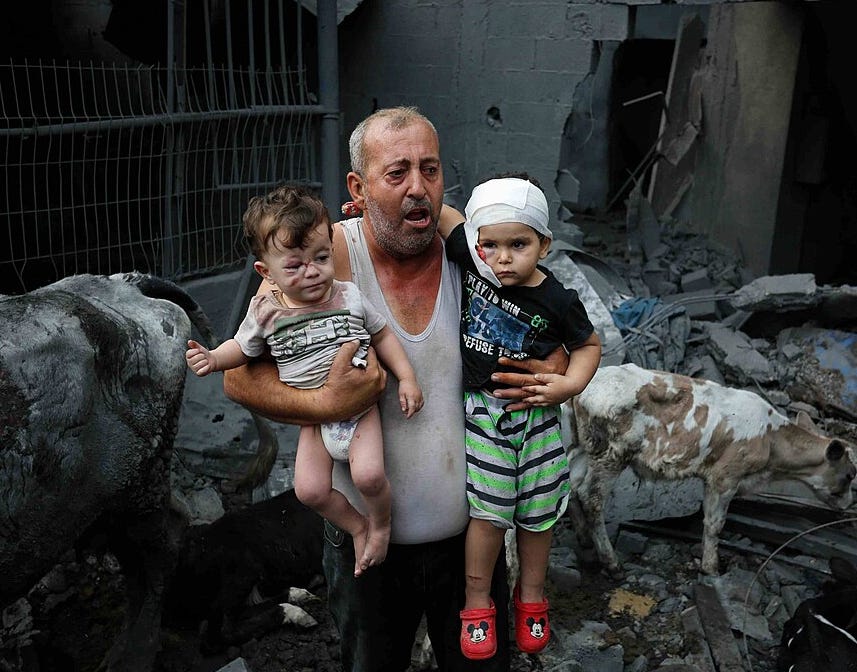
The world often treats Gaza as breaking news. A strike. A death toll. A statement. A headline. Then another crisis emerges elsewhere, and Gaza slips once more into the background. But what is happening in Gaza today is not a fleeting development, nor a daily update, nor a routine conflict. It is the continuation of a catastrophe that has entered its third year, a reality so relentless that even the extraordinary has become ordinary.
There is no ceasefire in Gaza. Israel has killed more than 950 Palestinians in Gaza since the so-called ceasefire was announced in October 2025, pushing the territory’s death toll above 72,000, according to Palestinian health authorities. That means Israel has killed an average of over four people a day in Gaza since the so-called ceasefire was announced.
Despite repeated references to a “ceasefire” reached in late October 2025, Palestinians in Gaza continue to be killed almost every day. Air strikes, artillery shelling and targeted attacks remain a constant feature of life. Every morning brings new names to the lists of the dead and wounded. Every evening leaves families wondering whether they will survive until dawn.
As if this reality were not cruel enough, Israel has once again shut all crossings and halted the entry of vital humanitarian aid following the recent escalation with Iran, further tightening the siege on more than two million Palestinians already struggling to survive.
People are killed in streets, apartments, displacement camps and crowded markets. Entire families disappear within minutes. Survivors emerge from the rubble only to discover that they have become the sole remaining witness to their family’s existence.
Endless Killing
At the same time, the space available for survival continues to shrink.
Today, roughly two million Palestinians are compressed into just 30 percent of Gaza’s territory. The rest is either occupied, militarised or designated under expanding “Yellow Line” and “Orange Line” restrictions imposed by Israel. Families are repeatedly displaced from one overcrowded area to another, carrying what remains of their lives in plastic bags and torn suitcases.
The humanitarian crisis deepens with every passing day.
At Al-Aqsa Martyrs Hospital, operating rooms have stopped functioning after Israel blocked the entry of fuel and generator oils needed to keep critical infrastructure running. Other departments face imminent closure. Across Gaza, a healthcare system already shattered by months of attacks is now collapsing under the weight of shortages.
Hospitals report a 50 percent deficit in medicines, a 60 percent shortage of essential medical supplies and the depletion of laboratory stocks required for basic diagnostic tests. Thousands of patients suffering from cancer, chronic illnesses and severe war injuries are waiting for medical evacuation abroad, knowing that every day of delay may be the difference between life and death.
Meanwhile, one of Gaza’s most prominent physicians, Dr. Hussam Abu Safiya, has reportedly been transferred to solitary confinement in Nafha Prison. His crime is that he continued treating patients while Gaza’s hospitals were under siege.
The imprisonment of a doctor who refused to abandon the wounded is emblematic of a reality in which not only patients are targeted, but those who attempt to save them.
Empty Pots
The hunger crisis has become equally devastating. The World Central Kitchen, whose community kitchens became a lifeline for vast numbers of Palestinians, has significantly scaled back its operations. For many families, those kitchens represented the only reliable source of food.
Only weeks ago, Palestinians gathered in the streets carrying empty cooking pots in protest against worsening hunger. The image was painfully simple: empty hands holding empty pots.
Behind it lies a reality of soaring poverty, near-total unemployment and the collapse of income sources across Gaza. Families search desperately for flour, cooking gas and basic necessities while prices continue to climb beyond reach.
Even money itself has become inaccessible. With banking systems crippled and cash liquidity nearly exhausted, Palestinians often pay enormous commissions simply to access their own savings. The cost of withdrawing money can consume a significant portion of what little remains, transforming every purchase into another struggle for survival.
Stolen Futures
Yet beyond the statistics are the stories that reveal the cruelty of this reality. A few days ago, a young Palestinian named Mohanad Ferwana was preparing for what should have been the happiest day of his life. His wedding day. But he never made it to the ceremony. An Israeli strike targeted his tent in Khan Younis and burned him alive on the morning he was meant to marry.
He never wore his suit. He never saw the guests arriving. He never watched his bride, Asmaa, walk toward him in her white dress. His wedding became his funeral. “The joy of my life was today,” his mother cried. “It was the joy of my life, but they took him from me.”
In Gaza, genocide does not only kill people. It kills futures. It kills celebrations. It kills the ordinary milestones that make life worth living.
Happiness itself becomes a target. Killing happiness is one face of the genocide. Every attempt to rebuild, every effort to celebrate, every small act of normalcy appears fragile under the shadow of constant violence.
Inherited Absence
Another story emerged days later after an attack near the al-Jawazat area in western Gaza City. A young father who had spent the previous day celebrating the birth of his first daughter was killed before he had the chance to know her.
One day he was distributing sweets and smiles. The next day he was carried as a martyr. His daughter opened her eyes to the world only to discover that the first thing taken from her was her father. He did not have time to memorise her face. She will never have the chance to remember his voice.
This reminds me of the story of journalist Yahya Sbeih, who was killed shortly after the birth of his daughter Sana—only managing to see her for a few fleeting minutes before he was taken from her in the al-Tilandi massacre. These are not isolated tragedies. They have become a repeating pattern in Gaza, where children are born into life already marked by absence, and where parents are killed just as their families begin.
In each case, a life is reduced to a brief moment of meeting before it is violently cut short, leaving behind a child who will grow up knowing their parents only through photographs, stories, and the weight of absence.
Today, eight-year-old Jad Suleiman was killed while returning home from school in Jabalia Refugee Camp. He was still wearing his school bag. His father clutched the bag and cried, “Jad is gone. He is gone.”
People often speak of the children killed in Gaza, but they rarely understand what it means to raise a child here. Parents dream of graduations, birthdays and futures, only to find themselves carrying white coffins instead. Jad should have returned home from school with stories from his day. Instead, he became another child whose future was taken before it had the chance to begin.
World’s Silence
This is the reality in Gaza behind the headlines. A reality in which children are orphaned before they learn to speak, couples are separated before they begin their married lives and parents bury sons and daughters while trying to convince themselves they can endure another day.
The tragedy is not only what is happening. It is how the world has learned to absorb it. Daily death tolls are consumed as statistics. Images of destroyed homes pass quickly through social media feeds. Expressions of concern are issued while policies remain unchanged.
But no amount of repetition can make this normal. No number of days can make mass displacement normal. No passage of time can make hunger normal. No political language can make the destruction of hospitals normal. And no future historical explanation will erase what is being done today.
The reality in Gaza remains brutally simple. People are being killed every day. Families are being displaced every day. Hospitals are collapsing every day. The genocide continues every day.
What Gaza requires is not more statements of concern but meaningful pressure, accountability and action. Because history will not remember how many press releases were issued. It will remember who acted and who remained silent.
As the Arab poet, Amro Al-Zubidi, wrote:
“You would have been heard had you called out to the living,
But there is no life in those you are calling.
If you had blown upon a fire, it would have illuminated,
But you are only blowing into ashes.”
No ocean can ever wash away what Israel has done to the Palestinians in Gaza. And no silence can erase the truth.

This is how Isr@el wants it. Ever since 1948. Conceal the destroyed villages with forests. It’s always been about deception and rewriting the narrative
https://austinsikora.substack.com/p/what-your-life-is-worth?utm_source=share&utm_medium=android&r=32cg97 What is a life worth? Depends who died. That's the problem. #Politics #Gaza #WarCrimes