


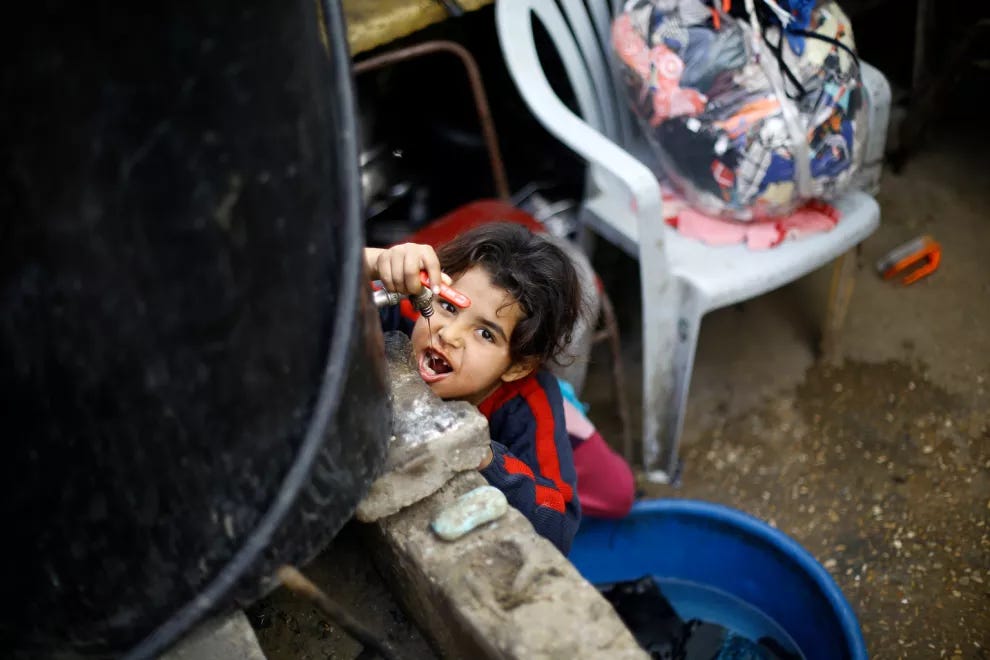
Access to clean water in Gaza has collapsed during the genocide, turning a basic necessity into a daily struggle for survival. Damage to water infrastructure, fuel shortages, repeated disruptions to desalination facilities, and the targeting of water distribution systems have left hundreds of thousands dependent on limited and often unsafe sources of water. For many families, obtaining drinking water now requires long journeys, hours of waiting, and difficult choices between health and survival.
Mohammed Al-Ghoz, 30, a father of two children, Rakaan, 4, and Yamaan, 2, lost his home and access to his neighbourhood of Al-Tuffah in eastern Gaza City. “My wife gave birth to two children during the genocide, and she needed special medications, food, and water, but almost nothing was available,” Mohammed said.
Before the genocide, potable water was easily accessible. “I used to fill my 500-litre barrel within a few minutes for $3,” he recalled. “Sometimes, I bought mineral water just to be healthier. I had never imagined there would be a water crisis in Gaza.”
When Mohammed evacuated from his home on 13 October 2023 to Deir al-Balah in central Gaza, he left carrying only one bag of belongings. He expected water to be available in the south, but quickly discovered otherwise.
“I thought water would be available in southern Gaza, but because of the massive displacement, people were fighting over bottles and competing to fill containers from the water shipments,” he said. “I bought a 20-litre gallon for $22 just so I could fetch water.”
Every day, regardless of the season, Mohammed woke before dawn to secure a place in line.
“Even in winter, I had to wake up around dawn to get in the queue so that when the water truck arrived at the camp, I would have a chance to get some water,” he explained. “In July 2024, potable water was non-existent in my area, so I had to walk more than two kilometres toward Al-Aqsa Martyrs Hospital to fetch water for my son.”
Jaundice
According to Mohammed, even water produced by desalination facilities was not always considered safe, particularly for pregnant women. During this period, thousands of people in southern Gaza were infected with jaundice, locally known as Regaan.
“When I asked a friend who was working as a doctor at a medical point in a nearby refugee camp, he told me that many of these cases were caused by drinking contaminated water,” Mohammed said. “The water produced by desalination plants relies on seawater, and sewage has been flowing into the sea because infrastructure was destroyed.”
Faced with those conditions, Mohammed worried constantly about his family’s health.
“I could not allow my wife to continue drinking water from water trucks and risk my son’s life,” he said.
When the current ceasefire was announced in October 2025, Mohammed returned to Gaza City and moved into his aunt’s apartment in Al-Shati camp. Yet access to water remained a daily burden.
“Living in my aunt’s apartment was physically exhausting because I had to carry potable water every day, but I had no other alternative,” he said. “Eight months have passed since the announcement of the ceasefire, and nothing has changed.”
Since the beginning of the genocide, access to water has remained uncertain. Water shipments, which have become the primary source of potable water for much of the population, have been targeted on multiple occasions. Even during the so-called ceasefire, in April 2026, two water truck drivers supplying residents in eastern Gaza near the yellow line were killed while working at a water distribution point.
“Although fetching potable water from water trucks is not safe, I have no other option,” Mohammed said. “The entire Strip depends on these water shipments.”
Daily Struggle
Like Mohammed, Bader Shallah, 20, has spent much of the genocide searching for water. A member of a six-person family, Bader has been displaced since 13 October 2023 and now lives in a tent in the backyard of a school in Deir al-Balah.
“I am responsible for fetching potable water for my family, so I walk hundreds of metres every day searching for a water shipment to fill our gallons,” Bader said.
By July 2024, the desalination plant serving the Deir al-Balah area had stopped operating because of severe fuel shortages. Access to safe drinking water became increasingly restricted, forcing many families, including Bader’s, to rely on non-potable water to survive.
“It was first my sister who was infected with Regaan,” he said.
Regaan, the local term for jaundice, causes the skin and eyes to turn yellow because of a build-up of bilirubin in the blood. Often associated with Hepatitis A, the condition became increasingly common across Gaza during the genocide amid worsening sanitation conditions and shortages of clean water.
To prevent the disease from spreading, Bader’s family stopped sharing food and drinks with his younger sister. Despite their precautions, he became infected two weeks later. “I do not know whether I was infected by my sister or somewhere else. The disease was spreading everywhere,” he said. “At first, my eyes and face turned yellow, and I couldn’t get off my mattress.”
The illness left him severely weakened. “My mother used to prepare my favourite meals no matter how much they cost, but I kept throwing up everything I ate,” Bader recalled. “I suffered from severe diarrhoea and was too weak to go to the bathroom alone. Someone always had to accompany me.”
Treatment options were extremely limited. “My only medicine was sweets, which were scarce and unimaginably expensive,” he continued. “My father bought one kilogram of honey, which cost $8 before the genocide, for more than $40.”
Bader believes contaminated water played a major role in his illness. “I remained sick for two weeks, unable to eat or do anything,” he said. “My father bought mineral water for me because the water from the water shipments only made my condition worse.”
Even during the current ceasefire, he says the disease continues to spread. “I know three individuals from a nearby camp who were infected with Regaan just a few days ago,” Bader said.
Chronic Illness
For people with chronic health conditions, the consequences of Gaza’s water crisis can be even more severe. Waael Yousef Bader, 60, a father of seven, purchased a new home in the Sudania area in north Gaza only four months before the genocide began. He was forced to evacuate on the first day and has never returned. “My home was completely destroyed,” Waael said. “I have evacuated seven times within Gaza City.”
Before the genocide, Waael worked for the Ministry of Transportation. He had also lived for years with a transplanted kidney. “In 2006, I was diagnosed with renal failure, and I underwent a kidney transplant in 2007,” he said. “Everything I needed was available—medication, proper food, and clean water. Since the beginning of the genocide, my situation has worsened.”
Access to food, water, and medicine quickly became limited. “What affected me most was water,” he explained. “I had no access to mineral water or malt drinks, both of which were important for my condition.”
On 15 January 2024, his health deteriorated and he required urgent medical intervention. “Fluid began to accumulate around my transplanted kidney because I lacked proper food and access to clean, filtered water,” he said.
At the time, obtaining treatment in northern Gaza was extraordinarily difficult. “Everything was impossible to find because there were no functioning hospitals or adequate medical teams,” Waael said. “Getting medication or medical assistance from the south was an immense struggle because the road between northern and southern Gaza had been cut.”
Laboratories in northern Gaza were no longer functioning. “When I first became ill, I went to Al-Shifa Hospital hoping to receive a diagnosis, but there were no specialists available to assess my condition or drain the fluid around my kidney,” he said.
After searching extensively, Waael located a radiologist who agreed to help. “He inserted a drainage tube into my abdomen to remove the fluid,” Waael recalled. The procedure was performed without anaesthesia. “There was no anaesthesia available during the procedure, and I suffered unbearable pain,” he said.
Despite the hardship, the procedure was unsuccessful. “The fluid was not fully drained, and after some time the tube stopped functioning,” he explained. “The fluid accumulated again, and I needed a second procedure.” By then, Al-Shifa Hospital had been destroyed, and he could no longer reach the same doctor through normal channels.
Contamination
After three weeks of worsening pain, Waael managed to contact the radiologist again and underwent a second procedure, also without anaesthesia. “The fluid eventually came out in large amounts, filling the drainage bag several times,” he said. “Medications for my condition were barely available, and mineral water could not be found anywhere.”
Before the genocide, Waael underwent monthly kidney function tests. With hospitals and laboratories no longer operating in northern Gaza, that routine became impossible. “I couldn’t find any laboratory operating in northern Gaza,” he said. “I was forced to drink non-potable water that was not suitable for human consumption.”
According to Waael, contaminated water had the greatest impact on his health. “I have lived with a kidney transplant for seventeen years and had never experienced serious complications,” he said. “Yet within the first three months of the genocide, I began suffering from fluid accumulation, largely because of the contaminated water I drank and the lack of essential medication.”
With no specialised hospitals available to treat his condition, he eventually made the difficult decision to leave Gaza. “On 28 April 2024, I evacuated to Egypt seeking medical treatment abroad,” he said. “To preserve my life, I had no choice but to leave.”
His family, however, remains in Gaza. “The situation remains the same,” Waael said. “People are still drinking contaminated water, and the food and medicine entering the Strip remain insufficient.” He fears many others with serious medical conditions have been unable to survive. “Many people are still suffering from conditions similar to mine and lack medical care and access to safe drinking water,” he said. “I do not know whether those people are still alive, but I believe many of them did not survive because they required urgent treatment that they could not receive.”
Although a ceasefire has been announced, Gaza’s water crisis remains far from over. Damaged infrastructure, shortages of fuel and repair equipment, and continued dependence on water shipments leave many families without reliable access to safe drinking water. For people across Gaza, the struggle for clean water continues to shape daily life, while the health consequences of contaminated water remain a constant threat.

“This is UNACCEPTABLE!
It's none less than Holocaust, a cruel sadistic Holocaust in which every method is used, to kill humans. 98% of this "civilization" watch idle, while the global politicians help the mass murder of 2 million civilians. Europe keeps shameless lying, nothing changed, their support for "Ishrael" goes on, they arrest the people who stand up for Palestinee