


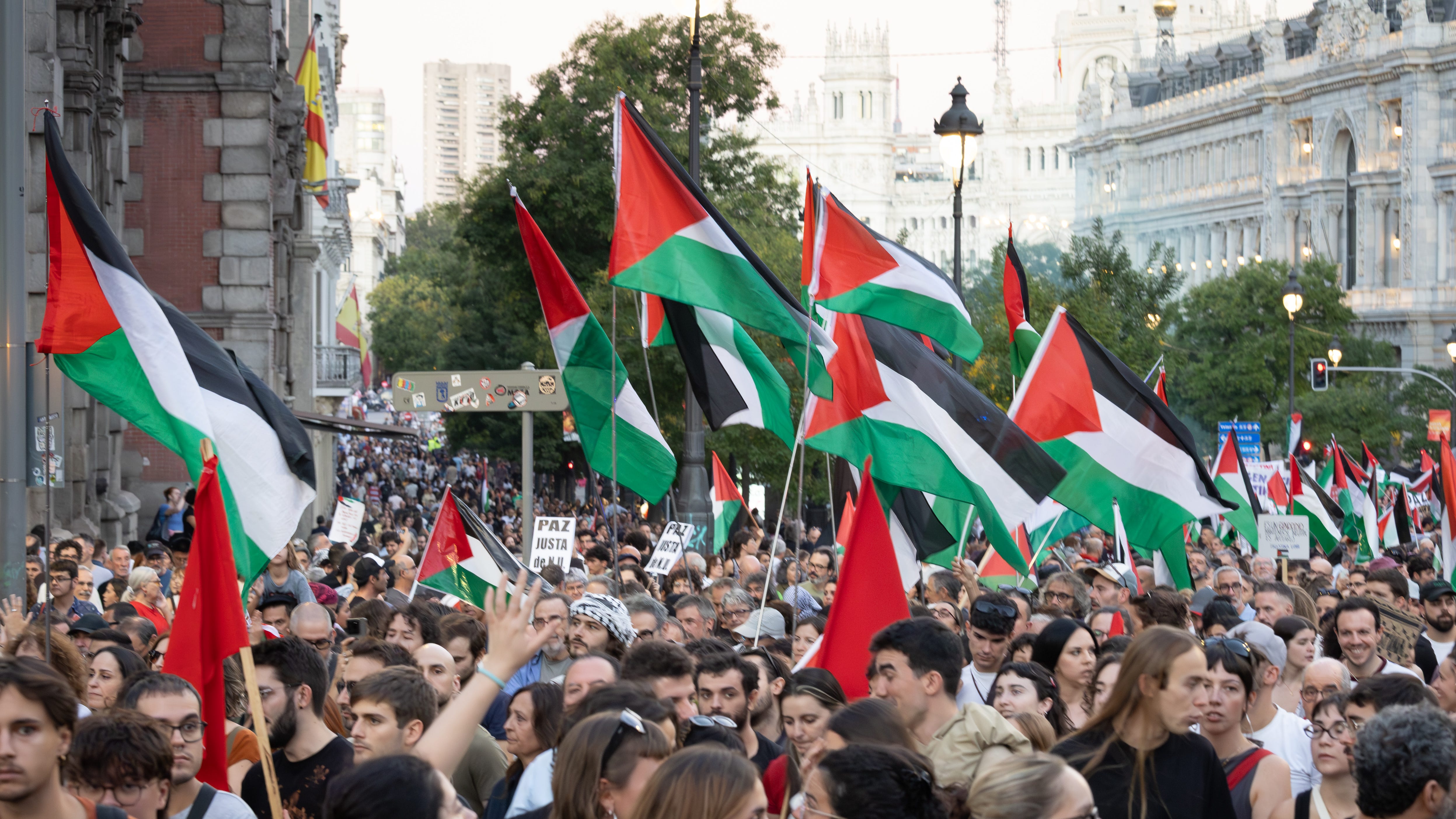
I often wonder why people who have never been to Gaza—who may not know its geography or history—feel compelled to march, to chant, and to carry its flag in cities oceans away. What drives them? What meaning does Palestine hold for them personally?
To understand, I reached out to individuals across the world—from Spain to England and the United States—who have joined pro-Palestine demonstrations. I wanted to listen, to ask, and to understand what connects them to a place they have never seen.
Ester Garcia, a 27-year-old Spanish teacher, recalls her first vivid memory of demonstrations for Palestine: “I remember it was last year when our president, Pedro Sánchez, recognised the State of Palestine in May 2024.”
When asked what motivated her to participate, Ester explains, “Most of my students are from Palestine. They talk a lot about their country. I also watch and read the news regularly, and the situation in Palestine deeply moves me.”
Although Ester has never visited Gaza or the West Bank, she feels a strong personal connection to the Palestinian cause. “My students show me the wounds inflicted by the Israeli army and share videos of their neighbourhoods, whether occupied or destroyed. I feel empathy. I put myself in their shoes, and it breaks my heart,” she says.
Ester follows the news closely: “I get information through my country’s digital newspapers, like El País or El Diario, or on television, and to a lesser extent, social media.” She trusts firsthand accounts from her students and their families the most, then balances that with official news, carefully considering the ideologies behind each source.
Looking forward, she hopes to visit Palestine one day. “I would like to visit the cities of my students, Ramallah and Nablus, because they have spoken to me with so much love for their country. I would also love to try authentic Palestinian falafel and learn to dance dabke,” she says.
When asked about her long-term plans for activism, Ester concludes, “I hope I don’t have to keep going to protests. That would mean Palestine is free.”
Moral Responsibility
Jackie is a 41-year-old activist from the United States. Her connection to the Palestinian cause is rooted in human empathy and personal conviction. “I feel connected to Palestine because we are all humans, and our safety and survival are ultimately linked. We have a responsibility to protect and care for each other,” Jackie says.
She adds that her connection is also shaped by accountability: “I don’t want this harm done in my name, with my tax dollars, or enabled by my representatives.”
Jackie recalls first learning about Palestine after Rachel Corrie, an activist from her country, was killed by the Israeli army. “I knew I had to go there to learn the truth because our government and media would never willingly share it. That’s why I went in 2011,” she explains.
Fourteen years ago, she lived in Nablus, in the occupied West Bank, with five Palestinian women and volunteered with students in a summer program. These experiences shaped her understanding and deepened her commitment.
“I have good friends from Palestine from my time there. One of my dearest friends was actually from Gaza. Mohammed and I met online many years ago and kept in touch for a decade. He passed away in the summer of 2022 while working as a doctor in Chile, and I miss him every day. Supporting Palestine feels like one way I can honour his memory and his life,” she says.
Patricia, a 33-year-old activist from New York, has participated in demonstrations for Palestine since childhood. Her motivation stems from a lifelong commitment to resisting human rights abuses, colonisation, genocide, imperialism, and war.
Her personal connection to Palestine is deeply rooted in family stories and heritage. “I have extended family who are Palestinian by marriage. Growing up, I heard my cousin explain how Jewish settlers stole their homes, forcing her family to leave the region entirely and come to the United States,” she says.
Additionally, as a descendant of Armenian genocide survivors, Patricia feels a profound kinship with those experiencing displacement and atrocities. “It’s impossible for me to witness acts of genocide without feeling sickened in my spirit and motivated to act, even if what I can do is insufficient,” she notes.
Patricia would love to visit Palestine and meet those she has connected with virtually, to explore the Armenian Quarter, to enjoy Palestinian food, listen to music, and experience the natural beauty of the land. Most importantly, she wants to support people however she can.
Identity Dissent
Eva, a 30-year-old activist from the United States, began participating in demonstrations for Palestine in early 2024, following the recent wave of Israeli violence.
Eva’s motivation is deeply tied to her Jewish identity and upbringing. “I come from a Jewish family, but I am not Israeli. Many of the first protests I joined were organised by Jewish anti-Zionist groups who oppose violence carried out in our name,” she explains.
Working as a mentor with writers from the We Are Not Numbers initiative for several years strengthened her connection to the Palestinian cause.
Growing up in an anti-Zionist household, Eva later became aware of how most Jewish Americans are educated about Palestine and Israel, which she describes as “eye-opening and horrifying.” She also gathers information from social media platforms, progressive news outlets, international news in Spanish and British media, and the work of Palestinian writers and organisations.
Eva would love to travel to Palestine to meet her mentees and see their environment firsthand. “I would want to go through a checkpoint to understand what that experience means. I would want to witness both the harsh realities and the beautiful aspects of Palestine,” she says.
As a professor of writing in the US, she integrates education about Palestine into her teaching, despite increasing crackdowns on pro-Palestine speech in universities. “I will continue teaching about Palestine, educating my students, and speaking out without backing down. This is a lifelong commitment for me,” she concludes.
Outsider
Sylvia, a long-time activist based in London, recalls that demonstrations for Palestine in the UK date back to at least the 1990s, though her own involvement began in 2004.
Her motivation stems from a deep sense of anger at injustice and moral responsibility. As a Jewish woman, she rejects Zionism and emphasises that Israeli actions are not carried out in her name.
She connects her political awakening to witnessing the situation firsthand: during her visit to Israel in 1966, she was struck by the reality that “the country was populated by Arabs who clearly belonged there,” while many Jewish newcomers “felt like outsiders.” That early encounter shaped her lifelong disapproval of the occupation.
Sylvia has visited Palestine several times, though never Gaza, and has built close friendships with Palestinian families, including one from Gaza whose members have suffered immense loss in recent years. These relationships have strengthened her emotional and ethical commitment to the cause.
Her solidarity developed through personal experience—meeting people, attending lectures, reading extensively, and engaging with Palestinian friends—rather than through social media. She rarely reads Western mainstream news, preferring trusted writers and solidarity networks, though occasionally checks major outlets to understand dominant narratives.
Sylvia stresses that many activists in the UK go beyond protest—boycotting Israeli goods, cutting ties with Israeli institutions, and disrupting arms manufacturing and trade.
If she could visit Palestine freely, she dreams of arriving by sea or plane through normal passport control, meeting her friends, attending cultural events, eating makloubeh, and painting with children again.
Her commitment is lifelong: “It will be until Palestinians can live in their own land in peace and with the same rights as others—or until I die, whichever comes sooner.”
***
Taqwa Ahmed Alwawi (born 2006) is a Palestinian writer, poet, and editor based in Gaza. She studied English Literature at the Islamic University of Gaza. As a dedicated chronicler and custodian of her people’s memory, she amplifies Gaza’s voice, illuminating stories that are often overlooked or silenced. Her work has been featured on more than 30 leading international platforms and prestigious publications, and she currently serves as an editor at Baladi Magazine. Her Portfolio: https://tqwaportfolio-project.netlify.app/

I first learned about Palestine and the Occupation when I was an 18 year-old American living in Athens, Greece. My Greek boyfriend and all his friends were anarchists and openly supported Palestinian liberation. As someone who innately feels injustice and is moved to speak out against it, I have supported Palestine since that time. I am now 67 years old. I have never been to occupied Palestine, but I have read about it and seen the videos about Palestine for decades and even more so since October 7. I will never stop supporting or speaking up for the Palestinians.
There is no need to have Palestinian friends, or to have visited Palestina (which, honestly, for most if not all would have been visiting “Israel”- look into your passports).
Solidarity is something we learn. I had my awakening in school, 13 years old: the news told, Victor Jara had been killed in Chile … We had our songs, we had our resistance 'heroes', we discussed, we did not take the streets, because Franco was still alive …
Nelson Mandela's maxime “nobody is free until Palestina is free” has always been true. This isn't the first genocide. This isn't the first apartheid
Then we had Morocco taking West Sahara, the Frente Polisario was born and alive, at our doorsteps, so to say.
Solidarity can connect to Palestina in many, many ways, no matter how far away. The keffiyeh. The food. The nakbah. Friends returning from “Israel”. The mediterranean. Manifestations. Poetry.
Finding other solidary people.