


In the geography of catastrophe, Naser Abu-Taqia and Sireen Absi are more than just colleagues; they are a husband and wife who have turned their shared trauma into a sanctuary for others. Separated by borders—Naser still working on the frontlines in Gaza, and Sireen continuing her healing mission from Qatar—their bond is a testament to resilience.
When the bombs fell on their lives, they did not only lose their daughter, Aliyah; they lost the ground upon which their world was built. Yet, they chose to take their shattered pieces—Naser, the social worker, and Sireen, the psychologist—and build a lifeline for those left behind. This is the story of two healers who, across the miles of separation, found that the only way to survive the death of their world was to help others build a new one.
Their marriage, once defined by the quiet routines of domestic life in Gaza, has been redefined by the fire of war and the cruel reality of forced separation. To be married in a catastrophe is to be each other’s sole reality, yet Naser and Sireen now navigate this reality across continents. Despite the distance, they remain mirrors for one another’s pain. When Naser struggles with the city of memories in Gaza, it is Sireen’s clinical insight from Qatar that holds him back from the brink. When Sireen faces the agonising silence of a house without Aliyah, it is Naser’s voice from the field that provides the safety network she preaches to others.
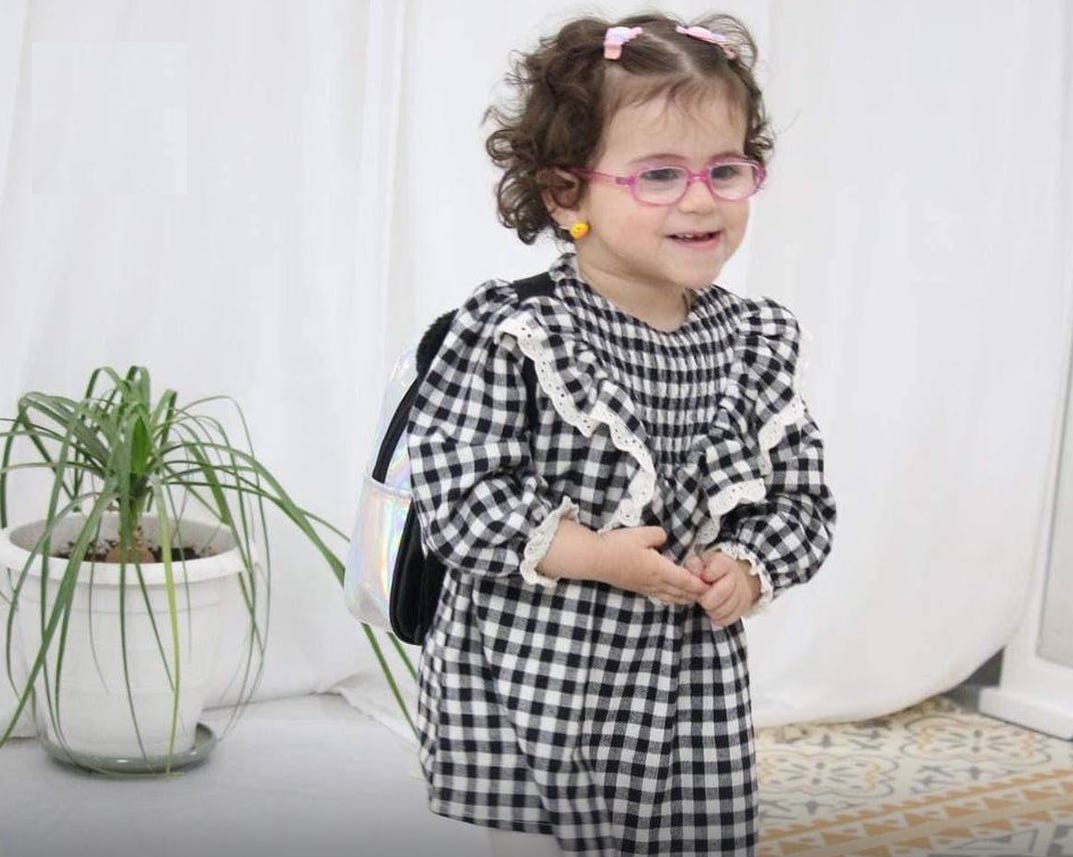
Their daughter, Aliyah, was more than just a daughter; she was Sireen’s world. Born in August 2021, the two-year-old girl with the thick glasses—which she wore like a second pair of eyes since she was ten months old—was the axis around which Sireen’s life revolved. “She was my leadership, my happiness, my safety,” Sireen recalls. When the war began, the terror wasn’t just for her own survival; it was the agony of hearing the bombs and wanting to shield her child inside her own body.
Aliyah’s Glasses
While they were displaced in Rafah, the night of 3 February 2024 began with a whisper. Aliyah, tired and wanting to sleep, told her mother, “Mom, I want to sleep.” Sireen tucked her in, and just before she drifted off herself, she reached out to hold Aliyah’s small hand, whispering, “You are my safety, my love.” It was a final, haunting promise of protection in a world that had become a slaughterhouse.
She woke up to the sound of Naser’s weeping. They had been bombed. Sireen’s first instinct, even through the haze of shrapnel wounds, a fractured skull, and a ruptured spleen, was not for her own survival, but for her daughter. When Naser brought Aliyah to her, Sireen saw the girl’s limbs hanging limp. She knew. Looking towards the sky, she whispered, “Oh God, accept her from me.”
The following days were a blur of hospitals, surgeries, and a false hope that nearly broke her. For four days, family members tried to shield Sireen from the truth, telling her Aliyah was fine but resting. But a mother’s intuition is a powerful, dangerous thing. When she finally confronted the reality, Naser confirmed the impossible: the girl who had asked for sleep had simply never woken up.
Amidst the ruins of their home, rescue workers spent ten days digging through the rubble, driven by a desperate mission: to find Aliyah’s glasses. They found them. Today, Sireen keeps those glasses close—the only physical tether left to the child who was her entire world. “It is agonising to look at them,” she says, “but I refuse to forget.”
Grief Unburied
For Sireen, this grief is not a quiet, private martyrdom; it is a battle for sanity. Having seen the long-term physical toll that repressed grief takes on Palestinians—the mystery illnesses that plague those who choose to stay strong rather than weep—she refuses to suppress her pain. “I don’t want to bring back the dead,” she says. “But I refuse to live a lie. If I need to scream, I scream. If I need to weep, I weep. We have been taught to believe that patience means silence. That is a lie. True resilience is acknowledging that the pain is real, that it is burning coal in your chest, and choosing to walk through the fire anyway.”
For both, the barrier between healer and patient vanished on 3 February 2024. The loss of their daughter forced a radical transformation in their work. Naser defines the lone survivor not just as one who escaped death in Gaza, but as one who carries an entire city of ghosts inside their mind.
“My job isn’t to fix them with pity,” Naser asserts from the field. “My job is to be the person who listens without judgement. I don’t believe in ‘at least you are better than others.’ My job is to walk with them through that city of pain.”
After being evacuated to Qatar for medical care, Sireen transformed her personal recovery into a professional mission. She currently works on the front lines of the displacement crisis, providing psychological support to the nearly 1,700 survivors who have been evacuated from Gaza to Qatar.
“When I meet these survivors, I don’t see cases or statistics,” Sireen says from Doha. “I see a mirror of my own journey. Many of them arrive in a state of total emotional anaesthesia. My role is to help them navigate this, to show them that we can weep for our children, our homes, and our city, and yet find the strength to breathe again.”
By helping those who, like her, have been forced to leave their lives behind, she is creating a community of recovery—a bridge between the Gaza that was lost and the future they are all trying to build in exile.
Surviving Together
Living across different worlds, the couple observes a paradox: the lone survivor often fluctuates between isolation and a desperate need for connection. Whether in a shelter in Gaza or a community centre in Doha, they see survivors who become addicted to numbing agents just to escape the silence of their own minds. Yet, when Sireen reveals she is also a survivor, that she too lost her daughter, the barrier crumbles. She becomes a living model of recovery, proving to those she treats that it is possible to be broken and still be functional.
The work they do is poignant. Children in Gaza have been forced into adulthood prematurely. Naser focuses on creating safe spaces in the shelters, while Sireen provides the psychological frameworks to decode their pain. “They have been forced to take on responsibilities way beyond their years,” Naser reflects from Gaza. “When you sit with a child, you are not just looking at a patient; you are looking at a survivor who is trying to figure out why the world is so cruel.”
Naser and Sireen emphasise that survivor’s guilt is the silent killer. “They ask, ‘Why was I spared?’” Naser explains. “Our job is to help them reframe this. We tell them: ‘You were spared not to live in guilt, but to carry the story of those who were lost.’” They argue that Palestinian society must stop sanctifying grief—stop making martyrs of those who can no longer function. True resilience, they argue, is using the pain as fuel for living.
Naser and Sireen do not claim to be heroes; they claim to be survivors who have decided their suffering will not be their only identity. “We are not here to cry forever,” Sireen concludes from Doha. “We are here to acknowledge that we were broken, and that in the process of putting the pieces back together, we became something new.” As a husband and wife separated by borders, they are flourishing in the ruins, proving that love and purpose are the only true antidotes to the darkness of war.

A hard and inspiring history, on how war and destruction bombed lifes and familys, on how digg into their rubbles to put them togethers surpasing pain, using grieve as fuel and light to enlight the path, the own and these of the others. A history of courage to survive and still LOVE.
Wow. What a powerful story! Thank you for continuing to humanize and uplift the Palestinian people.