


As Europe swelters under another record-breaking summer, Western headlines are dominated by a familiar genre of climate anxiety. Media outlets fill their pages with practical advice: how to transition to remote work during peak hours, how to stay hydrated, and which air conditioning units offer the best energy efficiency.
For millions living in the north of the globe, where every comfort of modern infrastructure is readily available, extreme heat is an environmental crisis managed by functional safety nets.
It is a seasonal hardship met with resources. But as Westerners seek shade, fill their glasses with clean, cold water, and plug in affordable fans, a chilling question must be asked: Has anyone stopped to think about the people of Gaza who are enduring this same Mediterranean heat without a single basic means to survive it?
Just a short distance across the Mediterranean, in the ruined landscape of the Gaza Strip, heat is not a mere weather forecast. It does not invite lifestyle adjustments. After more than 1,000 days of a cruel, systematised genocidal war, the scorching summer heat has been weaponised. It has transformed into a silent, suffocating mechanism of confinement, compounding a man-made catastrophe where even a breath of cool air is a rationed, blocked commodity.
This is our third consecutive summer under the assault. For the vast majority of Gaza’s population, it is a summer spent trapped inside the exact same worn-out, torn plastic and canvas tents that have served as makeshift shelters for years. Over time, under the relentless sun, these materials have degraded, yet they remain the only barrier between displaced families and the sky.
According to recent reports documented on the ground by local journalists in Gaza, these plastic structures function as literal greenhouses. They trap the ambient heat, multiplying the external temperature until the air inside becomes thick, stagnant, and unbearably hot during the day.
Air Denied
With the electricity grid completely demolished, survivors are left with no conventional means to cool themselves. In any normal corner of the world, a simple, battery-powered desk fan is a cheap, mundane appliance, costing no more than $20. In Gaza today, because of strict Israeli restrictions on the entry of basic electrical goods and batteries, that same $20 fan has been artificially driven into a state of extreme scarcity. Its price has skyrocketed to over $500, while a functional battery to operate it can cost upwards of $1,000. A fundamental tool for human survival has been rendered an unattainable luxury, leaving millions to bake in the dark.
In the vocabulary of this war, I am considered one of the lucky ones. When the heavy bombardment began, my family and I lost our home in the initial waves of destruction, in February 2024. After months of uncertainty, we eventually managed to secure a rented, damaged house in al-Rimal neighbourhood in Gaza City—which, despite being damaged, at least gives us solid walls and a roof over our heads. Yet, for over a month now, sleep has become an impossibility for me.
Every night follows the exact same agonising rhythm. Fifteen minutes after I lay my head down on my worn cushion, the heat catches up with me. My skin begins to prickle, and within moments, I am drenched in sweat. The moisture quickly soaks through my clothes and saturates the thin floor mattress beneath me, rendering it hot and damp. Sleep cannot exist in these conditions. I am forced to get up from the floor and walk over to the living room window, pressing my face near the opening, desperately searching for a stray, moving breeze from the sea. Most of the time, the air outside remains flat, heavy, and warm.
So, I sit by the window for hours, staring out into the pitch-black silence of al-Rimal, waiting for the night to end. But I am never alone in this vigil. Looking down into the dark streets, I can see the silhouettes of men and young people emerging from what remains of the surrounding buildings and nearby tent clusters. Driven out by the suffocating, oven-like heat of their indoor shelters, and unable to bear the restless cries of their sweltering wives and infants, they retreat to the edges of the dirt roads. They sit on the pavements in the dead of night, staring into nothingness. It is a profound, communal silence—a gathering of fathers and brothers bound together by the crushing weight of total helplessness, unable to provide even a gust of cool air to the people they love.
We wait together for the Adhan, the call to dawn prayer. When the voice finally echoes through the ruins, people stream out toward al-Kinz Mosque, a makeshift, open-air mosque that has been set up among the debris. This dawn hour is the only fragment of the day when the temperature drops slightly, and the air feels remotely breathable.
Dawn Vigil
The moment the prayer concludes, the spiritual quiet dissolves into the heavy prose of survival. The conversation among neighbours never varies; everyone recounts, with exhausting detail, how they managed to endure the furnace of the previous night. My heart aches the most during these morning gatherings when I look at the elderly. Their frail bodies, already weakened by years of malnutrition, psychological trauma, and lack of medical care, can barely withstand the physical stress of this seasonal torment.
By 6am, the brief reprieve of the dawn is gone, and the sun begins its rapid ascent. This is when I usually run into the local children, including 13-year-old Kareem al-Shorafa. Kareem is bright, but his eyes carry the permanent shadows of chronic exhaustion. Every single morning, without fail, he greets me with the same update.
He never tires of describing how he couldn’t sleep a single wink the night before. He tells me how the air inside his family’s tent felt like heavy steam, and how the mosquitoes and flies—unleashed in millions by the completely destroyed sewage networks and accumulated waste—swarmed their small living space. He shows me the angry, red welts left on his skin and tells me about the infants in the camp who cry continuously through the night, their small bodies covered in heat rashes and insect bites.
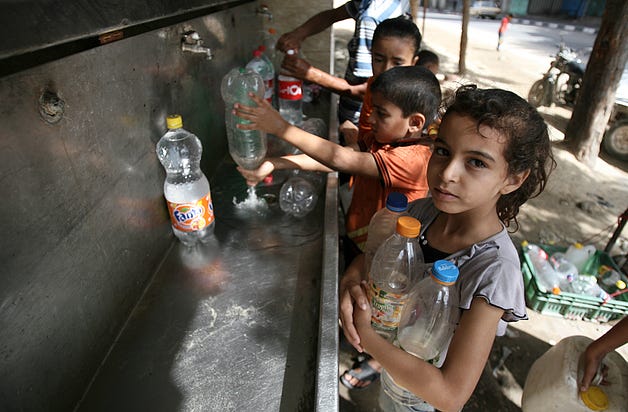
The desperate struggle to mitigate this heat dictates every hour of our daytime existence. Water, like air, has been weaponised. Whenever a freshwater filling truck manages to enter the district, the scene is immediate and frantic. Dozens of exhausted residents line up under the blinding sun, holding plastic jerrycans, waiting to secure just a few precious litres of drinking water.
Stolen Relief
But the children do not just wait for water to drink. They crowd around the sides of the truck, looking up at the driver with flushed faces and sticky hair, begging him to splash a few drops of water directly over their heads. When the truck finally drives away, you can see the children lingering, laughing, and playing in the tiny mud puddles left behind on the scorched ground. It is a heartbreaking sight—watching children try to extract a fleeting moment of childhood and cooling relief from a patch of wet dirt.
When Western academics and policymakers discuss “climate injustice” or “environmental racism,” they often speak in abstract, future-oriented terms. They look at carbon footprints, rising sea levels projected for the next half-century, and international treaties. But if you want to understand the true, raw definition of climate injustice, you must look at Gaza.
The global climate crisis is real, and it is driving temperatures up across the Mediterranean basin. But in Gaza, this environmental reality is filtered through a brutal, man-made matrix of siege and destruction. The population of Gaza did not cause global warming; we do not have heavy carbon industries or sprawling factories. Yet, we are paying the highest price for a changing climate because a foreign military power has systematically stripped us of our infrastructure, our power grid, our roofs, and our civilian tools for adaptation.
When extreme heat hits London, Paris, or Berlin, it is a severe meteorological event that triggers state-funded cooling centres, public health interventions, and systemic adjustments. When that same heat hits the Gaza Strip, it serves as an amplifier of an ongoing genocide. It turns tents into kilns, deprives the vulnerable of sleep, accelerates the spread of disease through stagnant waste, and turns the simple act of breathing into a daily battle for survival. The world must realise that the siege does not only stop food, medicine, and building materials from entering Gaza; it stops the air itself.

No words can adequately describe the inhumanity of both Israel and the U.S.A. and indeed the world to allow these atrocities to continue. They have lost all humanity and greed has taken over. Poor palestinians.
Im deeply ashamed of my "human" fellows. They're cannibals, building their welfare on the blood of innocent children. But karma will come. This civilization is so dumped down, they think their a door up there, that all this hypersonic bombs, that can pulverize human bodies, don't have effectson the clima. It's reaching global, special Europe that's not so far away. We're erasing our own future!