


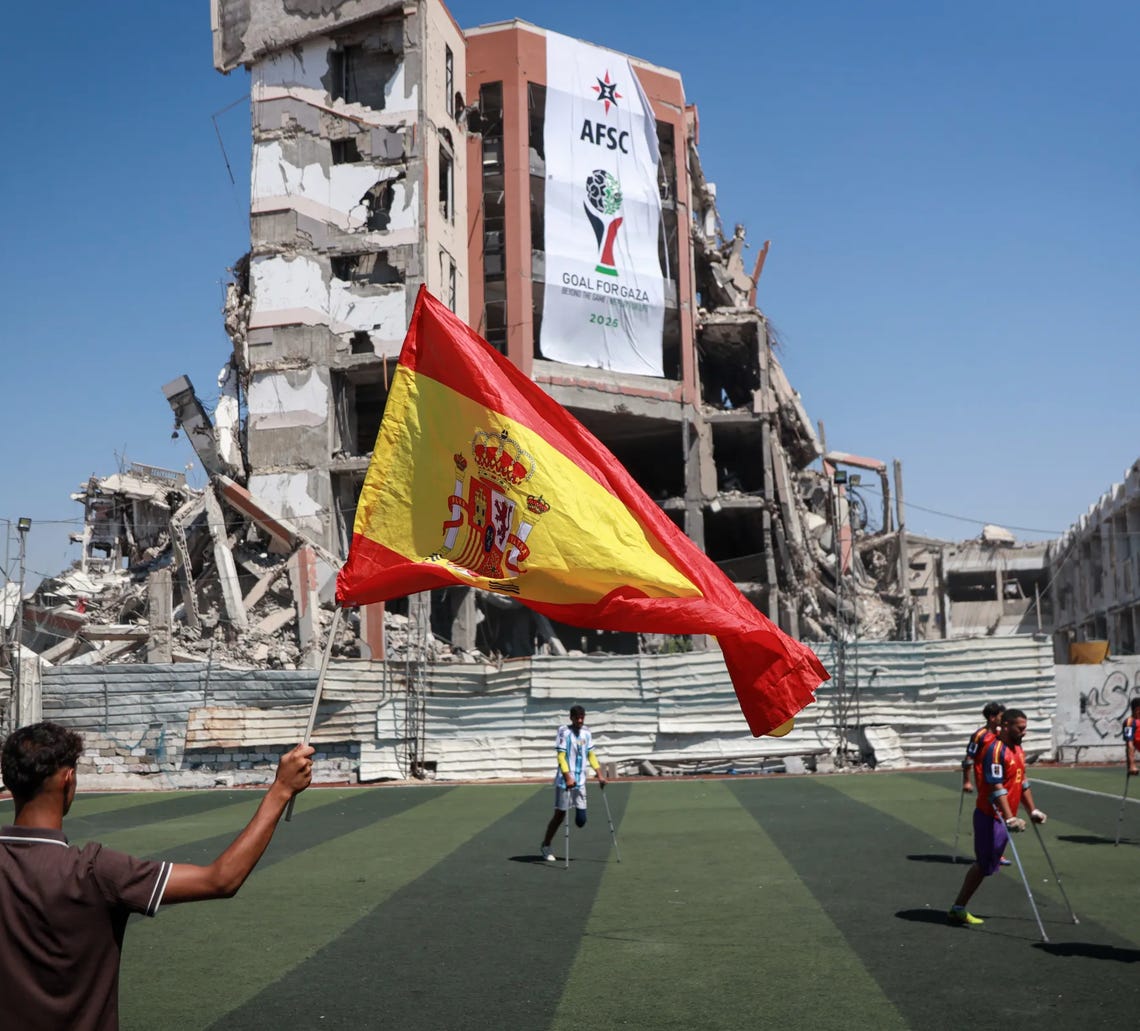
For anyone who says sport and politics should never mix, I have a simple question: where have you been?
For us in Gaza, politics has never stayed outside the stadium gates. It follows us into our homes, onto our phones, and even into the matches we watch. Football has always been about more than tactics, trophies, or ninety minutes. It is about identity, memory, dignity, and sometimes, solidarity.
This World Cup reminded me of that all over again. Growing up in Gaza, we rarely chose teams based solely on their style of play. Of course we admired beautiful football, but we also looked at what teams, players, and countries represented beyond the pitch. We carried our own reality into every tournament because we never had the luxury of separating politics from life.
That is why many of us cheered for Egypt whenever they played. Palestinians felt a deep affection for Egypt. Egypt is our neighbour, our Arab sister nation, and for many Palestinians, especially in Gaza, supporting Egypt felt natural. Their victories felt familiar. Their defeats hurt. We saw ourselves reflected in their struggle to carry the hopes of millions.
We felt immense joy when we saw Egyptian players such as Mohamed Salah and Emam Ashour celebrating by dancing to Egyptian songs in North America. All Arabs, including us in Gaza, sang the famous line from an Egyptian song: “And the question on my mind is: how do you manage to do it, Egypt? How do you manage to do it?” It reminded us that football can still create moments of collective happiness even in the darkest times.
When Egypt’s journey ended, there was genuine heartbreak across Gaza. For generations, Egypt has never been just another national team. We celebrate their victories as our own. Their players carry the hopes of an entire region, and for a few precious weeks their football united millions beyond borders.
After the Egyptian coach Hossam Hassan spoke out in support of the Palestinian cause, a journalist asked him, following Egypt’s loss, whether he thought Egypt was being penalised by the referees because of what he had said before their last match.
He replied: “We were talking about human issues. Do you feel anything? Do you feel anything? Football, the players, the media, and sports are supposed to stand with a humanitarian cause.” This shows that football can deliver a human message that goes beyond the game itself.
Spanish Solidarity
When Egypt exited the tournament, many of us searched for another team to believe in. Many hearts turned towards Spain. Not because of tiki-taka. Not because of trophies. But because, in recent years, Spain has become home to some of the strongest expressions of solidarity with Palestine in Europe. From football stadiums filled with Palestinian flags to players and public figures speaking out, from demonstrations in Madrid and Barcelona to local governments taking symbolic positions, many Spaniards have shown that they refuse to remain silent while Gaza burns.
Spanish streets filled with marches for Gaza. Palestinian flags appeared in stadiums across the country. Municipalities, activists, artists, and ordinary supporters refused to look away from our suffering. Among those voices was Lamine Yamal, who waved a Palestinian flag during Barcelona’s La Liga title parade, reminding us that the game could still carry a moral conscience. Those gestures travelled all the way to Gaza. Some of us found ourselves raising Spanish flags alongside Palestinian ones—not because we had abandoned our own identity, but because gratitude naturally follows solidarity.
Governments are not people, and people are not governments. Yet solidarity matters. When your existence is constantly denied, every voice raised in support carries weight. As a Gazan, I cannot pretend that those moments mean nothing. When Spanish fans waved Palestinian flags, we noticed. When Spanish streets filled with people demanding justice for Gaza, we noticed. When prominent Spanish voices challenged the silence that dominates much of Europe, we noticed. Football supporters often say that loyalty cannot be bought. The same is true of solidarity.
Beyond Football
This is why Spain won more than the World Cup. They won our hearts. Some will dismiss this as bringing politics into sport. But politics entered football long before Palestinians ever spoke about it. Nations use sporting victories to project power. Governments celebrate athletes as symbols of national prestige. Major tournaments are wrapped in flags, anthems, diplomacy, and image-building.
To ask Palestinians alone to leave politics outside the stadium is to ask us to ignore the reality that shapes every part of our lives. We cannot. When the final whistle blew, many of us felt we were witnessing something larger than football. Spain—the country that recognised the State of Palestine in 2024, offering Palestinians a rare moment of hope that the world was finally beginning to acknowledge our existence—stood at the summit of world football.
For many of us, Spain lifting the trophy meant more than sporting success. It felt like humanity, dignity, and justice had claimed a small victory of their own. Here was a team representing a country that had taken the principled political step of recognising Palestine, now receiving the biggest prize in world football on a stage watched by billions. For Palestinians, symbols matter because recognition matters. Every act that affirms our existence pushes back against decades of erasure.
There was a sense of poetic justice. Not because football can solve political injustice. But because, for one brief moment, humanity seemed louder than indifference. When you have lived through genocide, displacement, siege, and unimaginable loss, you begin to see football differently. You celebrate goals, but you also look for humanity. You admire skill, but you also remember who stood with you when the world looked away.
That does not mean every Spanish player shares the same politics. It does not mean every supporter agrees. It certainly does not mean any nation is beyond criticism. It simply means solidarity creates connections that statistics never can.
Shared Humanity
This World Cup reminded us that football remains one of the few languages understood across borders. A chant in one stadium can echo across continents. A flag held aloft in Europe can reach someone watching from Gaza. A gesture that lasts seconds can be remembered for years.
People often ask why Palestinians care so deeply about these symbols. Because symbols are sometimes all that survive. Because recognition is a form of resistance. Because when so much has been taken away, being seen still matters.
Spain lifted the trophy. History will remember them as world champions. But many Palestinians will remember something else. We will remember a country whose people stood with Gaza when silence was easier. We will remember recognition when much of the world denied us. We will remember solidarity carried across football stadiums, city squares and television screens. We will remember Lamine Yamal’s solidarity when he held the Palestinian flag. That is why this World Cup will live differently in Palestinian memory.
Perhaps that is the greatest lesson this tournament leaves behind. The biggest trophies are not always lifted by those with the loudest politics or the greatest power. This World Cup reminded us that trophies are won with talent, but lasting respect is earned by those whose principles and actions remind the world that football, at its very best, can still reflect our shared humanity. Cups belong to champions. History belongs to those who choose humanity. For many of us watching from Gaza, Spain won both.

Excellent article, both heart-warming & sad. I cannot comprehend what is happening in Gaza and now South Lebanon & Iran. I cannot comprehand how Greece, Italy, France & Canada allowed bibi shitanyahoo to fly to the US using their airspace.
Viva España!