


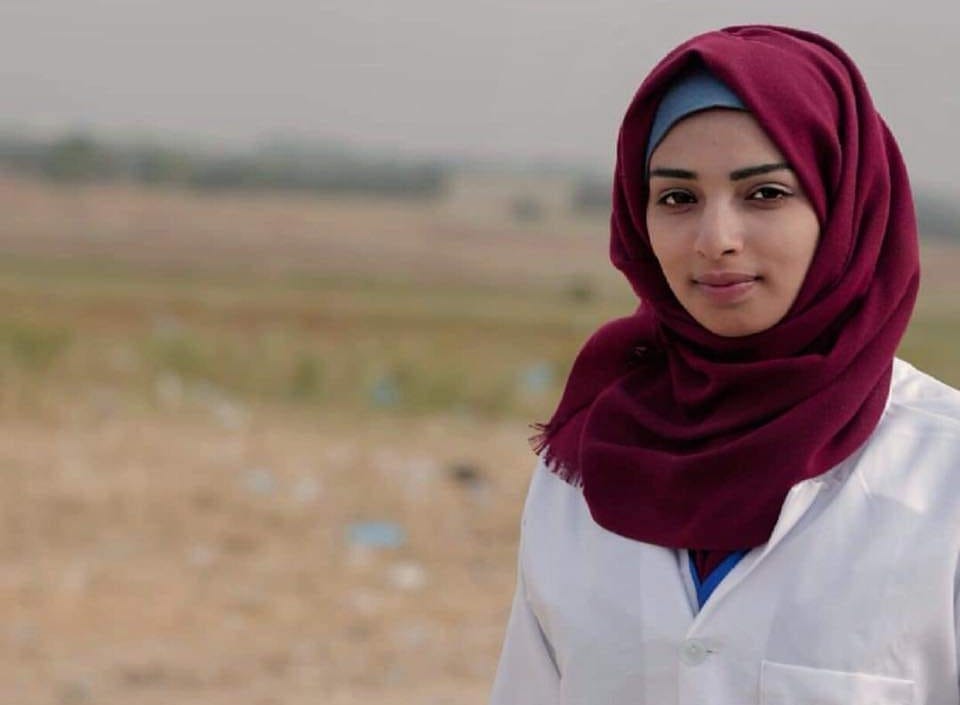
In an age of madness, war, and the rise of fascist and racist currents, the world’s need grows greater to know about inspiring individuals—people who dedicated their lives to spreading love, who possessed nothing but words and faith to resist oppression, and who left behind a legacy of light.
For this reason, I share the story of Rozan al-Najjar.
Rozan was a young Palestinian volunteer paramedic in Gaza. She worked tirelessly to save the lives of those injured by Israeli snipers during the Great March of Return. While trying to save others, she herself was killed by the Israeli soldiers, becoming an icon of that movement.
I tell Rozan’s story not only because it is inspiring, but because the world needs more people like her.
In Gaza, I was among those who initiated the call for the Great March of Return in 2018. What began as an idea quickly turned into a mass movement, with more than one hundred thousand Palestinians participating in nonviolent demonstrations near the separation fence over nearly two years.
The protesters carried no weapons. Their tools were peaceful gathering, cultural activities, and collective presence. Their aim was to protest the slow suffocation imposed on Gaza and to demand the right of return for Palestinian refugees.
Protest Days
On the evening of Friday, June 1, 2018, I returned home after participating in the demonstrations for the tenth consecutive Friday. The protests were held at five main locations along the separation fence.
That day, I had been at Malaka Square, east of Gaza City. As I headed home, I felt some relief. There had been no immediate reports of casualties, and the day seemed calmer than previous Fridays, which had often been marked by deadly repression by the Israeli occupation army.
But that feeling did not last.
When I opened social media, I was met with a flood of posts mourning Rozan. It was the first time I had heard her name. Yet people were not writing, “A nurse was killed.” They were writing, “Rozan was killed.” It was clear she was already deeply known.
That night, her words spread widely: “I am in the field to save the lives of my people. I began my journey here, and I will end it here. I work with courage and determination. I receive no salary, nor do I expect reward or thanks. It is enough that God rewards me.”
In a previous interview, Rozan explained that she had been present in Khuzaʿa, east of Khan Younis, from the very first day of the Great March on March 30, 2018. She worked continuously from early morning until late evening, treating around 170 injuries in a single day—30 caused by live ammunition.
She described one of her hardest moments: treating two critically injured people at once. After saving one, she returned to the other—only to find that he had died before she could reach him.
Despite such experiences, she never left the field.
Relentless Courage
Rozan’s dedication was absolute. From the beginning of the protests, she remained in the field without interruption, driven by a deep sense of purpose.
In another interview, she said: “I fainted from tear gas. When I woke up in the ambulance, I panicked and begged them to let me go back. I did not come to be treated—I came to treat others.”
On that occasion, her wrist had been broken. Her colleagues tried to take her to the hospital so she could rest and receive treatment. She refused—even refusing to have her hand properly set—because she feared it would prevent her from continuing her work.
She summarised her mission in one powerful sentence: “Without weapons, we can do anything.” These words captured the spirit of the movement—and her own belief in nonviolent resistance.
The day after her killing, I attended her funeral and visited her family home in Khan Younis. Her mother stood before cameras holding Rozan’s bloodstained medical vest and said: “This is Rozan’s weapon—the one she carried, and for which Israel killed her.”
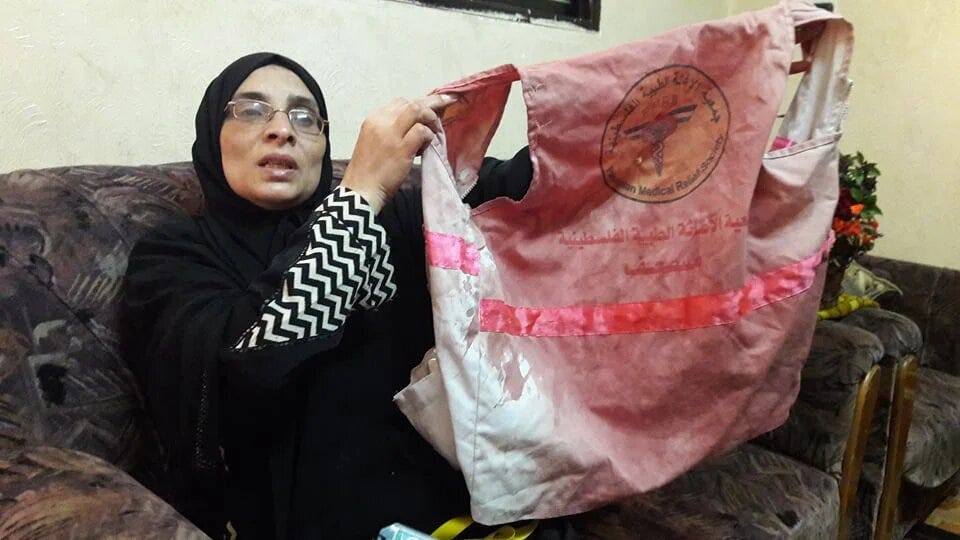
Rozan came from a poor refugee family originally from the village of Salama, from which they were forcibly displaced by Zionist militias in 1948. Her dream was to return there one day, and this dream was one of the motivations behind her participation in the March of Return.
From childhood, she dreamed of becoming a doctor. Poverty prevented her from achieving this dream, but her determination to help others never faded.
She enrolled in a first aid course and saved her small allowance until she could buy a medical kit. Once she had it, she went directly to the field to help the wounded.
Her compassion was evident from a young age. She constantly thought about the poor and the marginalised. She once told her mother that she wished she had enough money so that no one would be in need—that she could make all poor people happy.
She would cry during holidays, upset that some families could afford multiple outfits while others could not afford even one.
Her sense of justice developed early. While watching a historical film, she was deeply affected by a scene showing the torture of Bilal. She asked her mother whether he was being tortured because of his faith or because he was Black—revealing a deep awareness of injustice.
Her mother once asked her, half-jokingly, if she intended to solve all the world’s problems alone. Rozan replied: “Aren’t these poor people human beings just like us?”
Enduring Legacy
Rozan’s kindness extended into every aspect of her life. She shared everything she had. If she ate something outside the home, she would save part of it to bring back to her family.
She cared for her younger siblings as if she were their mother—watching over them at the beach, giving up her own enjoyment to ensure their safety, and covering them at night while they slept.
One day, as a child, she overheard her father saying he had no money to feed the family. She began to cry and then offered him her small savings—just a few dollars—insisting he take it to help support the household.
She rejected gossip and judgment. If anyone spoke badly about others, she would object strongly, asking: “Are you gods to judge people?”
She also avoided attention. Her mother recalled that she would cut interviews short and run back toward the sound of gunfire if she thought someone might need help. She used to say:
“I do not want people to know me. I want God to know me.”
After her death, I visited her Facebook page, reading her posts to understand her spirit. Her writing was sincere, sensitive, and deeply aligned with justice. She consistently expressed solidarity with the poor and rejected injustice.
Her final post, written on May 31—just hours before she was killed—read: “Your conscience will be comforted as long as God knows your intention. Be good.”
Deep Loss
Her loss deeply affected people. Even months later, her story continued to resonate.
Investigations, including one by The New York Times in collaboration with Forensic Architecture, concluded that she was shot by an Israeli sniper while clearly identifiable as a medic and that neither she nor those around her posed any threat.
Yet even without such investigations, Palestinians know this reality intimately, having lived under decades of violence and loss.
In 2019, while I was visiting the United States, I stayed with an American Jewish woman. I arranged a phone call between her and Rozan’s mother. During the call, the woman broke down in tears and asked: “Why does Israel commit these acts in our name?”
Rozan’s life raises painful questions—but also offers a powerful answer. She lived a short life, but one filled with meaning. She devoted herself entirely to helping others, embodying compassion, dignity, and selflessness. She was present in this world, yet carried a spirit that seemed beyond it.
Rozan is an icon of beauty and purity. Israel hates beauty because it reminds it of its ugliness. There is nothing uglier than establishing a murderous, racist, colonial regime. She showed us that even in a world torn apart by violence, injustice, and hatred, it is still possible to choose love. And in doing so, she left behind something enduring: Proof that without weapons, we can still change the world.

I am very sorry for the loss of this beautiful spirit in the world. So much love and care and symathy to Rozan's family and everyone who knew her. Rest in peace dear Rozan and know you are loved, always.
I and several Palestinian American friends, notably, the late Father George Makhlouf, Reverand Fahed AbuAkel, Emad Sabbah, Said Mousa and Mike Sabbah, started a fund raiser to fund the tuition of Rozan's sister who decided to study nursing and to continue the work of Rozan. She was able to graduate as a nurse and volunteer to help the people of Gaza. My Rozan rest in eternal peace. Free Palestine 🇵🇸.
WY, Atlanta GA