


This story begins not with missiles or explosions—memories that have haunted my days since I finally fled the war in Gaza for Cairo. Instead, it begins with something entirely mundane: the reluctant decision that it was finally time to get a haircut.
I had delayed it for weeks. Partly because I’ve always dreaded the tedious wait, but also because ordinary moments often carry memories beneath them, waiting quietly until something stirs them. Eventually, avoidance runs out of room, and distance stops protecting you.
Around me, men chat about weekend plans, inflation, and football—conversations that feel trivial to me. For them, this is just what people do while waiting for a haircut. But for me, the wait fills with memories of sitting in frozen silence, unsure if I would make it out alive. I remember stepping into the thick smoke of an airstrike and struggling to lift the lifeless body of a man whose skull had cracked open.
Staying behind
I never wanted to leave Gaza. Even when I had the chance early in the war, when an Egyptian friend offered to help, I refused. I told myself I would stay no matter what.
I was used to the reality that even simple acts—like going to the barber—could be difficult at best and life-threatening at worst. Finding a barber with enough battery power to operate an electric shaver was no small feat. The absence of electricity made haircuts a rare luxury, something that required both luck and patience.
Fortunately, I had both.
Unlike many who were displaced to the southern reaches of the Gaza Strip, I remained in Deir Al Balah and managed to secure an appointment with my barber, Abu Salma. He was a man of quiet dedication who took his craft seriously, insisting on spending two full hours to ensure a perfect cut. It was an excruciating wait made bearable by his undeniable skill.
His devotion impressed me, though the cigarette smoke that filled the shop felt like a frontal assault on my already fragile commitment to quitting. Still, the memory of that day became something we shared.
At least, for a while.
I used to think he carried that memory too. Now he is gone, and I carry it alone.
The explosion
The haircut had just begun when a rocket struck nearby.
The explosion was close—150 meters away, maybe less. The blast rattled the shop, collapsing parts of the ceiling and sending dust pluming into the air. For a moment, life seemed to pause.
Then Abu Salma and I looked at each other.
We were alive.
When we stepped outside, we immediately sensed something was wrong. Normally in Gaza, when a bombing happens, people run toward the site to help. This time, people were running away. A rumour spread quickly: quadcopters were targeting civilians.
It later proved false. But in that moment, it felt real.
Still, Abu Salma and I ran toward the wreckage.
Through smoke and debris, we searched for survivors. The first thing I lifted was a couch. Beneath it lay a lifeless body. The man’s skull had cracked open.
As we tried to lift him onto a nearby mattress, his pants slipped down, revealing threadbare boxers. Absurdly, I found myself wondering whether, if he had known that today would be his last day, he might have chosen a different pair. I pushed the thought away in shame. Had I become numb to grief and horror?
Another passerby joined us, and together we carried the man toward an ambulance, shouting for paramedics.
Then a voice cut sharply through the chaos.
“Can’t you see he’s obviously dead? Drop him and find someone still breathing.”
I froze.
I hadn’t been helping. I had simply been refusing to accept death—even while holding it.
We moved on.
Soon we found her: a young girl, maybe five or six years old, standing alone in the smoke. She didn’t cry or call for help. She simply stood there, trembling.
Was it fear? Cold? Shock?
I didn’t know.
She was alive, untouched by the blast except for the soot covering her face. Lucky, I thought at first. But what does luck mean if you lose everything? If the memory of this moment stays with you forever?
By the end of that day, more than twenty people were dead. Most of them were children.
Paramedics worked desperately to resuscitate a young boy whose tongue hung unnaturally from his mouth. Watching them, I realised something: no matter how many times I witnessed scenes like this, I would never become desensitised.
Some horrors refuse to become normal.
Finishing the cut
Eventually, more rescuers arrived, and Abu Salma and I understood that our role was over.
We stepped back, covered in blood that wasn’t ours—a silent reminder of what had just happened.
For a moment we simply stood there, looking at each other, locked in an unspoken contest: who would break the silence first?
He lost.
“So… should we finish the haircut?” he asked.
What else was there to do?
I nodded.
Two hours later, I walked home with neatly trimmed hair and blood still on my hands—an irony only war can produce.
My uncles had already assumed I was dead. They had called friends and checked hospitals. My cousin had confirmed I was near the bombing site when he called around to ask if the barbershop was open.
By the time I walked through the door, they were already mourning me.
I expected relief—maybe even an embrace. Instead, I was scolded.
They weren’t angry that I had nearly died.
They were angry about the stress it had caused my mother.
This bombing took place on February 23, 2024. It targeted a member of the Abu Zaaiter family on Yafa Street in Deir Al Balah. Who knows why the Israelis were after him.
Even then, I still resisted the idea of leaving Gaza.
But two months later, my brother needed emergency surgery, and no ambulance could reach us because so many others needed help. Suddenly, it was no longer just about me.
We scraped together the astronomical “fee” required to cross the border—$5,000 per person. My two younger siblings and I eventually made it out.
Lingering Echoes
Now, two years later, I am back in a barber chair.
The memories return the moment the razor hums near my ear.
But it isn’t just haircuts that trigger them. The sound of a plane overhead, the rumble of cars, even cheers from friends during a football game can send panic through me.
I once believed nothing could scare me anymore.
But horror lingers in the mind long after the bombs stop falling.
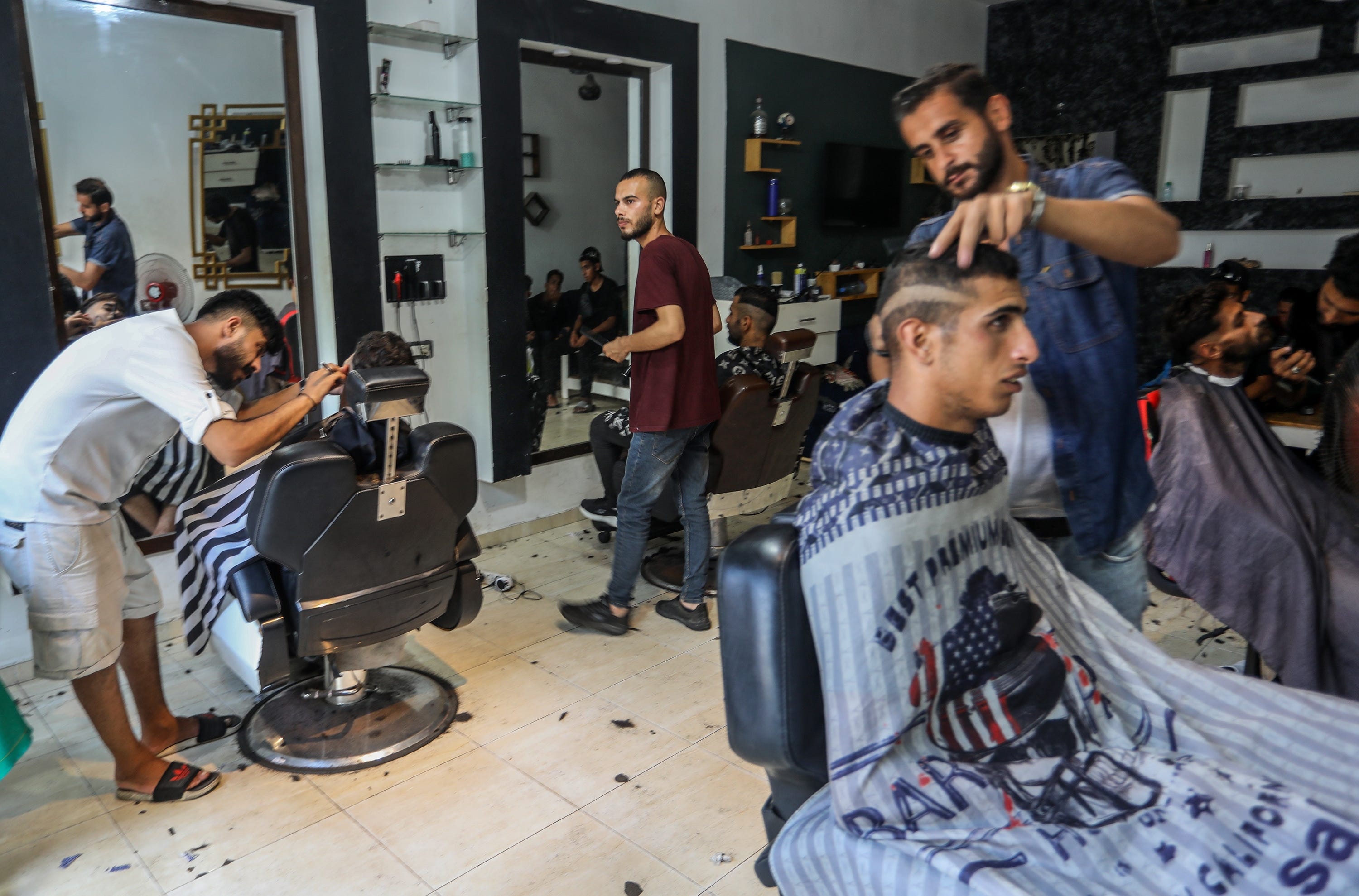
Some time ago, I asked a friend to visit Abu Salma’s shop and take photographs so I could include them in this article.
That’s when I learned he had died.
His house was bombed shortly after I left Gaza. He survived the initial strike but later succumbed to his injuries.
I sometimes wonder what passed through his mind in those final moments. Did he think back to that night in the barbershop, when we believed surviving meant we might still have a future after the war? Did he feel that same brief relief—the feeling that he had made it—before realising that he hadn’t?
In the end, it was only me who survived to remember.
May God have mercy on Abu Salma’s soul.
I had hoped only to revisit his shop through a photograph, to preserve a small piece of our shared story. Instead, I was left with the finality of his absence.
Now I wonder whether a simple haircut will ever again be just that. Or whether it will always be tied to the image of a shattered body and the memory of a barber who never lived to see peace.
And if such echoes persist in me—an adult who understands where they come from—what resonance will they leave in the minds of children who are only beginning to form their earliest memories?
What kind of future can grow from foundations of fear and smoke?

I had my hair cut today - in peace and safety and the quiet certainty that tomorrow would arrive unbloodied. May your future bring you such days - even as in your memory you honour Abu Salma's memory.
Thank you for this :(